
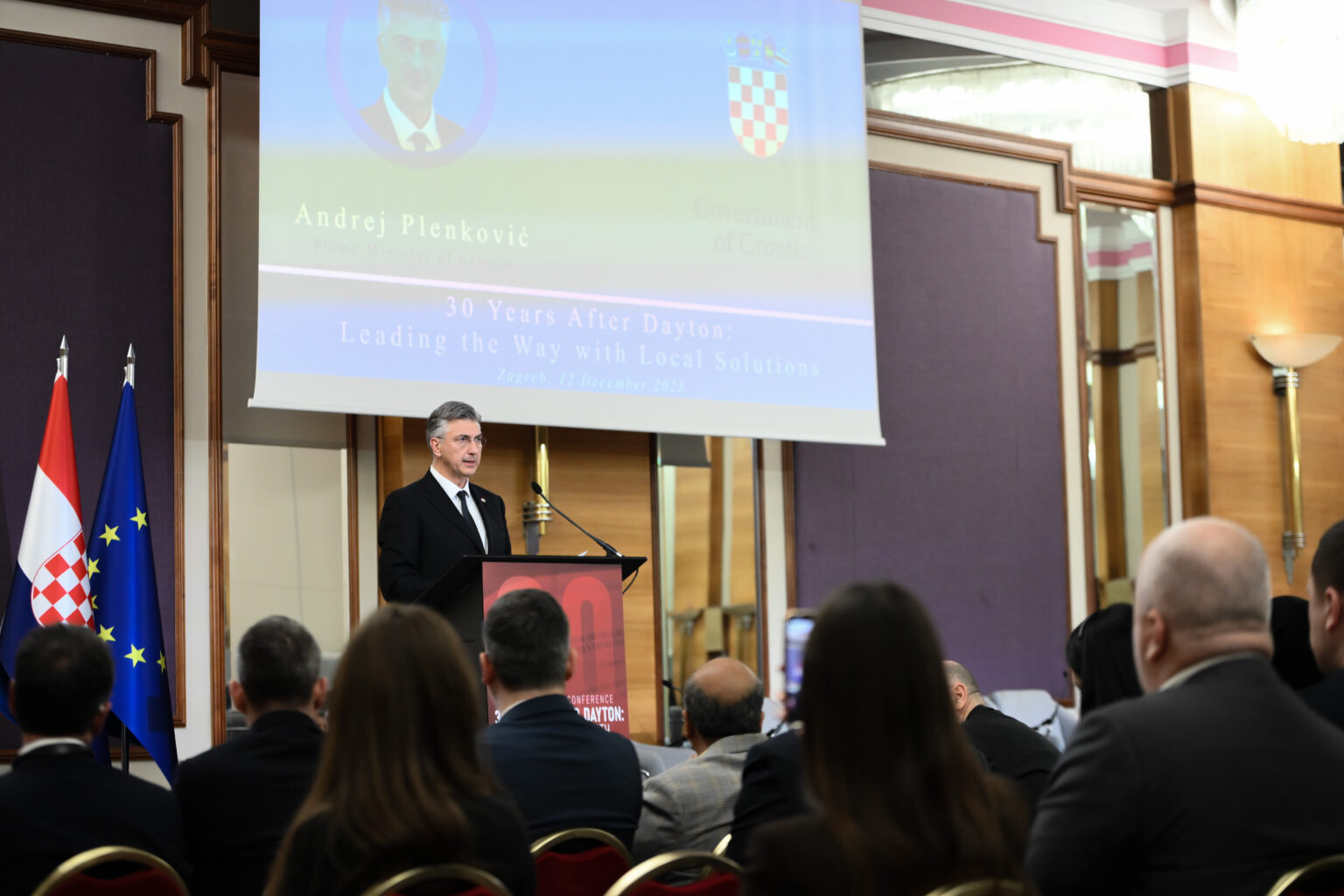
Prime Minister Andrej Plenković participated today in the international conference “30 years after Dayton: leading the way with local solutions”. On that occasion, he emphasized that Croatia, as a guarantor of the Dayton Agreement and as a member of the European Union and NATO, will not give up its commitment to stability, equality and the European path of Bosnia and Herzegovina. “Our only interest is the same one that we defended in the 1990s. A stable, functional and prosperous neighboring country in which Bosniaks, Serbs and Croats, like all other citizens, enjoy equal rights and equal dignity and where no one feels like a second-class citizen in their own country”, he said. It is crucial to implement the Constitution in a way that strengthens, not undermines, trust between the three constituent peoples and to avoid practices that deviate from the spirit of the agreement or create unnecessary and harmful misunderstandings.
Prime Minister Plenković emphasized at the conference that the Dayton-Paris Peace Agreement ended what was then the bloodiest conflict on European soil since World War II, a war that, until the Russian aggression on Ukraine, represented the darkest chapter in the recent history of our continent.
One lesson, he emphasized, remains painfully clear, and that is that peace, once achieved, is never guaranteed.
“It must be protected, strengthened, and renewed – day by day. This is why we gather here today. Not only to remember, but to promote dialogue and enhance mutual understanding.
The story of Bosnia and Herzegovina in the 1990s is not distant history; it is a living warning and an enduring source of hope. It teaches us the cost of hesitation, the power of solidarity, and the essential importance of shared responsibility”, he stressed.
Joint defense at a time of extreme vulnerability for both countries
Recalling the circumstances in which the war in Bosnia and Herzegovina occurred, Prime Minister Plenković pointed out that the aggression against that country had a prelude – briefly in Slovenia and fully and with devastating consequences in Croatia.
“It was waged by Milosevic’s regime underpinned by the ideology of Greater Serbia – which prevented any possibility of a negotiated and peaceful separation among the Yugoslav republics”, he said.
Stressing that Bosnia and Herzegovina has always been marked by a rich diversity, with its three constituent peoples, he stated that in 1991, the country’s population was composed of approximately 44% Bosniaks, 31% Serbs and 17% Croats.
“Muslims, Orthodox, Catholics, Jews, and others lived side by side for centuries. Its defining feature lay in its multinational character”, said PM Plenković.
The first blow to Bosnia and Herzegovina came earlier than is often remembered, he added recalling that in the autumn of 1991, during its wider operations against southern Croatia and the encirclement of Dubrovnik, the Yugoslav People’s Army attacked and destroyed the predominantly Croat village of Ravno. This happened six months before the assault on Sarajevo.
With no protection for the local population, Croats and Bosniaks began to organize their own defence through the first village formations of the Croatian Defence Council (HVO) in September 1991., said PM Plenković and added that this occurred well before the formal establishment of the Army of the Republic of Bosnia and Herzegovina in April 1992.
In July 1992, Presidents Franjo Tuđman and Alija Izetbegović signed in Zagreb the Agreement on Friendship and Cooperation between Croatia and Bosnia and Herzegovina, which recognized the armed component of the Croatian Defence Council as an integral part of the unified armed forces of Bosnia and Herzegovina, strengthening joint defence at a moment of extreme vulnerability for both states.
Restoration of the Croat-Bosniak alliance and creation of Federation of Bosnia and Herzegovina
In the months that followed, Serb forces carried out the most extensive phase of their offensive, seizing around 70% of Bosnia and Herzegovina and driving nearly one million people from their homes.
As a result, Croats and Bosniaks – who together made up two thirds of the country’s population – found themselves confined to less than one third of its territory, fighting to preserve what remained of the country’s freedom.
Combined with severe shortages of food, medicine and weapons – supplies that for both communities arrived exclusively through Croatia – local tensions steadily rose, said PM Plenković.
Under the pressure created by the mass displacement of Bosniaks into central Bosnia following Serb advances, disputes over vital resources intensified, and in this climate a tragic Croat-Bosniak conflict erupted in 1993.
Its scale, however, remained incomparably smaller in absolute terms than the systematic violence carried out by Serb forces across the country, and the conflict was ultimately overcome through diplomacy.
The Washington Agreement of 18 March 1994 – brokered by the United States and supported by Zagreb and Ankara – restored the Croat-Bosniak alliance and created the Federation of Bosnia and Herzegovina, which became the institutional core of the peace that followed.
Croatia’s compassion for Bosnia and Herzegovina did not disappeared even amid war
Croatia and Bosnia and Herzegovina were the principal targets of the same revisionist project, stressed PM Plenkoivć.
“Bosnia and Herzegovina’s profound multinational diversity made it particularly vulnerable to such aggression. Tragically, this very strength was weaponised by those who chose force, ethnic cleansing, and expulsion. Within months of Bosnia and Herzegovina’s independence – an independence Croats in BiH helped secure in the 1992 referendum and which Croatia was among the first to recognise – the very foundations of the new state came under direct assault”, he said.
Prime Minister added that by the end of the conflict, around 100,000 people had lost their lives, tens of thousands were missing or wounded, and entire communities were erased.
In the face of this systematic campaign of violence, Bosnia and Herzegovina’s society was torn apart, and the humanitarian crisis deepened across the country.
Croatia, itself bleeding from the Homeland War and sheltering more than 260,000 internally displaced persons, opened its doors to over 400,000 refugees from Bosnia and Herzegovina.
“We kept supply lines open. We sustained an airlift to the besieged Bihać enclave for three long years. Compassion, even amid war, did not disappear”, PM said.
The Split Declaration – a turning point that enabled victorious military operations
Speaking about the path that ultimately led to peace, the Prime Minister said that the turning point occurred in 1995.
“The Split Declaration, signed by Presidents Tuđman and Izetbegović, restored the alliance between Croats and Bosniaks and enabled joint military operations. Operation Storm liberated occupied Croatian territory and simultaneously broke the siege of Bihać – saving, even by conservative estimates, more than 100,000 lives from the fate that had befallen Srebrenica only weeks earlier. By autumn, joint efforts liberated more than half of Bosnia and Herzegovina’s territory”, he recalled.
After the liberation operations in western Bosnia – in which Croatian forces played a decisive role – the territory held by Serb forces fell from more than 70% to about 45.5%.
However, this was below the 49% threshold imposed by the Contact Group as the basis for a future settlement. To reach that ratio, delicate territorial adjustments had to be made so that Serb forces would agree to withdraw from the positions from which they had encircled Sarajevo, and to open a land corridor to the besieged enclave of Goražde.
Choosing peace was the highest form of statesmanship and cooperation.
At that very moment of maximum strength, a different choice was made – a choice for peace, said Plenković recalling that, at the initiative of the United States, President Tuđman agreed to return approximately 2,100 square kilometres of hard-won, liberated territory in western Bosnia – on one condition: that all parties accept peace.
“This was not weakness. It was the highest form of statesmanship and cooperation within the international community. A deliberate decision to exchange tactical advantage for strategic peace, so that our neighbouring state could continue to exist as a sovereign country”, he said.
This political decision also enabled the 51:49 territorial balance imposed by the Contact Group – a prerequisite for lifting the siege of the capital and securing access to the last remaining Bosniak enclave in eastern Bosnia, without which no peace agreement would have been possible.
“In this sense, without that Croatian decision, and without sustained American leadership, there would have been no Dayton. And the map of South-Eastern Europe – including Bosnia and Herzegovina – would look very different today”, said PM Plenković.
The lesson from 1995 remains clear, he stressed: Force gave way to diplomacy, and military victory was followed by moral and political responsibility.
European and Euro-Atlantic integrations remain the strongest and most reliable guarantees of lasting peace
Dayton stopped the war and saved countless lives, stressed PM Plenković adding that its success rested on a clear constitutional architecture: the equality of its three constituent peoples and the balance between individual and collective rights.
“Respecting both the letter and the spirit of that agreement remains essential for the country’s stability”, said Plenković adding that this framework was applied correctly throughout the first decade after Dayton, when the equality of all three constituent peoples was upheld in practice – and Bosnia and Herzegovina made real and visible progress.
It is only when this balance began to be eroded, he warned, especially through arrangements that disadvantaged Croats, that the country’s political functionality weakened and its reform momentum slowed.
Thirty years later, Bosnia and Herzegovina still grapples with questions of legitimacy, representation, and institutional functionality, said PM Plenković.
And so, the lessons remain urgent – peace requires partnership, never domination,I ndividual and collective rights must coexist in a delicate balance, demographic strength must never become a tool of exclusion.
Undermining the equality of any constituent people undermines peace itself, warned Plenković adding that legitimate representation is not a technicality – it is the backbone of democratic confidence.
As the most important he stressed that European and Euro-Atlantic integration must remain the strongest and most reliable guarantees of lasting peace.
It is crucial to implement the Constitution in a way that strengthens trust among the three constituent peoples
“Croatia has no hidden agenda in Bosnia and Herzegovina. Our only interest is the same one we defended in the 1990s. A stable, functional, prosperous neighbour in which Bosniaks, Serbs and, for us especially, Croats, and all other citizens, enjoy equal rights and equal dignity – and where no one feels like a second-class citizen in their own country”, PM stressed.
Bosnia and Herzegovina once again stands at a familiar crossroads. Between stagnation and a genuine European future. Between separatism that denies unity and hegemonism that denies diversity. The only sustainable path is the European one – federalism, power-sharing, dialogue, and the search for compromise for the benefit of all.
The Croat people in Bosnia and Herzegovina, rooted there for centuries, have consistently chosen cooperation over conflict. They were the only party to accept every international peace proposal during the war, and they continue to serve as a bridge even when others pull apart. They are also among the strongest advocates of Bosnia and Herzegovina’s European and NATO integration.
“Croatia – as a guarantor of the Dayton Agreement and as a member of both the European Union and NATO – will not waver in its commitment to Bosnia and Herzegovina’s stability, equality, and European path. Because peace is not an inheritance that maintains itself. It is a responsibility. The war in Bosnia and Herzegovina was Europe’s gravest tragedy since 1945 – until the war in Ukraine reminded us once again that peace on our continent can never be taken for granted”, he stated.
Saying that thirty years after Dayton, our task is not to reopen what was agreed, but to uphold it – fully, consistently, and in good faith, PM stressed that the key is to apply the Constitution in a way that strengthens, rather than erodes, trust among its three constituent peoples – and to avoid practices that depart from the spirit of the agreement or create unnecessary and harmful misunderstandings.
We want Bosnia and Herzegovina to be a functional, just and irreversible European state
“Only such an approach can ensure a Bosnia and Herzegovina that is stable, functional, and responsive to all its citizens. On that path, Bosnia and Herzegovina can always count on Croatia’s support”, PM Plenković stated adding that he says this as the Prime Minister who is in his third term, almost ten years, and who knows what is being said in international forums, emphasizing that no one else raises the issue of reforms and progress of Bosnia and Herzegovina on its path towards the European Union so honestly and so often.
We want Bosnia and Herzegovina to become a fully functional, just, and irrevocably European state – one in which every citizen, regardless of identity, can feel represented, protected, and respected.
“Croatia will continue to invest in Bosnia and Herzegovina’s future with resolve, and responsibility. A future in which Bosnia and Herzegovina moves from being a symbol of Europe’s past suffering to a testament to the capacity for renewal, unity, and shared destiny”, he stated.
PM added that Croatia works with its EU and NATO partners to secure Bosnia and Herzegovina’s stability and progress.
This is why we organised this conference, to enable dialogue among legitimate and authentic representatives of the three constituent peoples, alongside academics and the international community, so they can freely and constructively share their visions for Bosnia and Herzegovina and its future and to promote trust as an essential ingredient of any political cooperation.
As long as Croats feel disadvantaged, we have a responsibility to raise the issue of their equality
“Allow me to add one point with sincerity and respect: Croatia does not raise the issue of Croat equality in Bosnia and Herzegovina lightly, nor with any desire to burden our relations.
We would be happiest if we never had to raise it at all. Yet as long as the Croats feel disadvantaged, we have a responsibility to signal that concern – always in good faith, and always in the interest of Bosnia and Herzegovina itself”, PM stated.
The quickest and most constructive way for this topic to disappear from public debate is for it to be resolved within Bosnia and Herzegovina, through arrangements that strengthen confidence among its constituent peoples and benefit all its citizens, especially ahead of the upcoming elections in 2026.
Finally, he stressed that Croatia’s policy is equal towards every part of Bosnia and Herzegovina, and in this context he recalled that he had visited Banja Luka yesterday.
Croatia will continue with all projects that help improve the quality of life of all citizens in Bosnia and Herzegovina and accelerate the country’s European path.