
There have been frequent debates on agro-business companies not showing adequate concerns for small farmer livelihoods. Farmers’ unions have often protested, generally with good reason, that while they are not getting proper returns after all their high risks and hard work, those corporate interests who merely process the crops produced by farmers are able to earn high profits. Hence there is a yearning for alternative models of agro-business development which show much higher concern for protecting livelihood concerns of farmers.
This is particularly very important in a country like India where protection of small farmer livelihoods is a matter of very high national priority.
In this context it is very interesting to see the efforts of some young social entrepreneurs who are trying in their own small but very meaningful ways to find and develop a model that makes their enterprise strong and sustainable but only in ways that are compatible with the wider social objectives of not just welfare of farmers but also of protection of health and environment.
Satyam Bhandari, Mohit Rana and Rohit Singh are three young men who have formed an edible oil producing company named Heart in Hills or HIH (this name is probably a homage to the Himalayan origins of the three social entrepreneurs despite the concentration of their work in Rajasthan). While the main production unit is based in Hindaun city of Rajasthan, it reaches out to farmers and partners elsewhere too. Producing edible oils under the brand name of Foreka, particularly mustard but also others based on indigenous oilseeds (groundnut, sesame, coconut) the aim of this company is to ensure supply of healthy food while being fair to farmers and protective to environment too by taking up the processing mainly of that farm produce which is obtained by using natural farming methods.
As Satyam Bhandari says with emphasis, “These aims of being fair and useful to farmers and to protect health and environment concerns are non-negotiable aims for us. We are not just entrepreneurs, but social entrepreneurs and social objectives are integral to us and to our business ethics.”
Of course one cannot ignore basic business realities but within the existing market constraints and the limitations of a small enterprise within these, this social enterprise has been striving to provide more helpful terms to farmers such as by doing away entirely with various unfair practices such as arbitrary deductions and weighing manipulations, and ensuring that prompt payments are made to farmers.
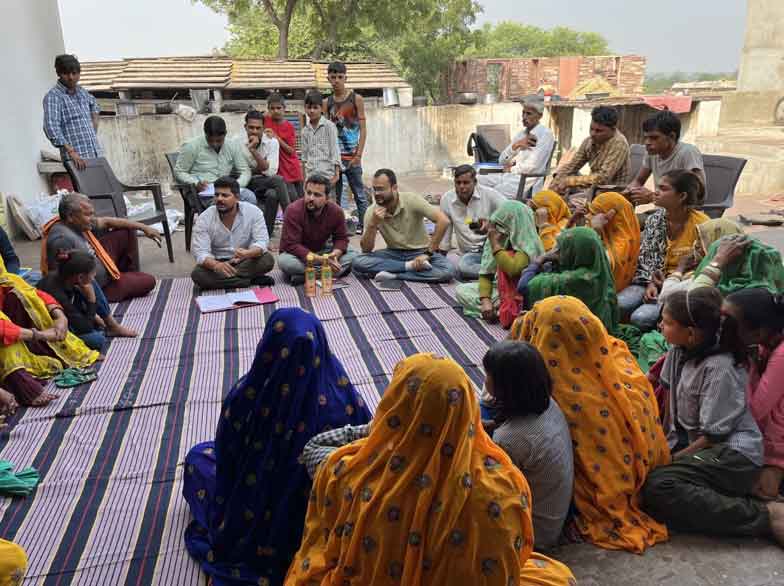
Mohit Rana says—Once a farmer takes his crop-load to market in uncertain situations, he becomes vulnerable to exploitation of unscrupulous elements. Therefore, we have established contacts with farmer-producer organizations so that the transactions can be made in a situation of trust and the produce in most cases can be collected from the farmer right within the village, thereby saving transport expenses as well.
This social enterprise has established close linkages with farmer producer organizations and companies such as Dang Vikas in Karauli district of Rajasthan (mainly for mustard seed) and another one named after freedom fighter Jhalkari Bai in Bundelkhand region. As the company expands, more such reach-outs will be possible.
Satyam says, “We see our future not only in terms of our own business but also in terms of how helpful we can be to several such farmer-producer groups and their emerging transformation into companies. They have noble intentions and good ideas, as also rural reach and understanding of farmers’ issues, but in terms of success as a business they may need professional help of various kinds and we should be able to assist those groups who seek this from us. Our help can be particularly useful to them as we have ourselves coped with some harsh market realities and unscrupulous elements within it in the course of our own journey and therefore we can link professional expertise also to these practical realities.”
While all food enterprises should seek to promote healthy food, this is particularly important for the edible oil industry as edible oils are consumed more than once every day by all households in some form or the other. This enterprise honors its health concerns by using the healthier cold press technology, by prioritizing natural farming produce ( and also offering a small margin for this produce) and by firmly rejecting any adulteration or ‘blending’ which can dilute the nutrition of edible oils based on healthier indigenous oilseed crops.
HIH has also sought to live up to fair working condition practices by ensuring payment of at least the legal wages or when possible somewhat more than this, plus incentive payments for any extra work at a higher rate. In fact some marginal farmers facing distress situation were employed on priority basis and trained in skilled work.
Within a short period of about three years this social enterprise has already emerged as one of the more promising social enterprises of agro-business with a different approach more in tune with social and national objectives.
In the course of its journey HIH has received help from several sources. Satyam Bhandari emphasizes as particularly valuable the support he received from the fellowship program of the Budha Institute. In addition HIH continued to benefit from the mentoring and other support received from time to time from this institute.
Get the latest CounterCurrents updates delivered straight to your inbox.
Bharat Dogra is Honorary Convener, Campaign to Save Earth Now. His recent books include India’s Quest for Sustainable Farming and Healthy Food, Protecting Earth for Children, Man over Machine and A Day in 2071.