
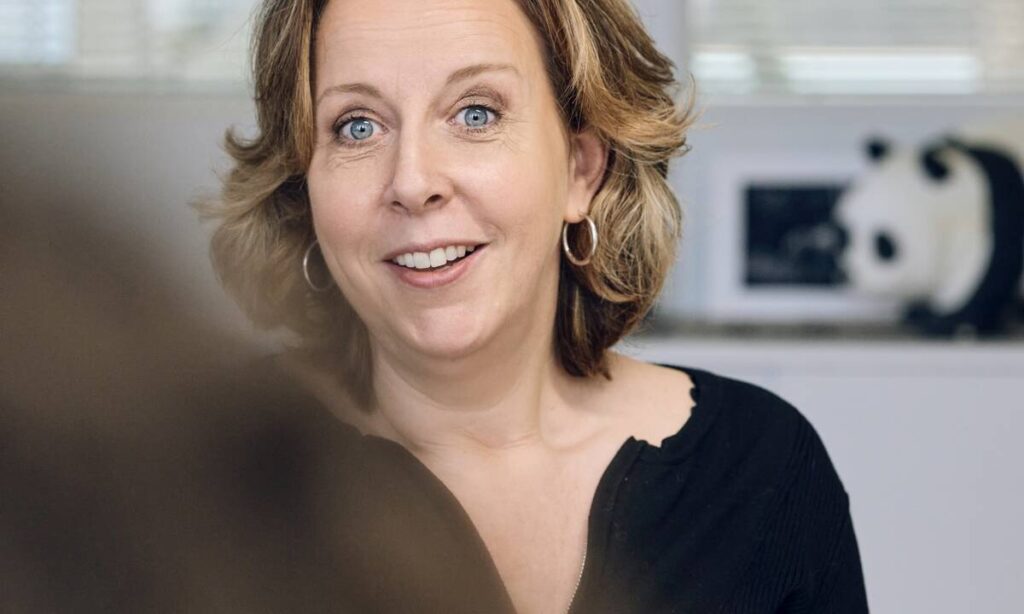
As a leading voice in defending the climate and biodiversity, WWF International will mark its 65th anniversary next year. Now back in Gland after attending Cop30 in Belém, its director general takes stock of international efforts to tackle global warming – and explains why she still remains optimistic.
Ten years ago, on 12 December 2015, the Paris agreement on climate change was adopted by some 195 countries to widespread acclaim at Cop21. It aimed to limit global warming to 2°C – and if possible, to 1.5°C – by the end of the century. A decade on, greenhouse gas emissions are still on the rise, and Cop30, held in Brazil from 10 to 21 November, failed to deliver any landmark commitments.
Yet Kirsten Schuijt, the Dutch national who has led WWF International for two years, refuses to lose hope. Speaking from her office in Gland, she explains why she believes it is still possible to protect the environment despite the complex context.
Le Temps: The Paris agreement turned ten this year. Is there really anything to celebrate?
Kirsten Schuijt: The agreement was a huge moment of celebration. Many of us were waiting for decisive climate action to follow. But today it is clear that we are not where we should be. The goal was to keep warming below 1.5°C by the end of the century – and we will not achieve that. We see the devastating effects of climate change every day. Right now, many of our colleagues, families and countless others are facing massive flooding in Asia. In that sense, there is nothing to celebrate.
That said, I always try to see the glass half full rather than half empty. Without the Paris agreement, we would be worse off. We were heading towards almost 4°C of warming; now we are on a trajectory of around 2.5°C. Another reason for optimism is the green energy revolution. The International Energy Agency announced that in the first half of 2025, renewables overtook coal for the first time in global electricity generation. Solar and wind power are becoming cheaper and cheaper. So yes, the disappointment around the Paris agreement is enormous, but the world is moving – and there is light at the end of the tunnel.
You attended climate talks in Belém last month. What is your takeaway?
The outcome was disappointing. Formal negotiations failed to produce a clear roadmap for phasing out fossil fuels and deforestation, as we had hoped. But there were still some important announcements, such as tripling adaptation finance and establishing a just energy transition mechanism. And for the first time, forests were given centre stage. Too often, international conferences create an artificial divide between climate and nature. Most of the world’s biodiversity is found in tropical forests, which also play a massive role as carbon sinks – making this a critical issue. We know that if 20 to 25 per cent of the Amazon is deforested, we will hit a tipping point with global consequences, as this ecosystem is key to regulating the world’s climate.
Did the conference result in concrete initiatives to protect these ecosystems?
Yes, it’s important to remember that positive developments also happen on the margins of the official talks. WWF supported the launch of the Tropical Forest Forever Facility, a fund that pays countries to protect their tropical forests in the Amazon, the Congo Basin and Borneo. We are also backing new projects to improve energy access and livelihoods in protected areas of the Amazon, enabling local communities to safeguard the forest. Finally, WWF has worked with the Chinese, Brazilian and Indonesian governments to promote sustainable supply chains. This is crucial, given that China is the largest importer of Amazonian beef and soy – the two biggest drivers of deforestation.
Read more: Cop30: Indigenous groups say big forest funds don’t cut it for them
In Belém, representatives of Indigenous peoples protested at being insufficiently included in the discussions. Were they right?
The Brazilian government – particularly the minister for the environment and climate change, Marina Silva – made sure that many Indigenous people were able to attend Cop30. But they are not always included in the formal negotiations, and that is a key gap that remains to be bridged. More broadly, Indigenous groups and local communities are often sidelined from global and national decision-making structures.
How can nature protection be carried out with local communities rather than against them? How does WWF approach this?
This is a central issue for us. People who live and work in the places we are trying to preserve should be at the heart of our projects. First, because they depend directly on these ecosystems for their livelihoods. And second, because they are the best stewards and guardians of nature. By ensuring that Indigenous peoples have a say in the design, implementation and monitoring of conservation activities, we achieve more lasting results.
The biggest mistake humanity has made is separating itself from nature. We need to rebuild that connection within our economic activities. Indigenous peoples can be powerful examples and sources of inspiration in this regard. We have worked to integrate them into WWF’s governance structures, with an Indigenous advisory group and an Indigenous trustee on our international board.
WWF is well known for fighting for the protection of endangered species such as the panda. Is the news any better on that front than it is for the climate?
Unfortunately not. According to the latest edition of our Living Planet Report, published every two years, global wildlife populations have declined by 74 per cent over the past 50 years. It’s depressing. In some habitats, it is even worse: freshwater species are being decimated.
But here too, there are reasons for hope. The giant panda in our logo has moved from endangered to vulnerable status, thanks to efforts by the Chinese government. There are more rhinos in southern Africa today than there were 65 years ago. In Asia, tiger numbers fell dramatically, but they are now recovering. Europe is one of the continents where biodiversity has declined the most, yet restoration projects are now underway, and some species once thought lost – such as the wolf – are returning. Nature is resilient: if we give it space, it can bounce back. The problem is that our economic system is built on exploitation. We need to move towards economic activities that live in harmony with nature instead of destroying it.
WWF is sometimes criticised for working closely with multinationals. How do you justify that?
Every NGO has its own role. At WWF, we try to bring everyone to the table – and the corporate sector is a key player. As I mentioned, supply chains are critical. Whether it’s soy, timber, beef, palm oil or cotton, they have a significant impact on vital ecosystems. Most of our corporate partnerships aim to make the use of these resources more sustainable. We also work with companies to reduce their greenhouse gas emissions.
Some business leaders genuinely understand how important this is for future generations – and that it can be profitable too. But if we feel companies are not serious in their commitments, we do not work with them. And there are sectors we simply refuse to engage with, such as fossil fuels and arms.
Less well known is WWF’s work in finance. What is the goal there?
Before becoming director general of WWF International, I led WWF Netherlands. Like Geneva, Amsterdam is a major financial centre, which is why we have been very active in this area. One objective is what I call greening finance: working with banks, central banks, pension funds and investors to ensure that their investments support biodiversity conservation and climate action.
The other objective is financing nature itself – making sure that money reaches the places and people who need it. Billions of Swiss francs are invested in projects that harm biodiversity, including subsidies, particularly in agriculture and fisheries. We are not saying these subsidies should be abolished – they are important – but that they can be redirected to support nature rather than undermine it.
Between the US withdrawal from the Paris agreement and Europe’s backtracking on environmental policy – including the recent postponement of the anti-deforestation law – it’s is not an easy time for environmental advocates. How do you cope?
The situation is indeed challenging for civil society organisations – not only environmental groups, but also those working on poverty and inequality. Current leaders are focused on other priorities. Yet nature remains a powerful unifying issue. Whatever your political colour or country, it is something that brings people together.
Society is highly polarised at the moment, and for me, it is important that WWF stays out of that. We must remain at the negotiating table and keep pushing for conservation solutions. There are always periods when things are more difficult; this will not last forever. And I still see strong climate engagement around the world. It may no longer come from the usual countries, but from new actors in Latin America, Africa and Asia – as well as Indigenous communities, businesses, young people and individuals on the streets.
We no longer need to convince people that the climate is changing or that biodiversity is being lost. We are our own greatest partners, and we must challenge the world to act on climate and take steps to conserve biodiversity.
This article was originally published in French in Le Temps. It has been adapted and translated into English by Geneva Solutions. Articles from third-party websites are not licensed under Creative Commons and cannot be republished without the media’s consent.