
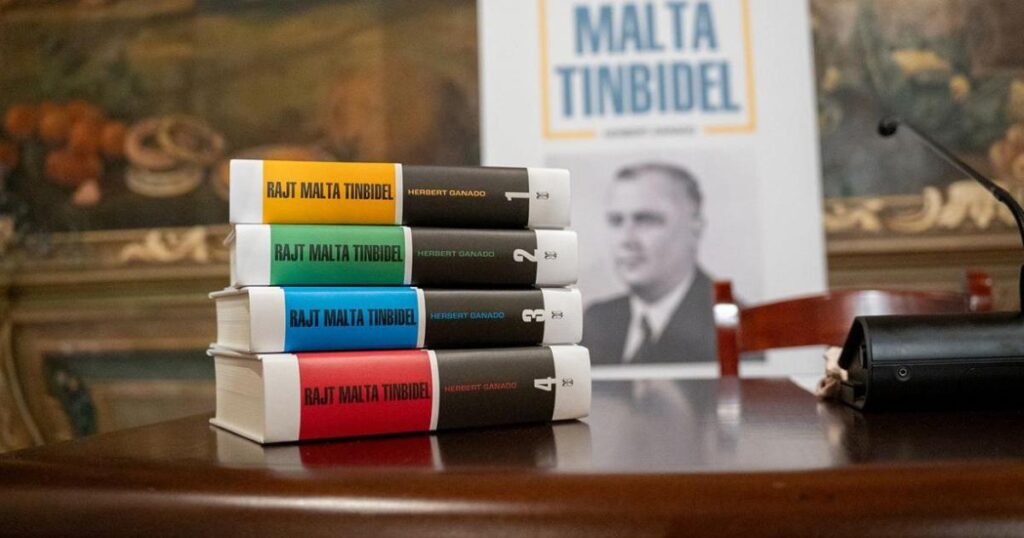
A new edition of Rajt Malta Tinbidel aims to make the defining history books accessible to a generation that has not seen Malta changing, in the publisher’s belief that all Maltese should read these volumes at least once in their lifetime.
Today’s younger generations are the first to have not experienced the events described in the autobiographical masterpiece by Herbert Ganado, and they are poorer for that.
But getting them to dive into and digest this magnum opus, described as a “literary monument to a changing nation” – as opposed to feeding on Instagram reels and Tiktok – is a tall order.
Joe Mizzi, from Midsea Books, said Rajt Malta Tinbidel (I Have Seen Malta Changing) had withstood the test of time in literary terms and was widely regarded as one of the best books in Maltese, and a cornerstone of contemporary history.
But its “void was becoming noticeable”, he observed.
On a mission to place Ganado’s work from the 1970s in every modern-day Maltese library and home, the intention behind the new edition is also to give the masterpiece the stature it deserves.
The plan is up against a generation who uses social media as a primary hub for anything from entertainment to news and education, and consumes information through a continuous stream of quick, visual and personalised content.
So, what could help a younger reader, with a fast life and a shortened concentration span, pick up the four volumes of this biblio-historical account? Mizzi believes that despite its length, Rajt Malta Tinbidel allows for flexible, bite-size reading – by sentences, pages, chapters and not necessarily in its entirety.
This accessibility appeals to the younger audience, who often prefer shorter readings, he said.
However, the true draw lies in the content, according to the publisher. It transcends mere history, exploring universal human values such as persistence and perseverance in adversity, truthfulness, compassion, understanding and tolerance; standing by what you believe in no matter what.
“These themes encapsulate the essence of what unites us as a nation and resonate within our collective identity.”
Written over half a century ago, Ganado’s personal and national biography “revolutionised” the narrative of historical events with a crisp and direct style, “rooted in the people’s perspective”. That language is still fresh today, Mizzi said.
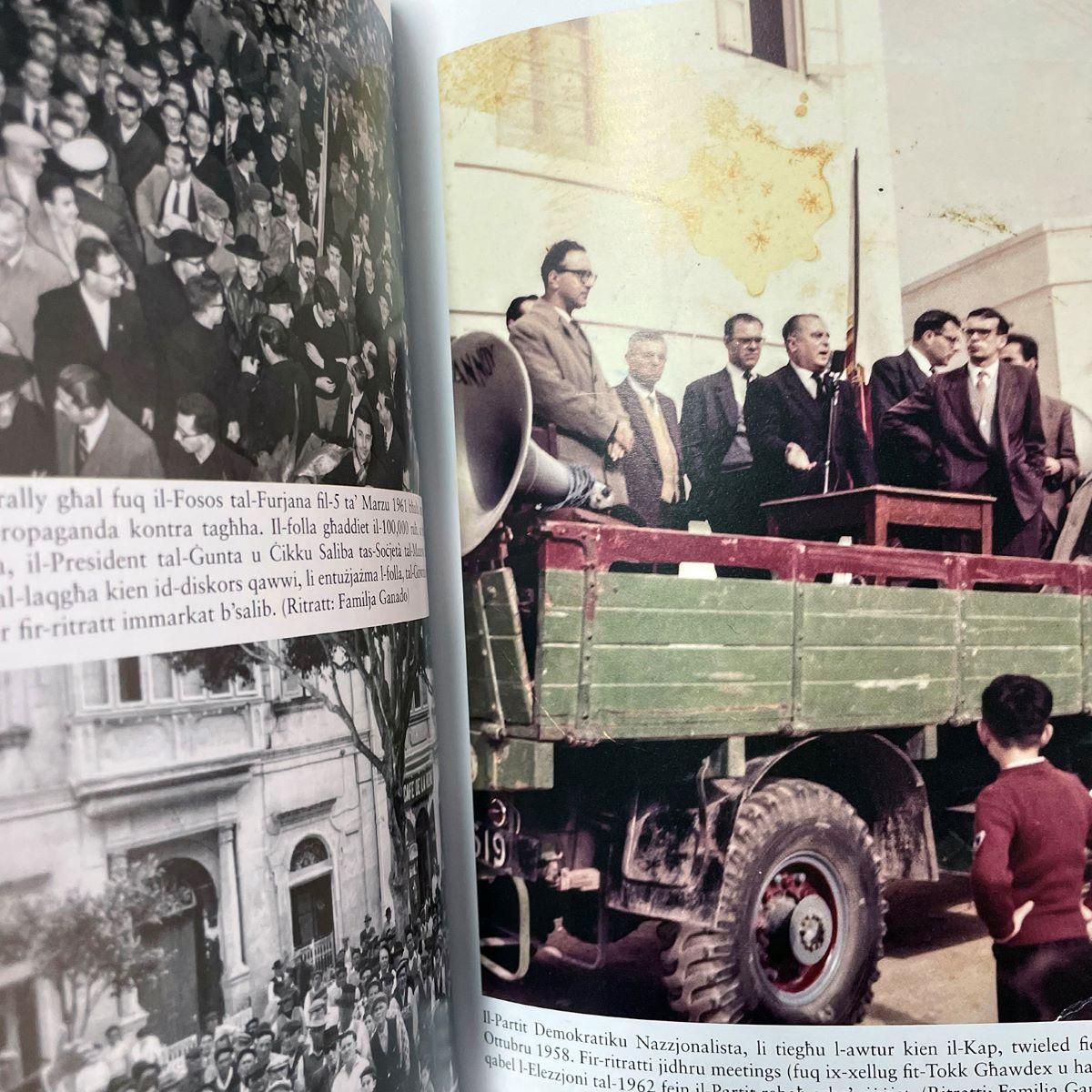 ‘Each scene offers an accessible entry point into Malta’s past.’
He believes Rajt Malta Tinbidel goes beyond its literary merit and is more than an autobiography or a history book: “It is the soul of nation talking to one of its protagonists.”
Serving as an enduring testimony of the 20th century for future generations, Ganado provided a vivid chronicle through detailed and human-focused accounts of pivotal historical events, from the devastating 1908 Messina earthquake, whose effects were felt in Malta, to the intricacies of the islands’ political struggles.
These themes encapsulate the essence of what unites us as a nation and resonate within our collective identity- Joe Mizzi
More than just a personal memoir, it is a masterful portrait of the Maltese social fabric, Mizzi said, capturing the nation’s journey through two world wars and its political evolution from a British colony to an independent, sovereign state.
It presents an essential resource for understanding the forces that shaped modern Malta, Mizzi said as his publishing house continues to celebrate the legacy of the series.
Like short-form storytelling
One young man has a few answers as to why Rajt Malta Tinbidel matters for younger generations.
At 42, Daniel Camilleri may not be Gen Alpha or even Gen Z, but he did not live the times Ganado recounts and feels his memoirs are both valuable and accessible to younger generations.
This is thanks to the author’s ability to weave the personal with the political, offering a “digestible” route into complex historical realities, according to Camilleri, who works in corporate governance and has an interest in history, trade and international affairs.
Likening his memoirs to vivid vignettes, he said they resemble, in many ways, the short-form storytelling that younger generations instinctively engage with today.
“Each scene offers an accessible entry point into Malta’s past: sometimes through major national events; at others, through the smallest, almost innocent details of daily life.
“Through these windows, first published more than 55 years ago, Ganado not only recounts history; he reveals the stories behind it – the sentiment, the contradictions and the lived reality beneath the formal narrative in academic circles.”
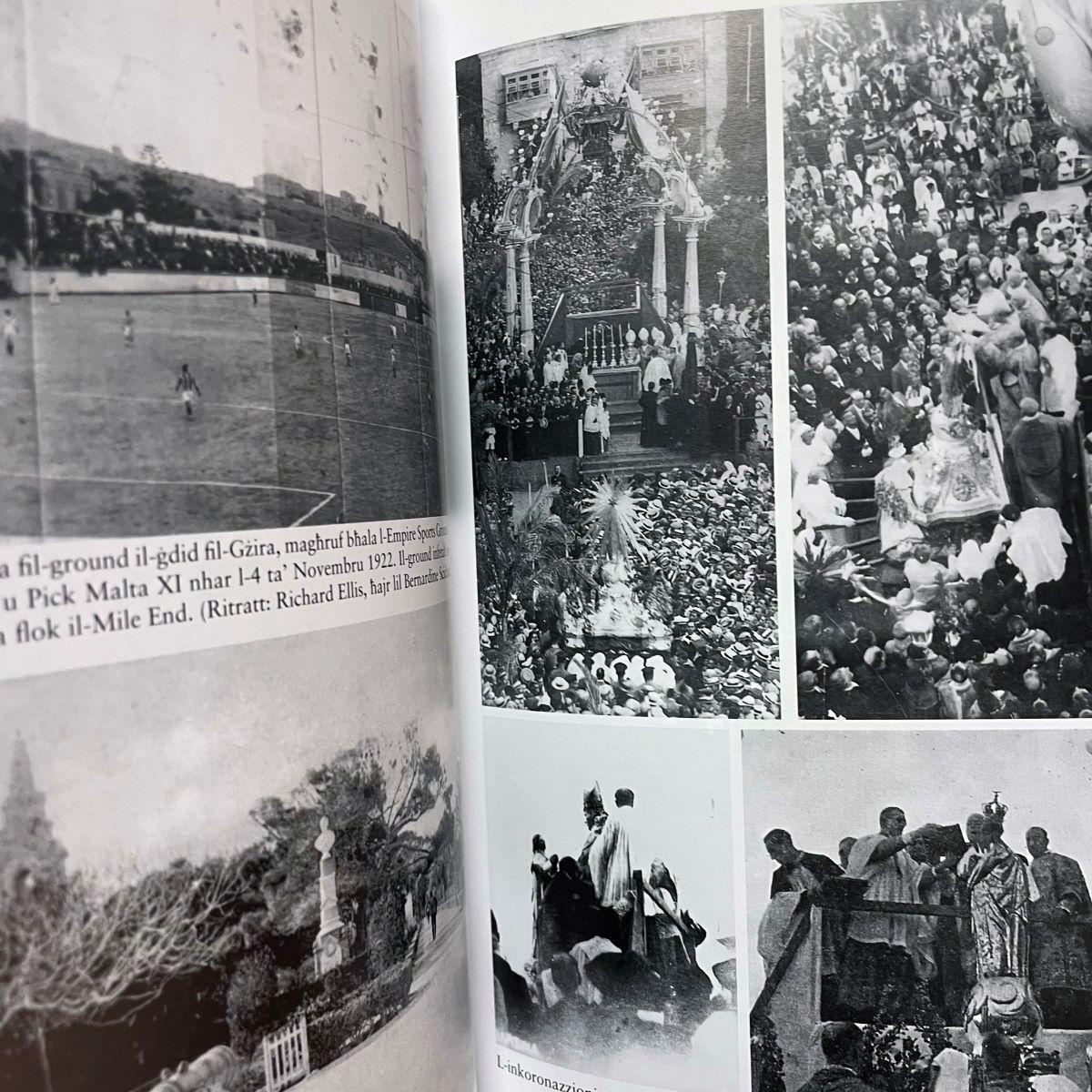 More than just a personal memoir, it is a masterful portrait of the Maltese social fabric.
Many of his vignettes feel like a mirror, Camilleri said. They prompt readers to reflect on how they should lead their life and on their opportunities to contribute to shaping the world.
Drawing parallels with today’s world, one such vignette that stayed with Camilleri is Ganado’s recollection of learning about the atomic bomb while standing on is-Saqqajja, so absorbed by its implications that he was almost run over by a car.
“Reading this passage, I was reminded of the familiar sight today of people absorbed in the screens of their digital devices, oblivious to what is happening around them.
“Within a few lines, the author moves from personal experience to a geopolitical reflection on how the atomic age would reshape Malta’s strategic and economic future.
“It is a reminder that global events inevitably shape us, individually and collectively – a lesson as relevant today as it was then.”
Certain passages show how thoughtfully Ganado framed change – technological, social and civilisational, Camilleri pointed out.
“His reflections should invite younger generations to recognise that rapid transformation is not unique to our time; earlier generations too grappled with uncertainty, disruption and the need to adapt.
Quoting author Maya Angelou, who wrote that you cannot know where you are going until you know where you have been, Camilleri said that for those who grew up in the 1980s and 1990s, the most formative decades of Malta’s modern history were barely addressed at school.
Ganado’s volumes help fill that gap by presenting a “layered and deeply human portrait of a country in transition”, according to Camilleri.
His level of quiet detail – the power of the everyday – functioned as cultural memory, and it was the small, seemingly ordinary moments that animated a Malta that would otherwise be inaccessible to younger readers.
Reader-friendly Maltese
The reset edition, published last month, includes an introduction by Judge Giovanni Bonello, who highlights Ganado’s pioneering ability to use Maltese as a sophisticated tool for compelling, pleasant and reader-friendly expression.
Its engaging style, infused with subtle humour and a human touch, made the complex tapestry of Malta’s history relatable to generations of readers, Bonello writes.
Would it be enough to grip Gen Z? Whatever the case, they are being invited not only to revisit their recent past through this “monumental achievement in Maltese literature”, but also to cultivate the critical awareness needed to understand Malta’s place in an ever-changing world, and to tap into a “timeless guide” on how to live with principle and courage.