
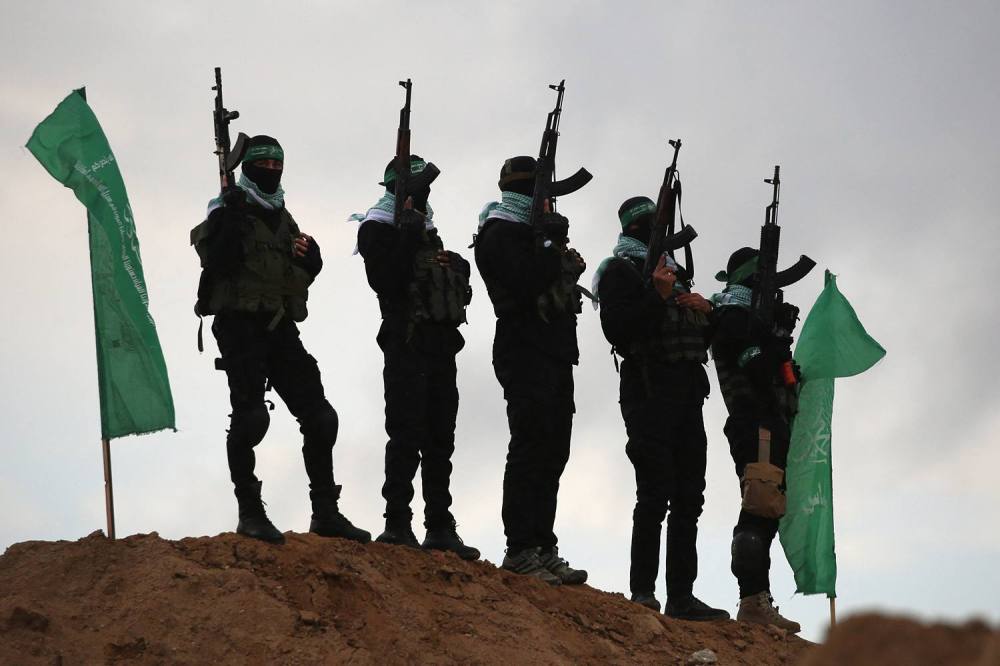
Despite the optimistic messaging of the Trump administration regarding its Gaza peace plan, moving the process to the next phase faces a slew of serious obstacles. The disarmament of Hamas, a key aspect of the 20-point plan, stands as perhaps the greatest challenge to overcome.
Armed resistance against Israel is a fundamental aspect of Hamas’s ideology, which is a large part of the reason the group has not agreed to disarm. Hamas recently signaled that it could be open to freezing or storing its arms, but Israel will not be satisfied with anything short of complete disarmament.
“The notion that Hamas can ‘freeze or store’ its weapons is pure fiction and a nonstarter. Hamas must and will be disarmed and Gaza will be demilitarized, as outlined in the 20-point plan. Israel is committed to the Trump plan and has upheld its side from the beginning of the cease-fire. Israel will ensure our border is secure and Gaza does not pose a threat to the Jewish state,” an Israeli government official told Foreign Policy.
The impasse over disarmament helps explain why many countries—particularly Arab states—are not rushing to commit personnel to a temporary International Stabilization Force (ISF). Under U.S. President Donald Trump’s plan, the ISF would handle security in Gaza and oversee the disarmament process. The ISF is meant to work in conjunction with a Board of Peace, which will supervise and support a transitional technocratic committee that will manage day-to-day governance in Gaza. The board’s membership, which Trump said will be “legendary,” is expected to be announced in early 2026. But even after the board is in place, there are many tough realities to overcome on the ground in Gaza—and disarming Hamas is at the top of the list.
“Unless there’s a successful mechanism to get Hamas to lay down their arms, to hand them over, to allow weapons and tunnels to be decommissioned, and even for Hamas fighters and remaining leaders to leave and go into exile, which is one of the points in the Trump plan, it’s very difficult to imagine security forces from these Arab and Muslim states coming in to play the part that they’re now blessed by the U.N. Security Council to do, because they don’t want to fight Hamas,” said Dan Shapiro, a former U.S. ambassador to Israel. “They want to come in and provide stability after Hamas has really been removed from power.”
But two countries in particular, Qatar and Turkey, could play a central role in pushing Hamas to lay down its arms, according to diplomats and experts.
Qatar and Turkey, which along with the United States and Egypt are guarantors of the Gaza cease-fire, have long-standing relationships with Hamas and have hosted its leaders and officials. Doha and Ankara leaned on their ties with Hamas to help convince the group to agree to the cease-fire, with U.S. Ambassador to Turkey Tom Barrack saying that the “cease-fire in Gaza would not have happened without Turkey” and its “relationship with Hamas.”
Shapiro said that “Qatar and Turkey’s special influence and ability to pressure and leverage Hamas is the best available tool” that Trump has when it comes to disarming Hamas. Trump will need to get Qatar and Turkey to convince Hamas leaders “that their time in power in Gaza has passed” and that they will lose the support of Doha and Ankara if they try to hold out and refuse to relinquish control of their weapons.
That said, Israel’s frosty relations with Turkey and Qatar—the latter of which the Israeli military bombed less than a year ago in a failed attempt to kill Hamas leaders in Doha—could present difficulties in terms of seeing the two countries steer major aspects of the peace process. The Trump administration is taking steps to improve those relations but has its work cut out for it. Though Israel has ruled out Turkey contributing to the ISF, the Trump administration and the Turkish government continue to push for it.
“Since the Turks have the largest and most effective ground troop operation in the region, and since they have a dialogue with Hamas, perhaps that would be beneficial as part of the force to cool the temperature,” Barrack said last week.
Still, Israel’s stance toward these two countries, among other factors, helps explain why not everyone is convinced that the road to disarming Hamas leads through Qatar and Turkey. Gönül Tol, a senior fellow at the Middle East Institute, said she’s “pessimistic” about the prospect.
“Turkey and Qatar are two countries that have a lot of leverage over Hamas. But organizations like Hamas, they have their own logic,” Tol said. “It will all boil down to what Hamas thinks about its own future.”
Tol emphasized that Hamas sees itself as fighting for the Palestinian national cause and, to some extent, feels that it has made progress toward this goal by seeing Israel isolated both internationally and regionally as a result of the post-Oct. 7, 2023, war. If Hamas disbands or disarms, another organization is likely to emerge “as long as there is no durable solution to the Palestinian cause,” Tol said. Hamas knows this, and “it’s further motivation for them not to disarm,” she added.
Hamas leadership is also likely to be skeptical of Turkish President Recep Tayyip Erdogan’s intentions in terms of what he could gain out of promoting a process backed by Washington, Tol said, particularly as Ankara pursues new deals with the United States and is engaged in talks on rejoining the F-35 program.
Even if Doha and Ankara ramp up pressure on Hamas to disarm, Shapiro conceded that it will be difficult to get the militant group to agree to willingly give up power. But he still sees the two countries’ involvement as the strongest tool available to accomplish this aspect of Trump’s plan.
Salman Shaikh, founder and CEO of the Shaikh Group, a political consultancy focused on peacebuilding, said he agrees that Qatar and Turkey could play an instrumental part in getting Hamas to agree to disarmament. Hamas is “stubborn” and will need to be persuaded by those it trusts and respects, he said, and Doha fits the bill. Shaikh also said that Turkish leadership can’t “afford for this issue to go on forever,” given the “strength of feeling” and support for the Palestinian cause in the country.
But “the conditions” surrounding the process and a clear “end destination” of a Palestinian state—and the political will to get there—will be crucial toward making any progress, Shaikh added.
Hamas has said that it will not fully disarm until there’s a Palestinian state. But the Israeli government is vehemently opposed to Palestinian statehood.
A French- and Saudi-led plan—endorsed by the 22-member Arab League and the European Union, among other countries—calls for Hamas to hand over its weapons to the Palestinian Authority (PA), though this is not what the Trump plan calls for. The Trump plan does envision the PA eventually taking control in the enclave after a period of reform, but Israel has signaled that it opposes PA involvement in postwar Gaza.
History shows that disarmament tends to be among the thorniest issues to settle in peace processes, and it can take a long time for armed groups to lay down their weapons. The Irish Republican Army, for example, did not completely disarm until 2005—taking seven years to fulfill its obligations under the 1998 Good Friday Agreement. But with the cease-fire in Gaza on shaky ground just two months after it went into effect, there is a growing concern that time is of the essence when it comes to creating the conditions for the next phase of Trump’s plan.
The process will either move forward quickly in terms of implementing the second phase or “we will go backward” and see a return to hostilities, a descent into anarchy, or both, Norwegian Foreign Minister Espen Barth Eide said in an interview at the Doha Forum. “The absence of progress is my biggest concern,” Barth Eide added.
“Qatar, Turkey, Egypt, and the U.S. were the guarantors of this agreement” and “are the most important countries in making sure that all parties stick” to it, Barth Eide said.
But Barth Eide also emphasized that disarming Hamas should not be viewed in “isolation” from other issues on the table. “The idea is that Hamas, the de facto authority in Gaza, needs to hand over that power to somebody else. They’re not going to hand it over to Israel, obviously. So, they will have to hand it over to a new Palestinian administration, which is supposed to be a temporary technocratic administration, which, again, is backed by an International Stabilization Force and the Board of Peace. In that context enters the disarmament of Hamas,” he said.
It’s “futile” to believe Hamas’s disarmament will happen without these “alternatives in place,” he added.
Hamas has also said it won’t disarm until Israel withdraws troops from Gaza. Israeli troops currently occupy around 53 percent of the coastal enclave, after pulling back to a “yellow line” as part of the cease-fire deal. Meanwhile, Israel has signaled that a troop pullout won’t happen until Hamas disarms.
When asked about the role that Qatar can play in Hamas’s disarmament during a press briefing at the Doha Forum, Majed al-Ansari, an advisor to the prime minister of Qatar and a spokesperson for the country’s foreign minister, said he could not offer details on the subject but that Doha was “working with our partners” to find the “right modalities over this.”
“The question is disarmament versus occupation. When does occupation end? When does disarmament begin? And sequencing has always been an issue,” Ansari added. “I think it’s still in play, as we are having discussions with all parties.”
In response to a follow-up question on whether Israel must withdraw before Hamas will agree to disarm, Ansari emphasized that there are other political and military factions in Gaza beyond Hamas and that full disarmament “can’t happen under the thumb of occupation.”
“You can disarm the group now and end up with 10 groups two months later, if the people who took up arms are faced with the same security threats,” Ansari said. He added that Qatar’s objective as a mediator is to remove any incentive to take up arms again once they are laid down, and that this can only be accomplished through a “sustainable peace.”