
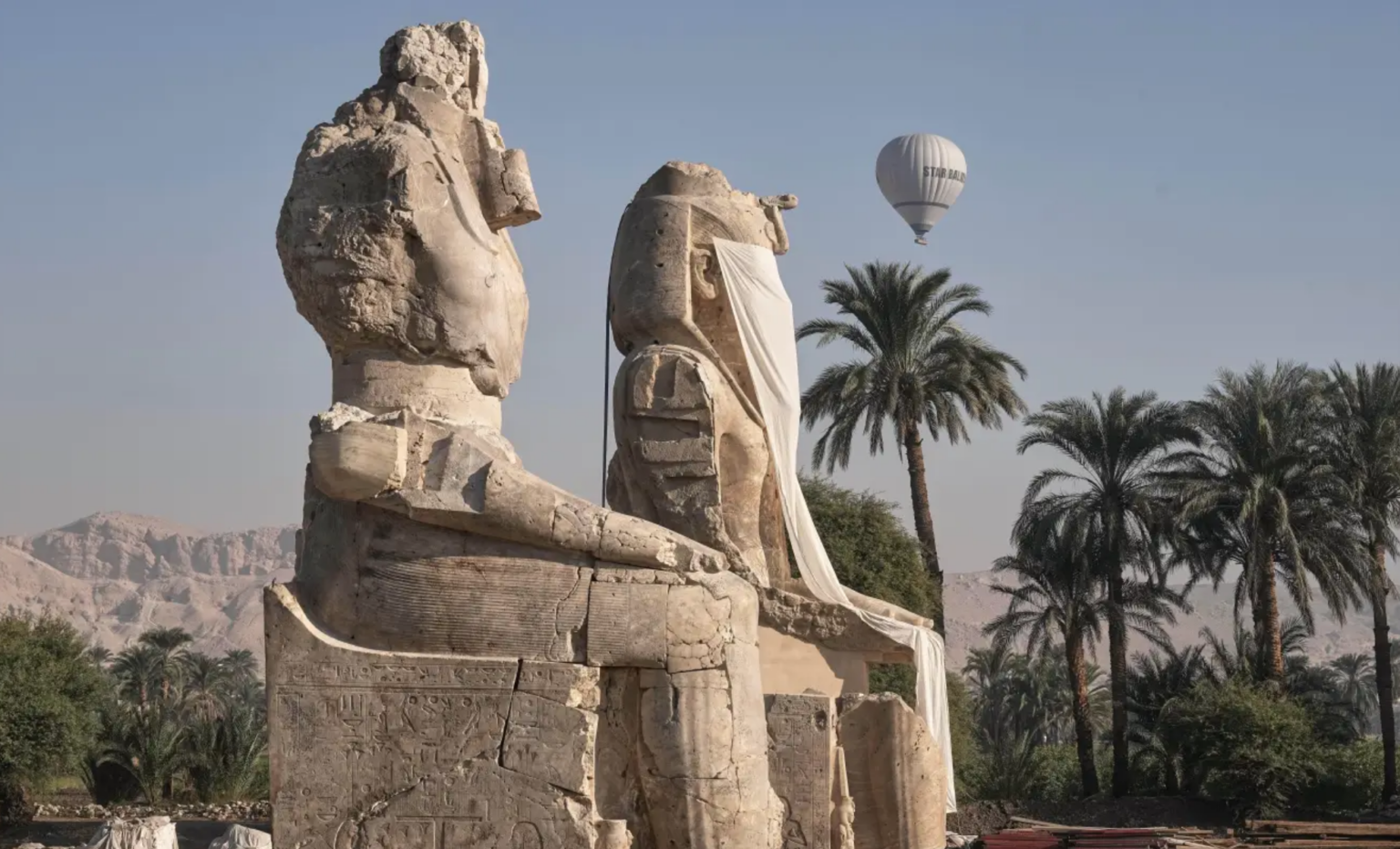
After years of meticulous restoration, Egypt has unveiled the reassembled colossal statues of Pharaoh Amenhotep III in Luxor. Once shattered by a powerful earthquake centuries ago, these ancient statues now stand as a proud testament to Egypt’s rich history and artistic mastery. The restoration of these monumental figures highlights the country’s ongoing efforts to preserve its cultural heritage while revitalizing tourism, a key driver of its economic recovery.
The Restoration Journey: Rebuilding Egypt’s Ancient Icons
In an ambitious restoration project that spanned over two decades, Egypt has managed to reassemble the towering Colossi of Memnon, two colossal statues originally built to honor Pharaoh Amenhotep III. Situated in the historic city of Luxor, these statues had been reduced to rubble after a powerful earthquake around 1200 BC. The pieces were scattered across the area, some even used in other ancient constructions, until archaeologists, led by a German-Egyptian team, began work in the late 1990s.
“This project has in mind … to save the last remains of a once-prestigious temple,” said Hourig Sourouzian, a prominent Egyptologist who oversaw the restoration effort.
According to APNews, the colossi, standing at 45 and 48 feet tall, were painstakingly reassembled, with some parts sculpted separately and reattached to the original alabaster cores. The immense scale and craftsmanship of these statues serve as a testament to the architectural brilliance of ancient Egypt, a period known for its monumental structures and prosperous rule.
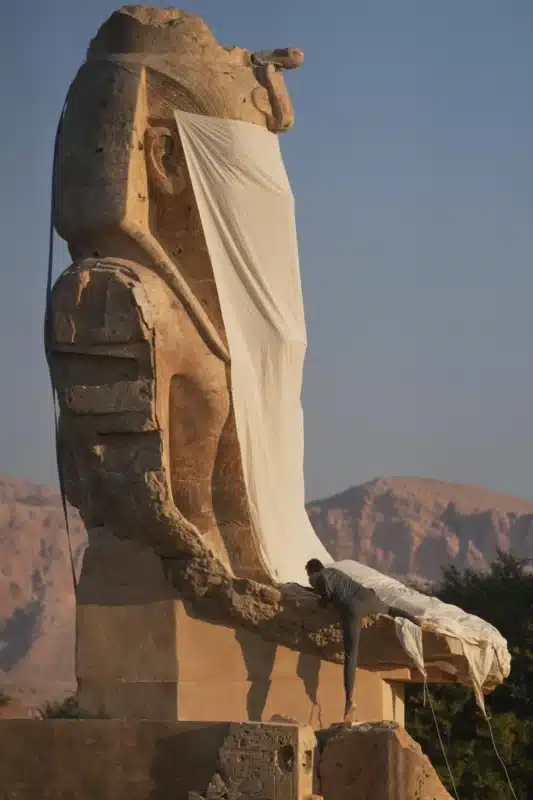 Antiquity worker prepares to unveil the assembly of a giant alabaster statue for the prominent Pharoah Amenhotep III, in the southern city of Luxor, Egypt, Sunday, Dec. 14, 2025. (AP Photo/Amr Nabil)
A Glimpse Into Ancient Egyptian Majesty
Amenhotep III, one of Egypt’s most celebrated pharaohs, ruled from 1390 to 1353 BC during the New Kingdom’s golden age. His reign was marked by prosperity and monumental construction projects, including his mortuary temple in Luxor, where the Colossi of Memnon once stood proudly at the entrance. The statues depict the pharaoh seated, facing eastward toward the rising sun, a powerful symbol of his divine rule. At his feet, smaller statues of his wife, Tiye, add a personal touch to the grandeur of the monument.
The significance of these statues extends beyond their sheer size. They are not only architectural masterpieces but also cultural artifacts that provide insight into the religious and political life of ancient Egypt. As symbols of Amenhotep III’s reign, the statues reflect a time of relative peace and wealth for Egypt, a period that contrasts with the more tumultuous times that followed.
Luxor’s Growing Role as a Global Tourism Hub
The unveiling of these grand statues marks a significant moment in Egypt’s ongoing efforts to revive its tourism industry, which has faced setbacks over the past decade due to political instability and global events. The restoration of the Colossi of Memnon is part of a broader initiative aimed at promoting Egypt’s ancient monuments and attracting more international visitors.
“This site is going to be a point of interest for years to come,” said Sherif Fathy, Egypt’s Minister of Tourism and Antiquities, who attended the unveiling ceremony.
Fathy expressed confidence that the project would draw tourists from around the world, contributing to the recovery of Egypt’s vital tourism sector. With millions of visitors already flocking to Egypt in 2024, the country’s tourism industry is poised for continued growth, especially with new attractions like the Grand Egyptian Museum, located near the Giza Pyramids.
The Economic Impact of Egypt’s Tourism Revival
Tourism has always been a cornerstone of Egypt’s economy, contributing significantly to its GDP. In 2024, Egypt welcomed around 15.7 million tourists, a number that is expected to rise as the country continues to invest in its archaeological heritage. The restoration of the Colossi of Memnon and the recent inauguration of the Grand Egyptian Museum reflect the government’s strategic focus on leveraging the country’s ancient treasures to boost tourism and attract foreign investment.
Fathy’s goal of reaching 30 million tourists annually by 2032 is ambitious, but with the country’s rich historical offerings and ongoing efforts to improve infrastructure, Egypt is on track to become one of the top global destinations for history and culture enthusiasts. The renewed interest in Luxor, in particular, is expected to play a key role in this growth, with the Colossi of Memnon standing as a must-see attraction for visitors from around the world.
A Peek Into Egypt’s Archaeological Future
With the reassembly of the Colossi of Memnon, Egypt is not only preserving its past but also shaping the future of its archaeological tourism. As Mohamed Ismail, Secretary-General of the Supreme Council of Antiquities, remarked before the ceremony, “Today we are celebrating, actually, the finishing and the erecting of these two colossal statues.” His words underscore the importance of this restoration not just as a historical act, but as part of Egypt’s broader efforts to reinvigorate its tourism industry and global cultural influence.
The government’s commitment to preserving and promoting Egypt’s ancient sites, including the Colossi of Memnon, reflects a growing recognition of the value these monuments hold, not just for Egyptians, but for the world at large. As Egypt continues to unearth and restore its ancient marvels, it reinforces its status as a global hub for cultural and historical tourism.