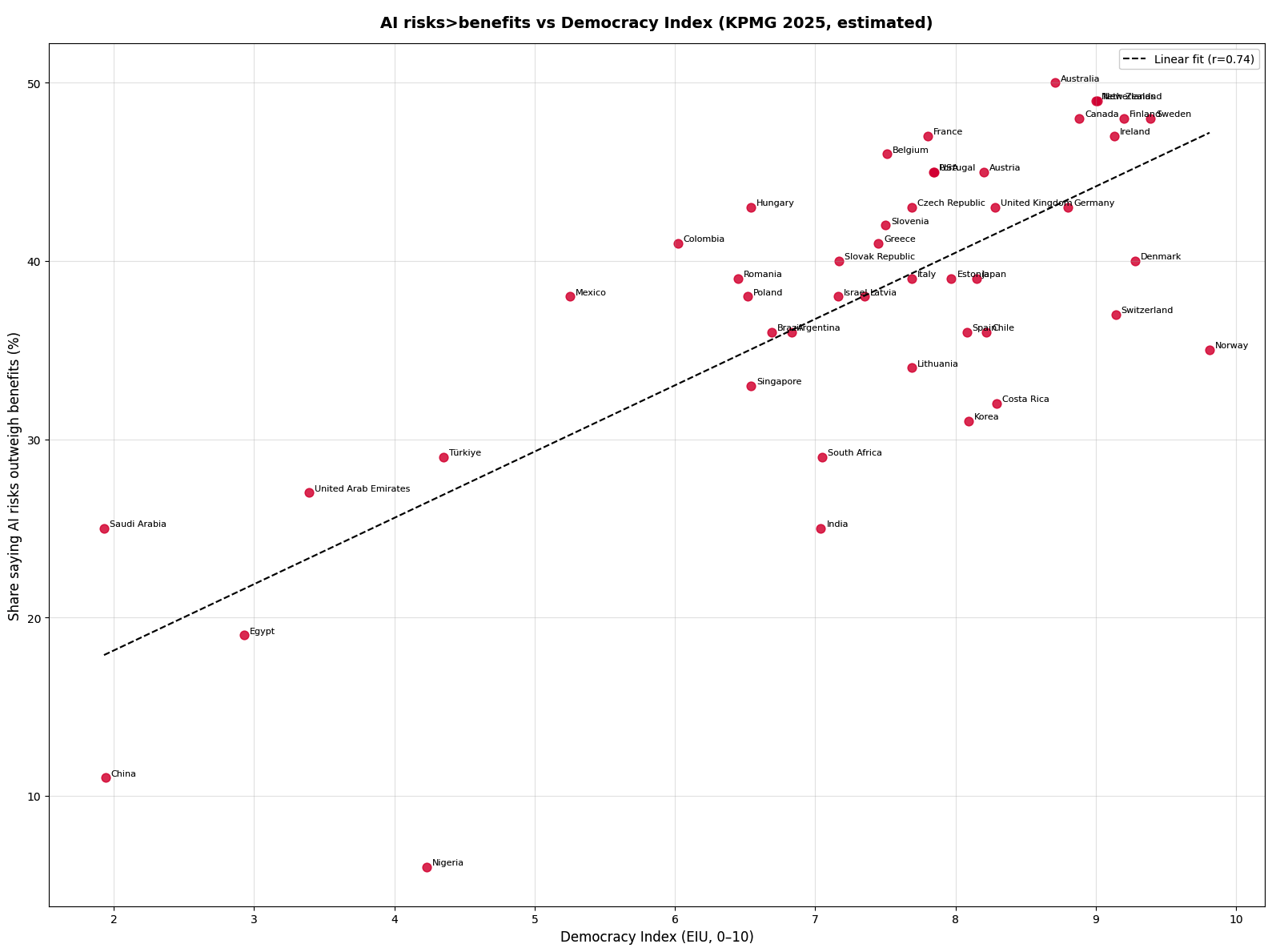
[OC] There is a strong correlation (r=0.74) between a country’s Democracy Index and how skeptical it is of AI (data from 2025 KPMG study)
Posted by GeneReddit123

![[OC] There is a strong correlation (r=0.74) between a country's Democracy Index and how skeptical it is of AI (data from 2025 KPMG study)](https://www.byteseu.com/wp-content/uploads/2025/12/3vzv6qwdxf7g1-1536x1149.png "[OC] There is a strong correlation (r=0.74) between a country’s Democracy Index and how skeptical it is of AI (data from 2025 KPMG study)")
[OC] There is a strong correlation (r=0.74) between a country’s Democracy Index and how skeptical it is of AI (data from 2025 KPMG study)
Posted by GeneReddit123
24 Comments
Source: [KPMG: Trust, attitudes and use of artificial intelligence: A global study 2025](https://kpmg.com/xx/en/our-insights/ai-and-technology/trust-attitudes-and-use-of-ai.html)
Tool: [Matplotlib](https://matplotlib.org/) (Python)
—
Edit: USA is overlapping with Portugal on the plot (left of Austria).
how do you measure skeptism if you cant speak?
AI is a fundamentally authoritarian technology. It is a centralized resource for “truth”. With AI, truth is not a collective process of mutual agreement. It is the owners of the model, who train it and operate it and charge people to access it, that get to decide what “truth” is.
EDIT: Downvoted for speaking the truth about the correlation between AI and authoritarianism. Either you’re scared or just ignorant. Feelings not facts will be the end of us.
r/dataisinteresting and r/dataiscompelling but r/dataisnotbeautiful because I had a hard time finding USA until I found USAugal.
Where is the USA on this graph? 🤔
It looks like there’s a data point precisely overlapping with Portugal, might be USA, as well as “New Zealand” and “Netherlands” overlapping. You should add a little bit of jitter to the data points and labels to make this readable.
Quite easy to generate a zero-centered jitter with `y_values + (np.random.random_sample(y_values.shape) – 0.5)*MAGNITUDE_OF_JITTER`.
It’s hard for me to believe the survey standards are consistent across countries.
The fuck is that regression line
This is just Europe-is-many-countries as a graph
Who the fuck pays those idiots
Perhaps they would welcome their AI overlords?
I’m in a third camp: I belive that BOTH the risks and benefits are wildly overstated and it will be a nothingburger once the dust of the ginormous financial bubble popping settles!
Look at that data, this is why linear analysis is not everything. You have a blob of democratic countries and couple of random points for low democratic.
There is a strong correlation between a country’s Democracy index and their truthfulness in answering surveys
Guess I’m moving to a dictatorship next year
Luckily everybody knows that correlation always means there is 100% guaranteed causation.
The regression will be highly influenced by the outliers with low democracy index so i would be careful when considering this result
A prime example of how correlation doesn’t equal causation. It’s a meaningless plot.
What the study was actually talking about is correlating AI skepticism and the degree to which the economies, education, and healthcare are developed, so essentially the graph should be AI skepticism vs HDI – and not some random democracy index.
To quote from the study itself:
>AI systems may be perceived and experienced as more beneficial in emerging economies because of their ability to fill critical resource gaps and provide greater relative opportunities to people. For instance, the use of AI systems in healthcare has the potential to enhance service delivery and improve health outcomes in areas where there is limited access to medical professionals.
I think numerical correlations don’t mean much when one of the axes (democracy index) is subjective and seems to be clumped in the 7-10 region. It is much either to have a higher correlation when you have a few points separate from the clump. I think there are too many confounding variables here to be meaningful.
This is what statisticians call p-hacking.
You’re KPMG and you do a study of which countries are skeptical of AI. But why should anyone care? So you compare it to all kinds of other ways to measure something about countries, one at a time, until you find something that correlates well.
It’s like noticing that the number of letters in the winning word of a spelling bee correlated with the number of people killed by venomous spiders. Technically true, but cannot be used to explain anything.
Is there a relationship between Democracy Index and skepticism overall?
I wonder if Norway, Denmark and Switzerland have welfare states that are developed enough that people are less worried about losing their job.
Only true if your definition of democracy is when you choose which bourgeois party oppreses you for a few years
Democracy index is also a bit subjective, they tend to make decisions based the ruling party’s ideology.
So this is mostly that if The Economist agrees with your views, you’re more likely to be skeptical of AI
Isn’t this “first world problems”?
If I can’t afford food, my home was wrecked by flooding, and gunshots happen nightly, what do I care about the noise a data center makes or how some mid level programmer bro is going to survive without his weekly salary that dwarfs my own lifetime earnings?
The correlation comes from a circlejerk penchant in any ranking for europeans made by europeans.
Side note: it is patently absurd to put China and Saudi Arabia on the same level because you can’t criticize Xi. One of those is *literally a monarchy*, and the other is both a) ostensibly democratic, and b) has massive, extremely active democratic apparatuses at sub-national levels.
Of course, this index is made by *The Economist*, so the lack of recognition of any democratic elements in anticapitalist countries shouldn’t be a surprise…