
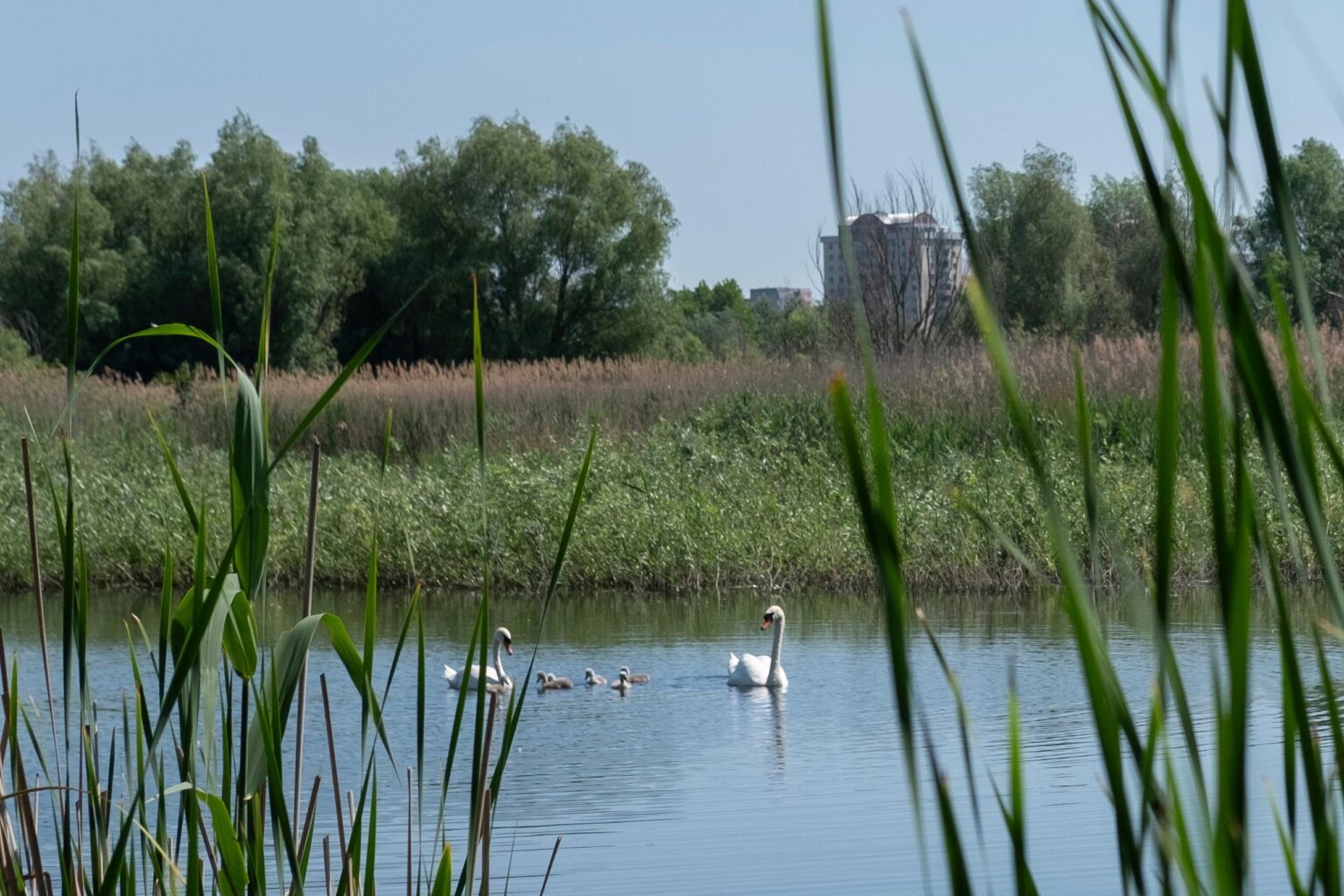
In the middle of Bucharest lies an unexpected wilderness: the Văcărești Delta. Spanning more than 460 acres, it is not only Romania’s first urban nature park but also the largest wild ecosystem in any European capital. Reeds, lakes, and meadows host herons, otters, turtles, and foxes — all within sight of apartment blocks and highways.
This thriving wetland emerged not from intentional planning but from abandonment. On the site of an unfinished communist reservoir left behind in the 1980s, nature took over, revealing its capacity to become feral, slipping out of human control and reorganizing itself in surprising, ecologically rich ways.
Văcărești’s establishment as a park, however, is ultimately a story of civic imagination, with local NGOs and scientists recognizing its value many years ago. As with most areas reclaimed by nature in urban settings, Văcărești Delta was an active battleground between economic and environmental interests.
Cristian Neagoe, the event and community engagement manager at Bucharest National Park, an NGO focused on rewilding the metropolitan area, explains that several real estate developers wanted to build on the site, and NGOs worked with community members and scientists to convince city management that “it’s important to have a place like this in a big city.”
In addition, researchers from local universities and residents documented species living on the site, organized clean-ups, built benches, walking trails, bird observation towers, and interpretive signs for park visitors, and campaigned to maintain the space as a park.
Sign up for our newsletter, The Hub, and keep up with the latest uplifting climate action news, sustainable living advice, and Earth-conscious recipes.
Sign Up Now.
“Similar to other neglected areas of the city, [the Văcărești Delta] was at that time a dumping ground for garbage and a notorious area for being unsafe to walk through, so people were avoiding it,” Neagoe says.
The joint efforts worked, and in 2016, the area became a protected park. Today, with more than 330 plant species and 175 bird species, the Văcărești Delta is the most biodiverse ecosystem in Bucharest, cherished for leisure, research, and environmental education.
Its success inspired other projects, such as the 5.6-hectare Petricani Meadow and the large Băneasa Forest on the city’s northern edge. These areas now weave wildness into Bucharest’s fabric, helping cool the city, absorb water, filter pollution, and support well-being.
”Nature suffers because of us humans and it’s us who have to help it recover, especially in urban environments where it’s completely attacked by the anthropic factor,” says Emanuela Radler, a horticulturist who traveled from Ploiesti, 70 kilometers from Bucharest, to participate in a cleaning and conservation volunteer operation at Petricani Meadow on a cold and foggy November morning, along with 30 other volunteers.
“Nature replenishes us with oxygen, it relaxes us, so I am keen to participate in volunteer operations, as they are both convivial and effective toward protecting nature.”
In an era in which human influence pervades nearly every ecosystem, such feral spaces increase urban biodiversity and ecological resilience. “In the Văcărești area, native plant species clearly dominate, which in turn attract pollinators,” Anastasiu says. “Unfortunately, some citizens don’t understand the value of native plants and consider them weeds. Exotic species don’t acclimatize well and don’t attract pollinators, whose decline is a global problem.”
She adds that rewilded areas sustain entire trophic chains. “The area is very well preserved,” explains Paulina Anastasiu, a professor of biology at the University of Bucharest and the coordinator of the city’s Botanical Garden. “The large number of plant and animal species indicates a healthy habitat.”
Challenges persist: weak enforcement, pollution, and competing land interests make legal protection a race against time. While Petricani Meadow received protected status in mid-2025, Băneasa Forest — one of the last remaining forests near Bucharest, located at the rapidly developing metropolitan border — is the subject of debate between real estate developers, authorities, and residents.
The Romanian Ministry of Environment did acknowledge its importance earlier this year. “If we don’t protect the Băneasa Forest, Bucharest will become a microwave oven,” warned Minister Diana Buzoianu when announcing plans to designate it a national park.
NGOs, however, fear that the government is moving too slowly. “This process can take years – a delay that can lead to extreme fragmentation,” Neagoe says. “Owners might deforest their parcels, or more illegal neighborhoods could appear. We think that its conservation is an emergency.”
Conserving and expanding green spaces and their biodiversity has been part of EU environmental policies for the past 50 years. The EU Biodiversity Strategy for 2030 aims to protect at least 30% of EU land by 2030. In this context, Bucharest’s inhabitants face a dire lack of green space — only 7 square miles per capita, far below the 26 square miles required by the EU or the 50 square miles recommended by the World Health Organization.
In economically challenged Romania, acknowledging the potential of rewilded urban spaces and their local plant species offers another advantage.
“Using native plant species is financially efficient,” Anastasiu says. “They are adapted to our local climate and, if they are also perennial, it means we don’t have to make yearly financial efforts to keep some areas green.”