
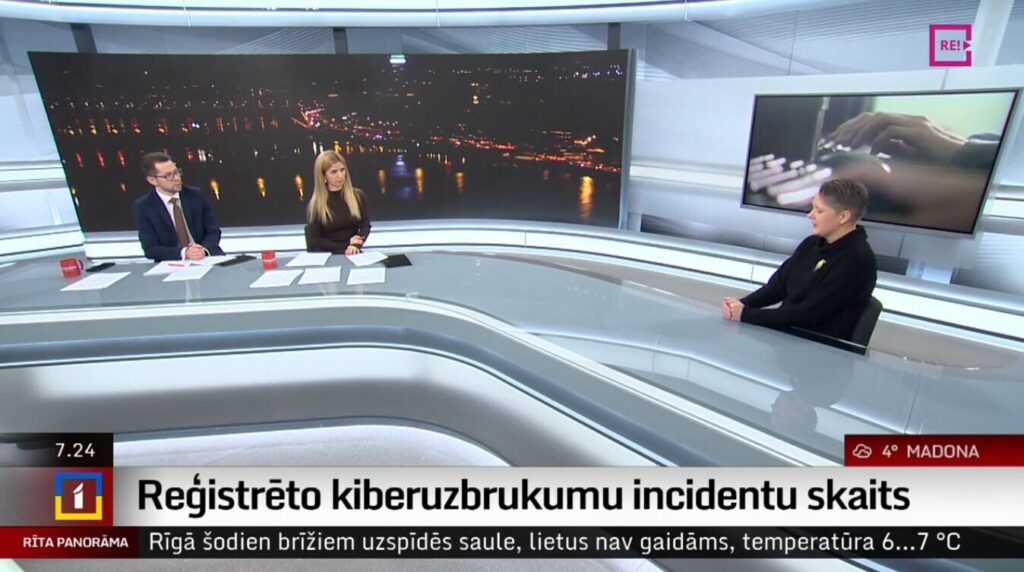
The level of cyber threats this year is the highest we have ever seen, and it is constantly rising, said Baiba Kaškina, head of the cyber incident prevention agency Cert.lv, in an interview with Latvian Television’s program “Morning Panorama” on 16th December. She emphasised that the main reason for this is various fraud campaigns.
The total number of cyberattacks is approximately 13% higher than last year. When registering various cases of fraud, the number is even 30-35% higher.
Kaškina pointed out that this year, there have been many fraudulent messages sent on behalf of the Road Traffic Safety Directorate (CSDD). Cert.lv has information about more than 100 cases where people have fallen victim to these scams while trying to find out whether they need to pay a fine. Kaškina emphasised that residents have lost approximately 175,000 euros in this way, which is not the largest financial loss.
Kaškina said that “this year, telephone scams have surpassed investment scams, as well as all other areas.”
She pointed out that action is needed to curb and improve the situation. “Clearly, if we could more successfully identify fake calls and number spoofing, it would solve some of the problems,” said Kaškina. At the same time, she emphasised that this requires investment and legislative changes.
Meanwhile, Mārcis Pelcis, head of the Finance Latvia Association’s Fraud Prevention Working Group and head of SEB Bank’s Security Department, said in an interview with Latvian Radio’s “Good Morning” program that the amounts defrauded from residents remain unchanged, but the number of cases prevented is increasing, which means that the volume of fraud also continues to grow.
Proposals to reduce fraud are a complex measure, but various solutions are already being implemented, including artificial intelligence solutions, to identify fraudulent activities more quickly, Pelcis said.
He emphasised that communication service providers should also take greater responsibility for potential fraudsters. “Operators are already doing a lot, but there is a lack of cooperation and communication between operators,” said Pelcis.
Pelcis also emphasized that the state needs to develop a plan of action – to find a specific solution that would oblige operators to get involved in combating telephone fraudsters. At the same time, Pelcis said that a broader discussion with operators is needed.
Select text and press Ctrl+Enter to send a suggested correction to the editor
Select text and press Report a mistake to send a suggested correction to the editor
Tell us about a mistake