

The new year is here, bringing a slew of changes to Switzerland in January. These include higher health insurance premiums and better protection for property buyers, among others.
Switzerland has a new president (yes, again)
Guy Parmelin, the current Economy Minister, was elected by the parliament to take over the presidency from January 1st until December 31st, 2026.
This is his second round at the top position as Parmelin was already president in 2021.
Switzerland rotates the presidency annually among the Federal Council, the seven-member cabinet that serves as the country’s collective head of state.
The president of the Swiss Confederation is first among equals, chairs the council and typically represents the country in major matters internally and abroad.
READ ALSO: Why does Switzerland’s president only serve one year?
Higher health insurance premiums will go into effect
From January 1st, Swiss health insurance premiums will rise by 4.4 percent in 2026.
That’s the national average — some cantons’ rates will be even higher: With a hike of 6.9 percent over current premiums, residents of Ticino will be saddled with the highest increase – 582 francs a month.
Next is Valais (5.8 percent – 439 francs); Appenzell-Innerrhoden (5.5 percent- 322 francs); Uri (5.3 percent – 363 francs); Zurich (5.1 percent- 451 francs); and Graubünden (5 percent – 400 francs).
READ ALSO: Which Swiss cantons will see highest hikes in health insurance premiums?
Advertisement
New year, new motorway vignette
You have until the end of the month to attach the 2026 sticker to your vehicle’s windshield, or purchase a digital version online.
If you are caught driving without one on a Swiss motorway from February 1st, you will be slapped with a 200-franc fine.
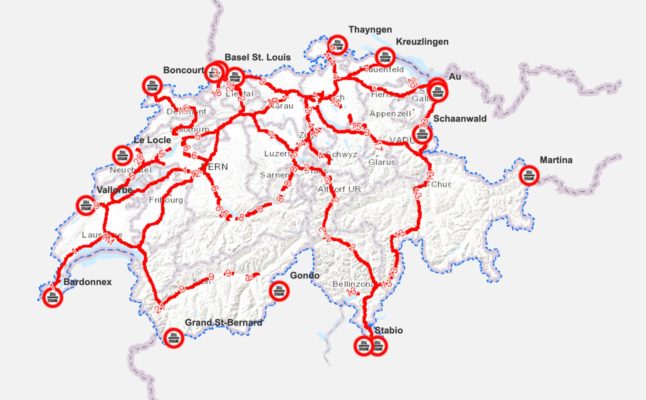
You must have the vignette if travelling on these Swiss roads:
The Federal Office for Customs and Border Security (BAZG)
Stalking will become a criminal offence
Until now, victims of stalking had limited options for prosecuting perpetrators of this type of harassment.
Mostly, they had to resort to civil proceedings or rely on broader criminal laws.
But from January 1st, people convicted of stalking can be sentenced to up to three years in prison.
Swiss police will use five different skin colours to categorise offenders
The government will be modernising the national Ripol search system, which centralises reports related to missing, wanted, deported, or dangerous persons.
The Federal Office of Police (Fedpol) announced in a press release on Saturday that the following five options for the offenders’ skin colour will be included: very light, light, medium, dark, or very dark.
As for the ‘type’ category, it will be covered by nine options, corresponding to geographical regions – namely Northern Europe, North Africa, Asia, and South America.
Advertisement
Better protection for property buyers
Anyone buying a house or an apartment will have more flexibility in claiming compensation or demanding repairs if the construction company fails to properly execute the work.
But from January 1st, the notification period for both apparent and hidden defects will be extended to 60 days from the date of purchase or the discovery of the defects.
Certain vaccines to be exempted from co-pays
Several vaccines recommended by the Federal Office of Public Health (FOPH) will no longer be subject to co-pays from January 1st. They include immunisations against Covid-19, tuberculosis, pneumonia, meningococcal disease, diphtheria, tetanus, and RSV for pregnant women.
The goal of this measure is to “increase the vaccination rate in Switzerland,” FOPH said.
READ ALSO: What jabs should you and your children get?
Advertisement
Digitalisation of vehicle registration
From January 1st, vehicle registration will become more digital and efficient.
Electronic European Certificates of Conformity (eCoCs) will be available directly from European databases, making data on individual vehicles in Switzerland’s Vehicle Registration Information System available electronically.
Manufacturers, importers, dealers, suppliers, transporters, garages, and authorities will have direct access to relevant vehicle data.
Vehicles with a valid European Certificate of Conformity (CoC), whether in paper or electronic format, are exempt from Swiss type approval. They can be registered in Switzerland for the first time in the name of any person, provided that all other registration requirements are met.
Advertisement
Payment of CO2 penalty will be a condition for vehicle registration
Also from January 1st, the enforcement of the CO2 law will be more closely linked with vehicle registration.
Concretely, certificates and license plates will only be issued after full payment of any penalty due under the CO2 law or the vehicle’s inclusion in a new vehicle fleet.
This applies primarily to new vehicle importers who exceed specific emissions targets.