
![[OC] OpenAI’s Valuation vs. Model Progress (2023–2025)](https://www.byteseu.com/wp-content/uploads/2025/12/00ufy7oujf7g1-1024x681.png "[OC] OpenAI’s Valuation vs. Model Progress (2023–2025)")
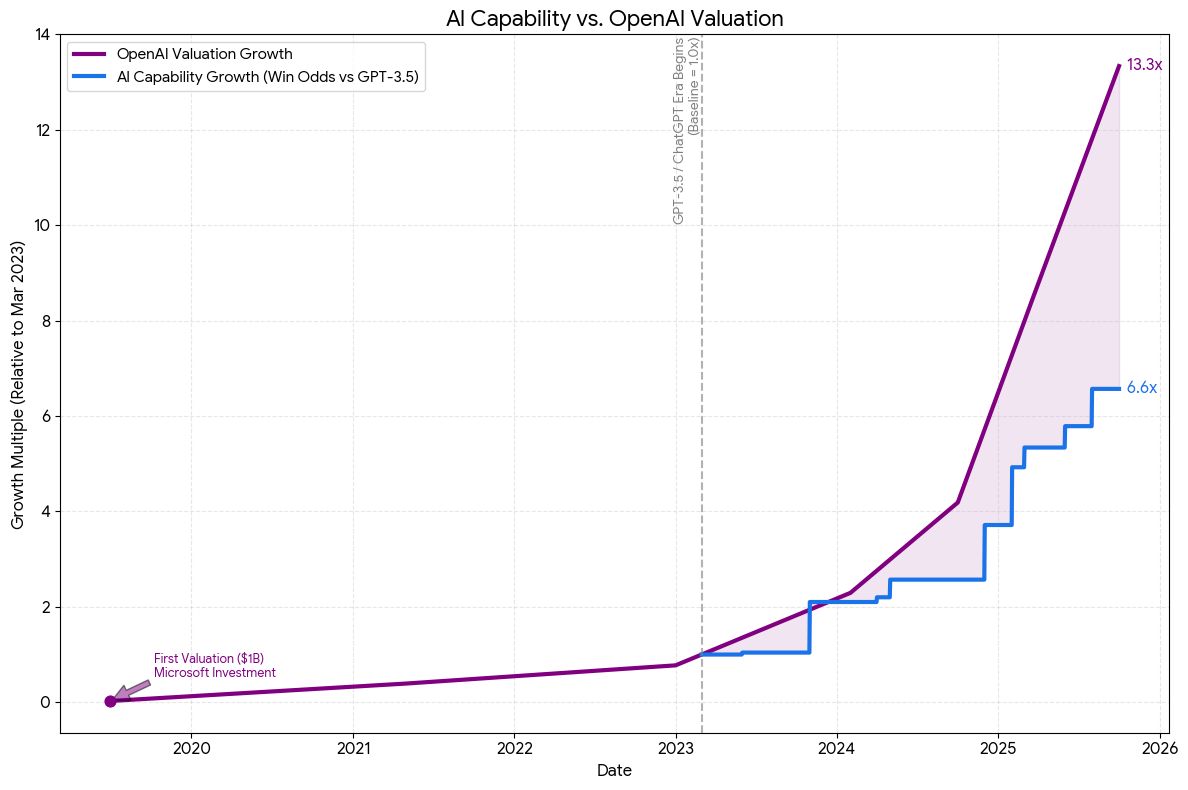
This visualization compares OpenAI’s projected valuation growth with estimated improvements in large language model performance between 2023 and 2025 (with OpenAI valuations going back to Microsoft's initial investment in 2019).
Model performance is represented as relative capability improvements over time (normalized against an earlier baseline), while valuation figures are based on publicly reported projections. The goal is not to suggest that AI progress has stopped, but to visualize how expectations and valuation have evolved relative to measurable gains.
There are obvious limitations in how “model capability” is quantified here, and I’m open to suggestions on alternative benchmarks or adjustments to the methodology.
For anyone interested in the broader context, assumptions, and interpretation behind this chart, I expanded on the analysis in a longer write-up here:
https://medium.com/@maxgorman2004/openais-narrative-is-outpacing-its-models-b1b47d89010f
Posted by BusinessPilot4614
10 Comments
>Model performance is represented as relative capability improvements
How is that measured? (What are those “win odds”?)
now do the valuation vs user base/revenue/assets
For any of you saying AI is in a bubble: why hasn’t it popped if everyone agrees its a bubble?
The valuation is a measurable thing, but measuring the “model capabilities” as a scalar value is like measuring a “tech company’s innovative-ness” or “the usefulness of the internet.” It’s an absurdly subjective metric.
Tech companies are looking at AI like a bunch of ancient neanderthals huddling around the new invention of fire. One sticks some food in the fire and half the neanderthals cry out in anger while another half cry out in delight.
It’s going to be like this for a while.
Might as well graph the Tesla stock price vs the maximum range on full car battery. There should barely be any positive correlation.
This does make sense. Once it reaches a certain threshold to be useful to new applications, adoption rapidly increases. The difference between the best search engine and one almost as good was never that big, but one got the vast majority of marketshare
6.6 X incompetent is still incompetent
It’s not about model performance, their wealth is their ability to collect all your data and ideas.
Very cool Max. I appreciate your approach to assessing the data and reality.
I thought very similarly to you at your age – I modelled asset valuations from the bottom up using facts. I was a realist. I’m now a Wall Street veteran. let me pass along some advice an old (retired and filthy rich) boss gave me: when you see a bubble forming, buy it.
This isn’t unique advice. The people controlling the world’s capital and leverage are doing the same – looking for the next big thing.
Valuations decouple from reality all the time.
Has no one on Wall St ever heard of the law of Diminishing Returns?