
Increasing the coverage of breast cancer screening, introducing innovative therapies, and strengthening a multidisciplinary approach are recognized as key steps towards reducing mortality and better supporting women facing this disease.
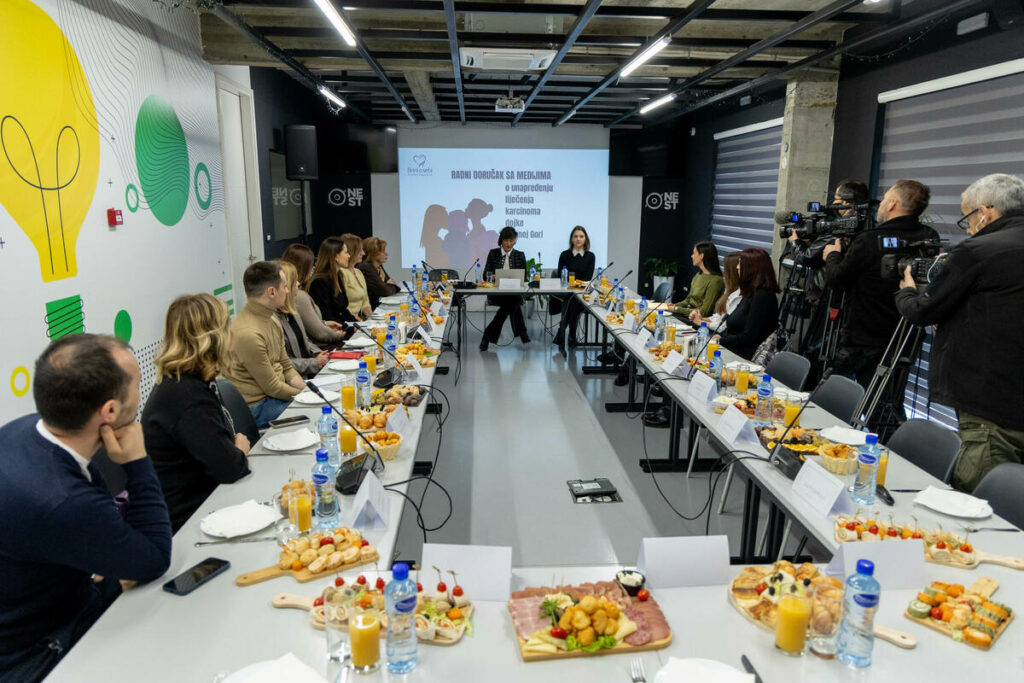
This was announced at a working breakfast of the NGO Take Care of Yourself, dedicated to the topic of improving the outcome of breast cancer treatment in Montenegro and reducing the risk of disease recurrence, which brought together representatives of key health institutions in the country.
Authorities also reminded that Montenegro has one of the highest breast cancer mortality rates in Europe – 23,2 per 100.000 women, and the main reason is late detection of the disease.
The president of the NGO Brini o sebi, Ivona Dabetić, emphasized in her opening remarks that breast cancer is the most common malignant tumor in women, but that early diagnosis and modern therapies significantly increase the chances of a cure. She pointed out that one in two patients may experience a recurrence of the disease in the first five years, and the risk lasts for decades, which is why the availability of optimal treatment is crucial. Dabetić reminded that women go through numerous emotional challenges after treatment, including the fear of the disease returning, and pointed out the importance of psychosocial support.
Dr. Adrijana Vujović from the Institute of Public Health of Montenegro said that “Montenegro has one of the highest mortality rates from breast cancer in Europe – 23,3 per 100.000 women, which is significantly above the European average of 14,5”. She pointed out that the mortality rate in Serbia is 18,5 per 100.000 women, in BiH 15, in Albania 14,5, and in Croatia around 11 per 100.000 women.
According to her, the main reason for the high mortality rate is late detection of the disease, as a large number of women are diagnosed at a late stage.
Vujović recalled that studies show that breast cancer mortality in Montenegro has been increasing for decades, with a particularly pronounced risk in women aged 55 to 64. She particularly emphasized the importance of prevention.
“Screening mammography allows the detection of breast cancer in women without symptoms of the disease, at an early stage when treatment is most effective. Early screening saves lives.” She also pointed out that 198 cases of breast cancer were detected through screening from 2016 to the end of 2024.
Ministry of Health representative Dr. Jovana Novaković said that the department is working to constantly improve the availability of modern therapies and that the list of medicines is revised three times a year. She explained that during each revision, about 30 new medicines are added to the list.
She emphasized that Montenegro can boast a good List of Medicines, but that there is always room for improvement, especially due to the increasing number of innovative therapies in the field of oncology.
Speaking about the role of modern therapy, Dr. Sanja Lekić emphasized that innovative drugs, especially adjuvant (postoperative) therapies for early cancer, reduce the risk of disease recurrence and increase the chance of cure. In this way, she explained, the progression of the disease to metastatic disease is prevented and patients are given a chance for cure.
She also pointed out that this need is most pronounced in the most common subtype of breast cancer.
“This is especially true for the subgroup of cancers that occurs in the largest number of women (HR+/HER2–), as many as 70 percent. In them, innovative therapies reduce the risk of disease recurrence in a third of patients,” she said. Dr. Lekić warned that in one third of women with early breast cancer, the disease returns, often as metastatic disease, of which half of them have the disease within five years.
“We have one chance to cure breast cancer, and that is in the early stages of the disease, before recurrence or metastatic disease occurs, and we must not miss it. Women in Montenegro deserve the same access to medicines as women in Albania, Bosnia and Herzegovina, Croatia, Romania and Bulgaria,” she said.
The Director of the Institute of Oncology of the Croatian Cancer Society, Dr. Gordana Bašović, emphasized that the goal of treatment in the early phase is always cure, not just disease control. She reminded that this is achieved through multidisciplinary teamwork that includes surgeons, oncology treatment teams, radiotherapists, radiologists and pathologists. She also pointed out the economic aspect of late treatment.
“Studies conducted in the countries of the region and the EU show that a significant portion of the costs related to breast cancer are indirect costs, ranging from 3 to 42 percent, such as loss of working capacity, disability pensions, and additional costs for the patient and family. At the same time, as much as 70 percent of direct costs are incurred for the care of metastatic disease and its complications.”
The representative of the Health Insurance Fund, Ružica Milutinović Đurišić, emphasized that investing in the early stage of the disease is the most rational approach. “Early treatment is more cost-effective and efficient, because it is time-limited and predictable, while metastatic cancer brings long-term and significantly higher costs. The outcomes are certainly much better, and pharmacoeconomic analyses clearly speak in favor of the years of life gained, quality years of life and a reduction in the overall burden of the disease.”
Dabetić presented the organization’s programs: emotional support workshops, the project “Empowered – Life and Career after Breast Cancer” and activities as part of the Race for the Cure initiative. She emphasized that women go through strong psychological challenges during and after treatment and that continuous support is just as important as medical treatment. Dabetić also presented the plans of the NGO Brini o sebi for the coming year, announcing the second ANIMA conference on women’s health and the development of a new project dedicated to research and education in providing psychological support to women.

News