
 Close
Close
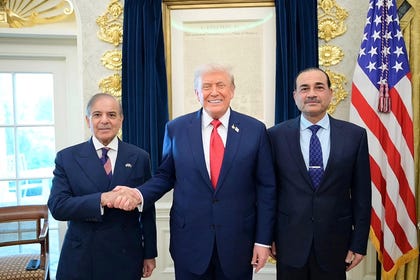
This handout photograph released by Pakistan’s Prime Minister Office on September 26, 2025, shows Pakistan’s Prime Minister Shehbaz Sharif (L), Army Chief and Field Marshal Syed Asim Munir (R) posing with U.S. President Donald Trump (C) at the White House in Washington, D.C. Credit: Pakistan’s Prime Minister Office/AFP Photo
This handout photograph released by Pakistan’s Prime Minister Office on September 26, 2025, shows Pakistan’s Prime Minister Shehbaz Sharif (L), Army Chief and Field Marshal Syed Asim Munir (R) posing with U.S. President Donald Trump (C) at the White House in Washington, D.C. Credit: Pakistan’s Prime Minister Office/AFP Photo
Pakistan’s most powerful military chief in decades, Field Marshal Asim Munir, is expected to fly to Washington to meet U.S. President Donald Trump in the coming weeks for a third meeting in six months that will likely focus on the Gaza force, two sources told Reuters, one of them a key player in the general’s economic diplomacy.
Many countries are wary of the mission to demilitarize Gaza’s Islamist militant group Hamas, which could drag them into the conflict and enrage their pro-Palestinian and anti-Israeli populations.
But Munir has built a close relationship with Trump to repair years of mistrust between Washington and Islamabad. In June, he was rewarded with a White House lunch – the first time a U.S. president hosted Pakistan’s army chief alone, without civilian officials.
“Not contributing [to the Gaza stabilization force] could annoy Trump, which is no small matter for a Pakistani state that appears quite keen to remain in his good graces – in great part to secure U.S. investment and security aid,” said Michael Kugelman, Senior Fellow, South Asia at Washington-based Atlantic Council.
Pakistan, the world’s only Muslim country with nuclear weapons, has a battle-hardened military having gone to war with arch-rival India three times and a brief conflict this summer. It has also tackled insurgencies in its far-flung regions and is currently embroiled in a bruising war with Islamist militants who it says are operating from Afghanistan.
Pakistan’s military strength means “there is a greater pressure on Munir to deliver his capacity,” said author and defense analyst Ayesha Siddiqa.
Over the past few weeks, Munir has met military and civilian leaders from countries such as Indonesia, Malaysia, Saudi Arabia, Turkey, Jordan, Egypt and Qatar, according to the military’s statements, which Siddiqa said appeared to be consultations on the Gaza force.
Pakistan’s military, foreign office and information ministry did not respond to questions from Reuters. The White House also did not respond to a request for a comment.
Pakistani Foreign Minister Ishaq Dar said last month that Islamabad could consider contributing troops for peacekeeping but disarming Hamas “is not our job.”
But the big concern at home is that the involvement of Pakistan troops in Gaza under a U.S.-backed plan could re-ignite protests from Pakistan’s Islamist parties that are deeply opposed to the U.S. and Israel.
The Islamists have street power to mobilize thousands. A powerful and violent anti-Israel Islamist party that fights for upholding Pakistan’s ultra-strict blasphemy laws was banned in October, but its ideology is still alive.
The party of former jailed premier, Imran Khan, whose supporters won the most seats in the 2024 national elections and has wide public support, also has an axe to grind against Munir.
Abdul Basit, Senior Associate Fellow, S. Rajaratnam School of International Studies in Singapore, said if things escalated once the Gaza force was on the ground, it would cause problems quickly.
“People will say ‘Asim Munir is doing Israel’s bidding’ – it will be foolhardy of anyone not to see it coming.”