
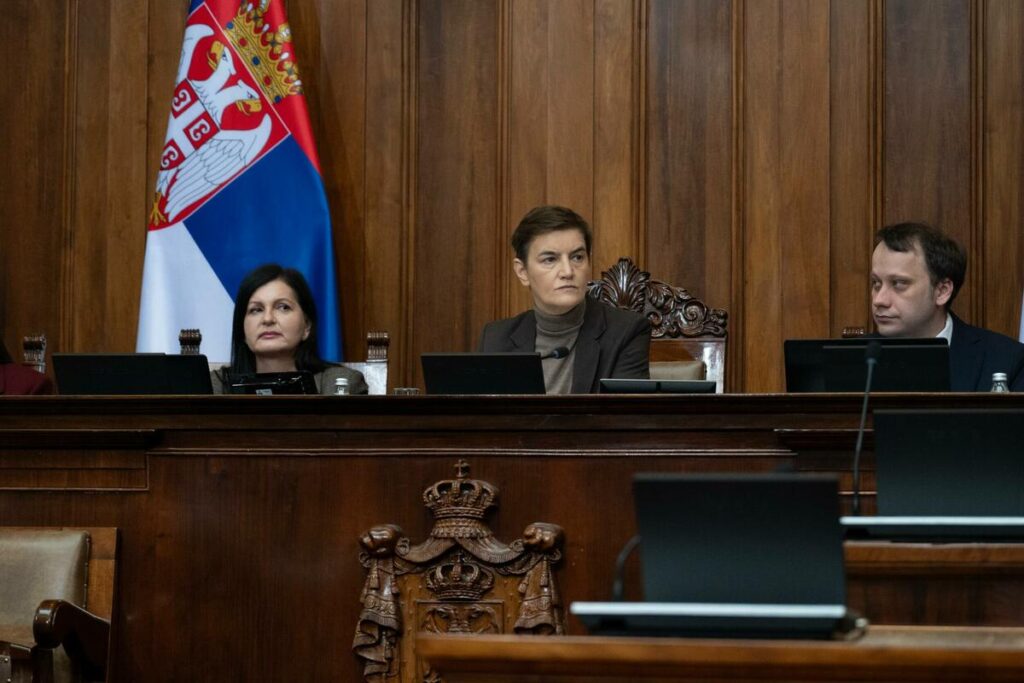
At a session of the Serbian Parliament, the Speaker of the Parliament, Ana Brnabić, responding to the opposition’s remarks that Montenegro and Albania have made more progress than Serbia on the European path, said that Montenegro and Albania do not have an opposition that goes abroad to complain and “slander” their country.
“You know what you don’t have in Montenegro and Albania? You don’t have people like you. You don’t have those who walk, run, whine, complain, pray, that this country doesn’t progress. Well, you don’t have that, and that’s actually the key and fundamental difference between Serbia and these other partners in the region. You, such an opposition and such blockers, don’t exist anywhere,” Brnabić said, as reported by Tanjug.
She also assessed that the only success of the opposition in Serbia is in stopping that state.
“It’s even harder for me to see you, who go to Brussels, to Strasbourg, to Berlin, to The Hague, complaining and whining and bemoaning your country, and that every success of yours is reflected in the fact that Serbia is stopped somewhere, that Serbia is criticized somewhere, that Serbia has lost something, from investments to jobs,” she said.
Speaking about other candidate countries from the Western Balkans, Brnabić pointed to some of the negative examples from those countries regarding the rule of law, such as the case of digging a tunnel to the depot of the High Court in Podgorica, for which no one was held accountable.
Deputy Speaker of the Assembly from the Alliance of Vojvodina Hungarians (SVM) Elvira Kovač said that the SVM is a Euro-Atlantic party, which is satisfied with cooperation with the SNS, responding to the MP of the Movement of Free Citizens (PSG) Ana Oreg, who asked her “why she has been supporting the radical government for a decade”, and “claims that the SVM is a pro-European party”.
“We are a minority party that participates independently in elections, wins mandates and then signs a coalition agreement, on the basis of which we agree on cooperation priorities. It is no secret that we have previously cooperated with other parties, but even then, those self-proclaimed European parties were not ready for a historic reconciliation between Hungarians and Serbs. And believe it or not, the SNS and Aleksandar Vučić personally were ready for that. That is why he recently received an award named after our late President Istvan Pastor. So, as far as cooperation is concerned, it is fruitful and we are satisfied with it,” said Kovač.
She pointed out that Serbia is technically ready for the opening of Cluster 3, and that this has been emphasized for the fifth time in the European Commission’s report.
“In addition, we must emphasize that, not so much loved by you, Hungary, during its Hungarian presidency, managed to reach a non-paper in which Serbia assumed certain obligations and has fulfilled most of them to date,” said Kovač.
When asked by Oreg how she would comment on Serbian President Aleksandar Vučić’s decision that Serbia would not have a representative at the EU-Western Balkans summit for the first time this year, Kovač replied that she understood the decision and pointed out that countries that are skeptical still have no understanding for almost anything when it comes to Serbia.
The head of the SNS parliamentary group, Milenko Jovanov, commented on Oreg’s statement in which she stated that EU Enlargement Commissioner Marta Kos said that only a democratic Serbia could join the Union, and pointed out that this meant that Serbia would never join the EU if it were led by the opposition.
“In a thousand years, it would not be able to enter the EU, because you are not for a democratic country, but for terrorism, for violence, for intrusion into institutions, for blockades,” said Jovanov.
Bojan Torbica, a member of the “Healthy Serbia – Movement of Socialists” group, commented on the European Commission’s report on Serbia and said that the EU does not want Serbia as a member, and that it does not want it as an equal partner.
“I think it has long been clear that the EU does not expect reforms from Serbia, but subservience,” said Torbica, who agreed with Vučić’s decision to have Serbia unrepresented at the EU-Western Balkans summit.
In response to ZLF MP Radomir Lazović’s statement that Serbia’s absence from the Brussels summit represents “a sign of the collapse of Vučić’s foreign policy of sitting on four chairs,” Jovanov responded that Serbia’s foreign policy is focused on protecting the interests of the state and its citizens.
“Our foreign policy is multi-vector, and there is only one chair, the chair of the state of Serbia,” said Jovanov.

News