
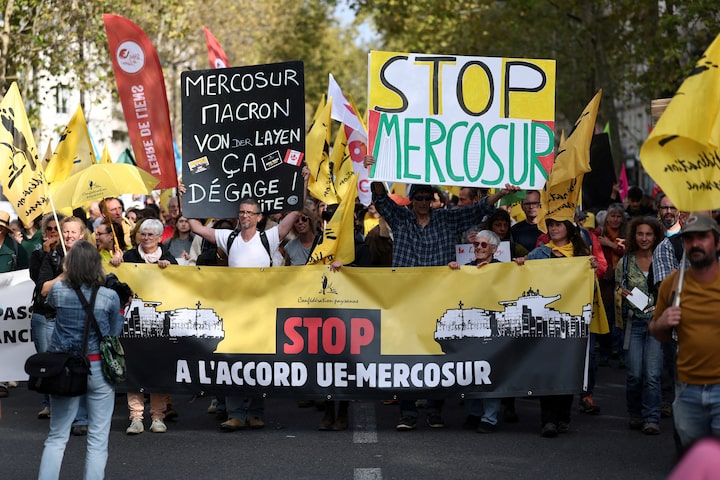
Germany and Spain urged the European Union on Thursday to move ahead with a long-delayed trade agreement with South America’s Mercosur bloc, while France maintained its opposition, warning the deal is not yet ready to be signed.
The proposed EU–Mercosur agreement, concluded last year after nearly 25 years of negotiations, would be the EU’s largest trade deal in terms of tariff reductions. Supporters argue it is increasingly necessary as U.S. tariffs rise and China tightens export controls, particularly on critical raw materials, News.Az reports, citing Reuters.
German Chancellor Friedrich Merz said the pact would strengthen Europe’s economic and geopolitical position, while Spanish Prime Minister Pedro Sánchez warned that delaying the deal would undermine the EU’s credibility in global trade. Both leaders stressed the need to diversify trade partners and reduce strategic dependencies.
France, however, remains firmly opposed. President Emmanuel Macron said the agreement fails to guarantee fair competition for European farmers, insisting on full reciprocity in production standards. France fears that imports of beef, sugar and poultry from Mercosur countries could undercut domestic producers.
Poland, Italy, Belgium, Austria and Hungary have also voiced concerns, raising doubts over whether the agreement can secure the required backing from EU member states. While the European Commission has proposed safeguards to limit imports of sensitive agricultural products, Macron said these measures are insufficient.
Farmers’ protests underscored the political sensitivity of the issue, with tractors blocking roads near EU institutions in Brussels as leaders met. Demonstrators warned that the deal could damage Europe’s agricultural sector, highlighting the growing divide within the EU over the future of the Mercosur pact.