
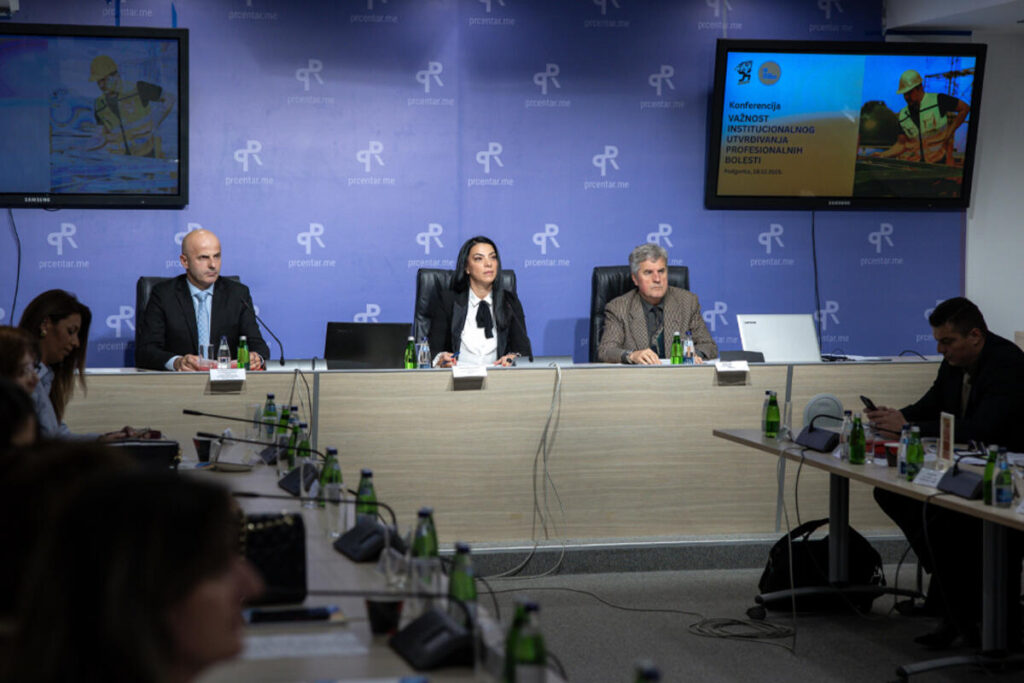
Montenegro urgently needs to establish a functional institutional mechanism for determining occupational diseases, and the Ministry of Health announced that occupational medicine will be institutionally developed within the Institute of Public Health, where a special office with a commission of doctors will be formed next year, which will, among other things, have the role of a reference institution for determining occupational diseases.
This was announced at the conference “The Importance of Institutional Determination of Occupational Diseases”, which was organized by the Union of Free Trade Unions of Montenegro (USSCG) in partnership with the Ministry of Labor, Employment and Social Dialogue, reports PR Center.
Deputy Secretary General of the USSCG Ivana Mihajlovic She recalled that since 2015, the trade union headquarters has been advocating the formation of a reference institution that would deal with the identification and verification of occupational diseases in Montenegro, while this initiative has been further intensified since 2020, during the coronavirus pandemic.
“From 2020 to today, we have sent at least four initiatives to the relevant departments: the Ministry of Health, the Ministry of Economic Development, the Ministry of Labor and Social Welfare, as well as the Ministry of Finance, because we believe that without secured financial resources, it is not possible to talk about adequate institutional arrangements,” said Mihajlović.
She recalled that the USSCG, through the Strategy for Improving Occupational Safety and Health, has continuously insisted on strengthening occupational medicine and the need to establish an Institute for Occupational Medicine or at least an interim solution that would enable employees to exercise their rights related to occupational diseases.
“Today we have rights prescribed on paper, but due to the lack of an institutional mechanism, we cannot realize these rights in practice,” Mihajlović emphasized.
Speaking about the legislative framework, she recalled that the USSCG has been pointing out for years the need to amend the 2004 Regulations on Occupational Diseases, calling for the introduction of an open or semi-open list of diseases, as well as real mechanisms for their determination.
“The regulation was amended in 2022, for the first time in almost two decades, which we consider a positive development. However, we still do not have an institution that diagnoses and recognizes occupational diseases,” she said, adding that social partners were not directly involved in the amendment process.
Mihajlović also recalled the USSCG’s 2014 initiative to recognize stress and its consequences as an occupational disease, stating that in 2019 the World Health Organization included burnout syndrome in the international classification of diseases.
“This confirms that our initiatives are justified and professionally based, but also that a lot of time often passes before they reach the agenda of decision-makers,” said Mihajlović.
She also pointed to data from the International Labor Organization, according to which occupational diseases are the leading cause of death at work, with almost six times the number of deaths compared to work-related injuries.
“In Montenegro, we do not have official statistics on occupational diseases. According to our knowledge, not a single occupational disease has been recorded since 2015, while about a dozen were registered in the period from 2009 to 2015. This clearly indicates serious systemic problems,” Mihajlović assessed.
She concluded that improving occupational health is of key importance, emphasizing that only a healthy worker can mean a healthy society, and that the goal of the USSCG is to have an open and constructive dialogue on these topics with all relevant stakeholders.
Secretary General of the USSCG Srđa Keković He said that it is high time for Montenegro to take the first concrete step towards establishing the Institute of Occupational Health, an institution that, as he emphasized, is of key importance not only for the world of work, but also for society as a whole.
He recalled that unions have been insisting on this topic for more than a decade, but that previous governments have not shown sufficient listening.
“Politics, religion and nation are always in the foreground, while almost no one is concerned with the lives and health of employees. Strategic documents talk about strengthening the healthcare system and safe workplaces, but in practice there is not a single concrete measure leading to the formation of the Institute for Occupational Health,” said Keković.
He pointed out that Montenegro does not have a unified and codified record of occupational injuries, occupational diseases and work-related illnesses, which is the basis for a serious system of protecting the health of employees, especially those who work in risky conditions.
Keković emphasized that the absence of such a system produces enormous costs for employers, the state, and the families of employees.
“When an employee falls ill with an occupational disease, the employer loses the worker, does not have an adequate replacement, the state bears the costs of sick leave, and the family is left with reduced income. It is a chain of losses that could have been prevented,” he pointed out.
Director of the Directorate for Occupational Safety and Health at the Ministry of Labor, Employment and Social Dialogue Aleksandar Memcevic He said that occupational diseases represent one of the “silent, yet most dangerous” risks of modern work.
Their correct, timely and objective determination, as he emphasized, is not just a medical procedure, but a prerequisite for exercising workers’ rights, planning preventive measures and building a sustainable labor policy.
“Institutional identification of occupational diseases is one of the key pillars of a modern system of occupational health and safety. In this way, we ensure the protection of workers’ rights based on real risks, strengthen the preventive actions of employers and institutions, improve records and analytics, as well as more efficient creation of public policies and regulations,” said Memčević.
He emphasized that this process requires coordinated and partnership cooperation between all participants, unions, the state, the healthcare system, and employers.
Memčević warned that modern challenges, such as digitalization, new forms of work, and changes in industry, impose the need for constant improvement of the occupational health and safety system.
“Today we are starting a conversation that I believe will contribute to building a system in which the health of workers is the highest priority, not just a legal obligation,” said Memčević.
Director General of the Directorate for Health Protection, Regulated Professions and Supervision of the Functioning of Professional Regulatory Bodies at the Ministry of Health Ognjen Delic He said that the department plans to institutionally develop the field of occupational medicine within the Institute of Public Health, as part of the tertiary level of health care.
He recalled that Montenegro has been trying to establish an Institute for Occupational Health for more than 40 years, but that model has never fully taken off.
“Due to the limited number of professional staff and the relatively small population, the Ministry has opted for a model that already exists in several European countries, which involves the integration of occupational medicine into the Institute of Public Health. Occupational medicine is, in essence, public health. It is partly linked to the Ministry of Health, and partly to the Ministry of Labor. That is precisely why we believe that the Institute of Public Health is the most rational and sustainable solution,” said Delić.
According to him, a special occupational medicine office will be established within the Institute, which will begin operating next year.
“It is planned that it will be composed of a commission of three doctors, which will have a clearly defined annual work plan. One of the key tasks of the new structure will be the development and implementation of regulations relating to occupational injuries and occupational diseases, as well as the role of the reference institution for their determination,” Delić added.
He explained that determining occupational diseases is an extremely complex process and requires a multidisciplinary approach, expertise, and adaptation of European models to the domestic context.
“We cannot mechanically adopt solutions from other countries. The best models should be adapted to the specificities of Montenegro,” said Delić, citing an example of the different treatment of certain health conditions in European practice.
The Institute of Public Health, as he explained, already has the necessary infrastructure, including a modern toxicology laboratory that has been in operation since last year, which allows for the implementation of all necessary analyses and procedures.
Delić pointed out the importance of including all relevant stakeholders in this process: the Ministry of Labor, the Ministry of Social Welfare, the Pension and Disability Insurance Fund (PIO), unions, employers and the professional community. He announced that all interested parties would be invited to participate in the work of the working group and be active partners in the further development of occupational medicine.
“This should not be seen as a temporary solution, but as a long-term and sustainable model that should bring concrete results,” said Delić.
Acting Assistant Director of the Insurance Implementation Sector of the Pension and Disability Insurance Fund Milka Vranes She said that in the last twenty years, the records of that fund have not recorded a single case of disability pension received on the basis of an occupational disease.
As she explained, the right to a disability pension can be realized as a result of illness, professional illness or work-related injury, but in practice, cases of disability caused by illness or work-related injury dominate.
“The fund does not have any insured persons who have submitted complete documentation with the necessary expertise for occupational diseases,” Vraneš pointed out.
According to her, there were several cases of workers at the Aluminum Plant in 2004 and 2005 who submitted expert reports from institutes in Serbia, but after that period, such documentation no longer arrived.
Speaking about the interest of insured persons in this type of right, Vraneš said that the Pension and Disability Insurance Fund acts exclusively on submitted applications, stating that she cannot speak about the extent of interest. As she added, the likely reason for the lack of applications is the inability of insured persons to provide the prescribed medical documentation, including the necessary expertise in cases of occupational diseases.
Occupational medicine specialists, individually and on behalf of the Association of Occupational Medicine and Radiological Protection Specialists, highlighted the challenges they face in their work, reports PR Center.
Currently, according to them, there are 24 occupational medicine doctors in Montenegro. A particular problem is the fact that the majority of them are obliged to work part of their working hours in the service of the chosen doctor, while the remaining part of their working hours or as additional work they work in the occupational medicine service.
However, they assess that significant progress has been made by the Ministry of Health in the previous period. It was particularly emphasized that the new Law on Health Care for the first time provides that the Institute of Public Health also performs tasks related to the implementation of health posts in the field of employee health care (occupational medicine), which created the prerequisites for the institutional organization of occupational medicine within the Institute. They assessed their participation in the creation of by-laws in this area as significant, pointing to the complexity of the matter, the importance of occupational medicine and the fact that specialization in this area lasts four years, and subspecialization takes an additional two years.
All participants considered the conference an extremely important step in a series of steps towards achieving the set goal. All participants agreed that it is particularly important to establish an institutional framework for the recognition and determination of occupational diseases, and welcomed the initial but significant steps taken by the Ministry of Health in this regard.
The USSCG will, as stated, continue to appeal to the Government and all decision-makers to devote additional attention to this topic and accelerate the initiated processes with the direct involvement of social partners and the entire civil sector in the processes. These processes must necessarily include the creation of a more adequate environment for the life and work of occupational medicine specialists, it was concluded in the end.
The conference was organized in partnership with the Ministry of Labor, Employment and Social Dialogue within the framework of the Action Plan 2025 of the Strategy for Improving Occupational Safety and Health in Montenegro 2022-2027.

News