
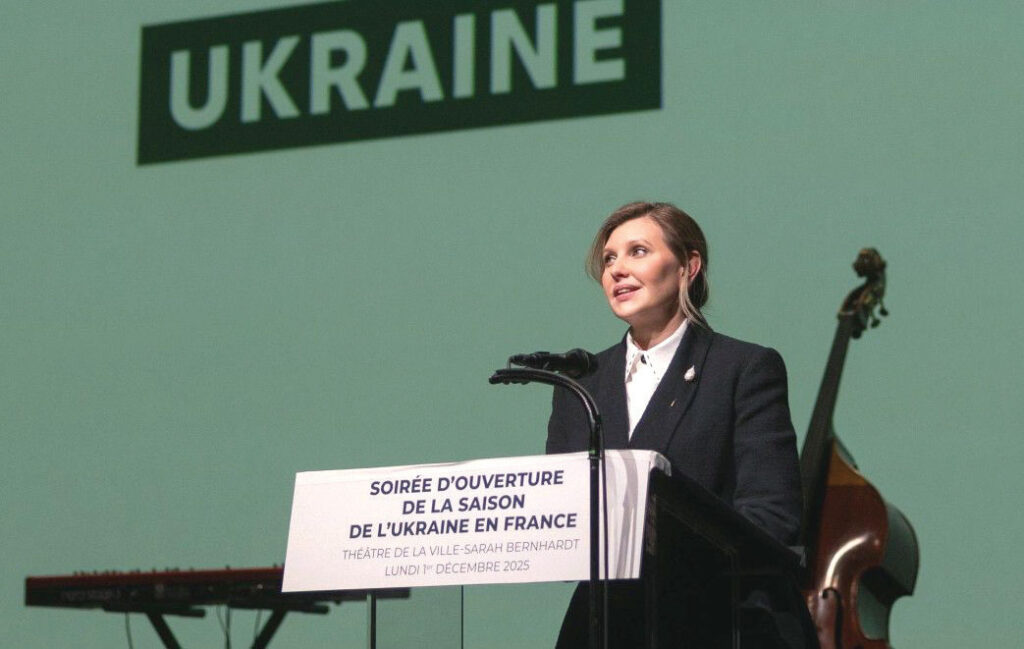
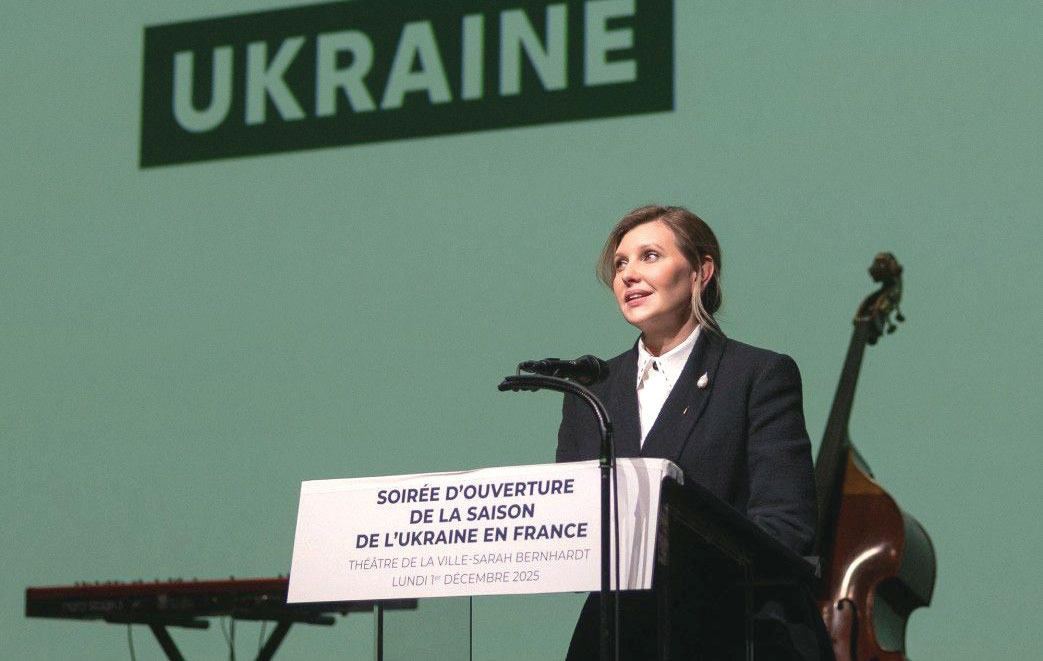
 Ministry of Culture of Ukraine First Lady of Ukraine Olena Zelenska addresses the audience during the opening ceremony of Ukraine’s cultural season at the Théâtre de la Ville in Paris on December 1.
LVIV – A major Franco-Ukrainian cultural initiative titled Le Voyage en Ukraine (Voyage to Ukraine) launched in Paris on December 1 and is set to run through March 2026, placing Ukraine in the forefront of cultural discussions of multiple French cities.
Organizers describe the season as the largest bilateral cultural undertaking in the history of diplomatic relations between Ukraine and France, with a program of roughly 50 events spanning cinema, music, theater, exhibitions, literature and public discussions on issues closely tied to wartime Europe, including human rights, security, memory, heritage, mental health and countering disinformation.
The opening ceremonies and inaugural events unfolded in Paris with high-level political and cultural participation from both countries.
Attendees at the launch included First Lady of Ukraine Olena Zelenska and First Lady of France Brigitte Macron, as well as Ukraine’s Foreign Affairs Minister Andrii Sybiha, France’s Minister for Europe and Foreign Affairs Jean-Noël Barrot, France’s Minister of Culture Rachida Dati, Paris Mayor Anne Hidalgo, Institut Français President Eva Nguyen Binh, and Ukrainian Institute Director General Volodymyr Sheiko.
Alongside official remarks, the inaugural night brought together artists and cultural figures from France and Ukraine for joint performances and collaborations presented under the slogan “La culture contre-attaque!” (“Culture fights back!”).
In her remarks at the opening, Ms. Zelenska framed the season as more than a cultural showcase, tying its importance to Ukraine’s struggle for survival and the need for international understanding.
“Right now, in this difficult time for Ukraine, in a time of struggle for existence, when our culture sounds abroad, we understand that we are not alone,” she said. “And that the entire civilized world shares the values we are defending now. That is why culture is so important. It creates understanding through feelings, establishes dialogue even without words.”
French officials, meanwhile, emphasized that the season is intended to highlight the political and strategic importance of cultural identity during wartime.
Mr. Barrot said the season “will bring Ukrainian cultural identity to the forefront in France, reminding everyone that war is not fought only with tanks and cannons, but also with the weapons of the mind.”
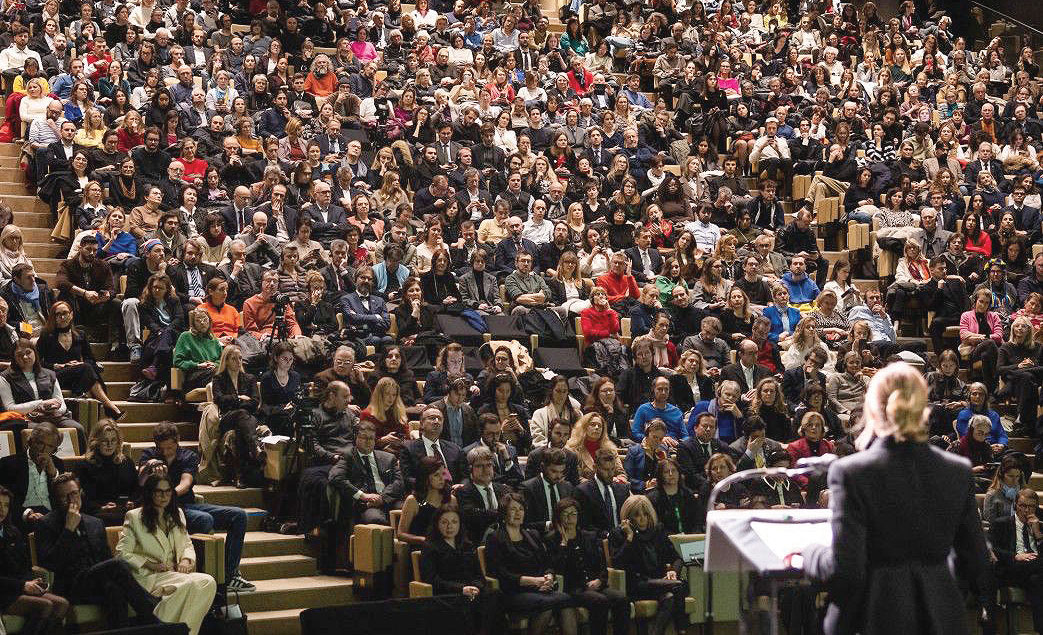 Ministry of Culture of Ukraine A full house attends the opening night of Ukraine’s cultural season at the Théâtre de la Ville in Paris, marking the launch of a months-long program of Ukrainian events across France.
Mr. Sybiha, speaking about the initiative earlier and again during the season’s launch period, argued that cultural exchange is part of Ukraine’s resilience and security, calling Ukrainian culture “a key element of our strength, our security, and our protection.”
“Through the Ukrainian Season in France, we will present Ukrainian culture and art to the French public in all their uniqueness and authenticity. Better mutual understanding between our cultures will strengthen ties between our peoples and our countries,” he said.
The program is planned to take place across a large physical expanse, reflecting an effort to expand Ukraine’s cultural presence beyond Paris and to build lasting institutional ties.
The main program lists events in French cities including Paris, Marseille, Lille, Rennes, Lyon, Metz, Toulouse, Nantes, Caen and Strasbourg, with promotional materials also describing a broader footprint that reaches additional locations.
According to the Ukrainian Institute, a central feature of the season is cooperation built through horizontal partnerships, including projects linked to sister-city relationships.
Organizers have described the season as intentionally multidisciplinary as it aims to create a coherent narrative rather than a scattered series of isolated cultural appearances.
Mr. Sheiko said the season differs from a set of separate events because it carries a unifying idea and recurring narratives intended for French society through cultural projects, dialogue programs and information campaigns.
“This is reflected in the season’s slogan ‘Culture fights back,’ because for Ukraine culture is not entertainment, luxury or an optional addition to everyday life, but the core of our resistance, resilience and struggle for freedom,” he said.
He also stressed that the program is designed to reflect the “many voices” of Ukrainian artists, scholars and activists, including those serving in the Armed Forces. It presents the season as a chance for audiences from across France to encounter Ukraine in places where Ukrainian cultural visibility has been limited.
Institut Français President Nguyen Binh pointed to a growing curiosity among French audiences since the start of Russia’s full-scale invasion, while suggesting the season responds to a continuing demand for deeper understanding of different cultures.
“The French public shows great interest in Ukrainian culture and contemporary realities,” she said.
She noted that, after the full-scale invasion began, many in France asked how to learn more about Ukraine – its people, culture and artists – and added that, while awareness has increased as Ukraine-focused events have multiplied, “there is still much to discover and understand.”
The public program features a diverse mix of high-profile performances, retrospectives and discussions designed to connect cultural experiences with questions of war, identity and Europe’s future.
In Paris, organizers highlighted a four-day forum that took place on December 10-13 at the Théâtre de la Concorde devoted to human rights, security, women’s rights during war and Russia’s war crimes, with announced participants including Maksym Butkevych, Oleksandra Matviichuk and Stanislav Aseiev.
Alongside these discussions, the season’s broader calendar includes cinema events and retrospectives, concerts featuring Ukrainian composers, theatrical performances and exhibitions that address cultural heritage and the politics of memory.
Among the events described in Ukrainian Institute materials is a major film program at the Cinémathèque Française, featuring a retrospective selection centered on Oleksandr Dovzhenko’s work, as well as discussions of his artistic legacy.
In Lille, the season’s materials feature a project presenting a painting by Illya Repin from the Kharkiv Art Museum, accompanied by a discussion on Russia’s appropriation of Ukrainian culture. The program also references performances and concerts across cities, including initiatives that bring to the fore Ukrainian music and contemporary artistic collaboration.
The season’s opening night exemplified the format that organizers say they aim to sustain: an artistic presentation paired with public conversation and international solidarity.
The inauguration featured joint performances and collaborations with participation from well-known French cultural figures such as Juliette Binoche, Michel Hazanavicius, Raphaël and Philippe Claudel, alongside Ukrainian participants including writer Andriy Kurkov, filmmaker and writer Iryna Tsilyk, artist Olha Gibelinda, bandurist Volodymyr Voyt, violinist Bohdana Pivnenko and the Dakh Daughters ensemble.
The evening’s theme – “La culture contre-attaque!” – was presented as a statement that culture can function as a place of dialogue, solidarity and resistance during war.
Institutionally, Le Voyage en Ukraine is organized jointly by the Institut Français and the Ukrainian Institute, with the support of the foreign affairs and culture ministries of both countries.
While the core schedule is presented as running from December through March 2026, specific events are expected to extend into late into March. Organizers, however, have consistently emphasized the same underlying purpose: to offer French audiences a structured way to encounter Ukraine’s cultural identity as contemporary, resilient and European, and to convert wartime solidarity into durable professional and institutional relationships.
As Ukraine continues to defend itself against Russia’s full-scale war, the season’s messaging repeatedly returns to a shared idea voiced by officials on both sides: that cultural presence abroad is not peripheral but strategic.
For Ukraine, it is presented as a tool of resilience and international understanding; for France, it is framed as an affirmation that Europe’s security and values are defended not only by military means but also through identity, memory and the public spaces created by cultural programs.