
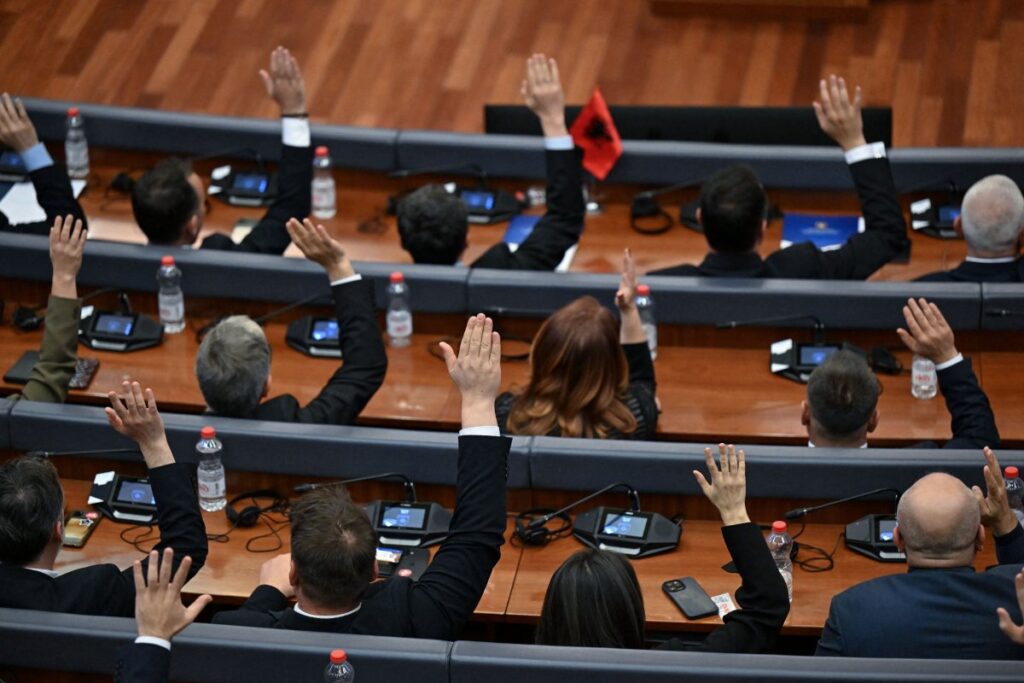

Kosovo parliamentarians vote on November 19, 2025.
Armend Nimani / AFP
Following parliamentary elections in February 2025, Kosovo descended into an institutional deadlock. The Western Balkan country was unable to form a government, triggering far-reaching consequences. Fresh elections are scheduled for the end of December 2025.
Kosovo voted on February 9, 2025, and for the first time in the history of the young democratic state, Kosovans abroad were allowed to cast their votes at diplomatic missions. Thousands of people in Switzerland also went to the polls that day: almost 4,000 people registered to cast their votes in person at the embassy in Bern and at consulates in Zurich and Geneva.
One of them was Sabahet Meta. Having fulfilled his civic duty, he left the Bern embassy on that chilly February morning full of hope. “How far we’ve already come,” he declared, referring to his country of origin.
But as 2025 draws to a close, his euphoria is no longer evident. And the same must be said for many Kosovans in Switzerland and living around the world. Their homeland is in the grip of an institutional crisis.
Kosovo has not had a new government since the parliamentary elections ten months ago. It took almost 60 attempts to elect a new speaker of parliament alone. As a result, parliament has been unable to operate correctly for over six months. At the end of October 2025, the formation of a government failed, and new elections are scheduled on December 28.
>>Read more about this topic in our reportage from February 2025.
More
More
Global elections
When Kosovo votes, so do 27,000 Kosovars in Switzerland
This content was published on
Feb 19, 2025
A large number voted for the incumbent prime minister, Albin Kurti – who is well aware of the importance of his supporters in the diaspora.
Read more: When Kosovo votes, so do 27,000 Kosovars in Switzerland
The political deadlock could be extremely costly. Kosovo is dependent on funding from the European Union to drive forward economic development and structural reforms.
However, access to EU funds is blocked due to the current crisis and Kosovo risks losing at least €170 million (CHF158 million) as a result. The country that declared its independence in 2008 remains one of the poorest in Europe.
How is it possible that state institutions have been unable to act for so long?
After the elections in February 2025, a political majority seemed clear initially: Vetëvendosje (VV), the left-wing party of incumbent Prime Minister Albin Kurti, won the elections with 42.3% of the vote. The two largest opposition parties, the Democratic Party of Kosovo (PDK) and the Democratic League of Kosovo (LDK), achieved 20.9% and 18.3% of the vote share, respectively.
However, Vetëvendosje fell short of the absolute majority it hoped for. The party had to rely on partners, but forming a coalition proved difficult.
Under Kosovo’s constitution, the speaker of parliament must be appointed first when forming a government. This seemed like a formality, but the opposition repeatedly rejected the candidate proposed by VV, Justice Minister Albulena Haxhiu. The opposition considered her to be too partisan and each election attempt failed.
Struggle for power
By July, a speaker had still not been chosen. Anger was brewing among the population and the international community expressed concerns. The US embassy in Kosovo urged parties to reach an agreement: “This ongoing deadlock is delaying progress on Kosovo’s future aspirations and is jeopardising the integrity of the institutions that the people of Kosovo fought so hard to create,” it said in a statement. “The people of Kosovo expect their leaders to fulfill their commitment to govern in the best interest of the country.”
Kosovo’s civil society has also voiced its concerns. Eugen Cakolli from the Kosova Democratic Institute said: “We raise our voices when the state is blocked and when political representatives – whether government or opposition – do not fulfil their functions.”
Experts say the deadlock reveals the deep rift between Vetëvendosje and the opposition parties. In an analysis, Kosovar political scientist Donika Emini described a political culture that has never been sufficiently consolidated, particularly in the context of elections and coalition-building, in order to prioritise government programmes. Instead, the political landscape is characterised by struggles for power, often driven by individual interests.
‘Very disappointing’
Finally, at the end of August, VV politician Dimal Basha won 73 votes of support, enough to be elected speaker of parliament. And on October 10, the parliament was able to finally begin work.
Kosovo’s President Vjosa Osmani asked Vetëvendosje to form a government. But on October 26, this failed. No party was prepared to form a coalition with Albin Kurti. The attempt to form a minority government also collapsed: the cabinet he proposed was rejected by parliament.
Sabahet Meta followed the news from Bern that day. “It’s very disappointing that we still don’t have a government after all these months. I am shocked by the stubbornness of the politicians,” he declared.
Displeasure, strikes and protests in Kosovo
Many people in Kosovo are unhappy with the current situation. Over the past few months, Pristina residents have protested the political stalemate in front of parliament, calling on those responsible to act. At the end of October, 21 civil society organisations sent a joint protest letter to Kosovo’s president. They warned of the consequences of the blockade: the longer the country remains without a functioning government, the more noticeable the consequences will be for the population.
Parts of the state budget are blocked due to the institutional crisis and demonstrations and strikes have been taking place. At the beginning of November, employees of the Kosovar public television station RTK protested the lack of wages with signs reading in Albanian: “RTK employees, not victims of the crisis.” The institutional crisis also caused a literal standstill on November 12 when public transport in the capital was suspended. Bus drivers went on strike because their wages were not being paid. Buses remained in their depots for nine days. But the pressure worked and the Ministry of Finance finally found the necessary funds.
There is huge resentment. But a key question before new elections at the end of December is: who will Kosovans blame for the institutional crisis, the current government or the opposition?
In the meantime, the ruling VV party has been campaigning intensively for the elections among the Kosovan diaspora in Switzerland. Hundreds of supporters welcomed Albin Kurti to an election rally organised by his party in Zurich in mid-December.
More
Democracy
Kosovo in Switzerland, Switzerland in Kosovo
The two small mountain countries are linked by a dense network of relationships: political, economic, historical, but above all human.
Read more: Kosovo in Switzerland, Switzerland in Kosovo
Edited by Benjamin von Wyl/adapted from German by AI/sb
Articles in this story