
Sign up for the Slatest to get the most insightful analysis, criticism, and advice out there, delivered to your inbox daily.
You’ve heard about the ice sheets melting in the Arctic—you know, the ones that are drowning polar bears, raising sea levels, and interfering with global current systems. You might not be familiar with Switzerland’s now-melted Pizol glacier. Its disappearance didn’t contribute significantly to sea level rise or the global climate, but it did affect the locals as if they had experienced the death of a loved one. In 2019 hundreds of mourners, many wearing black, attended a funeral for the glacier led by a priest and glaciologists.
Scientists who study glaciers tend to focus on ice volume loss rather than individual glaciers, says glaciologist Lander Van Tricht, because that metric has the more dire global consequences. But individual glaciers, even small ones, carry cultural, spiritual, and economic importance for locals. They’re the bedrock of many a ski resort, propping up winter tourism; the abode of gods for many Indigenous tribes; and the sites of rituals around the world, such as the Snow Star Festival pilgrimage in the Andes.
Now, for the first time, scientists have quantified the number of glaciers we’re losing—and it’s staggering. They’ve discovered that we’re already losing 1,000 glaciers a year. That rate is likely to climb. To learn more, we talked with Van Tricht, who worked on the new study. Our conversation has been edited and condensed for clarity.
Anna Gibbs: First of all, can you define for us what exactly is a glacier?
Lander Van Tricht: Glaciers are permanent ice bodies in the landscape that flow to lower elevations because of gravity or internal ice pressure. If it doesn’t flow, we don’t call it a glacier. That’s the main definition, I would say. And then the second definition, or threshold, is that it needs to be at least 0.01 square kilometer. The last glacier inventory, which is the inventory we used for this study, identified 215,000 glaciers on Earth, found in mountain regions around the world.
What causes glaciers to disappear? Do they ebb under normal circumstances?
Healthy glaciers are in equilibrium with the climate. They’re ice bodies that accumulate mass very high in the mountains. When the ice is thick enough, then it starts to flow down, where it then arrives in a warmer climate and gradually melts. So a healthy glacier gains as much mass in the upper areas as it loses in the lower areas.
As soon as you don’t accumulate enough mass anymore in the upper areas, then the glaciers start to get smaller. What we now see, because of climate change, is that these accumulation rates are getting smaller, on top of also melting more. To define when a glacier has gone extinct, we look at the area and volume of each glacier. Once the glacier is either less than 0.01 square kilometer or less than 1 percent of its initial volume, you cannot call it a glacier anymore.
We’re losing 1,000 glaciers a year right now. How much worse could it get?
In a scenario where the global climate warms by 1.5 degrees Celsius, we will eventually see that number increase to 2,000 glaciers lost per year. By 2100, that means we’ll have lost about half of all existing glaciers.
In the 4-degree scenario—our worst-case scenario—up to 4,000 glaciers could disappear every year. By 2100, that’s more than 180,000 glaciers lost, with only 18,000 remaining.
So it’s already bad but will get worse. How soon?
It depends a lot on the region. For example, mountain ranges like the Alps, Central Europe, the Pyrenees, Western Canada, the Rocky Mountains, they have a lot of small glaciers, which just don’t have enough ice-mass reserves. If there’s a couple of years in a row with large ice-mass losses, these small glaciers don’t have a buffer, and they’ll disappear. Recently, we’ve lost 10 percent or more of the glacier volume in the Alps in just five years. The small glaciers in these mountain ranges are doomed to disappear within the next 10 to 20 years, whereas other mountain ranges will experience losses further in the century.
A whole glacier disappearing is a big change in the landscape. What does that mean for humans?
Smaller glaciers don’t have a big impact on sea level rise—that’s really the big glaciers, which take a super long time to melt. But every glacier can be important. Even the smallest glacier in a very remote valley can be a tourism magnet for that valley. It can have a huge cultural value for the people living in that valley. I always compare it to, if you have seen out of your window for your whole life a glacier at the end of your valley, and one day that glacier has disappeared, that change might be minor, but it has a huge impact.
I imagine that these losses might feel personal to you too.
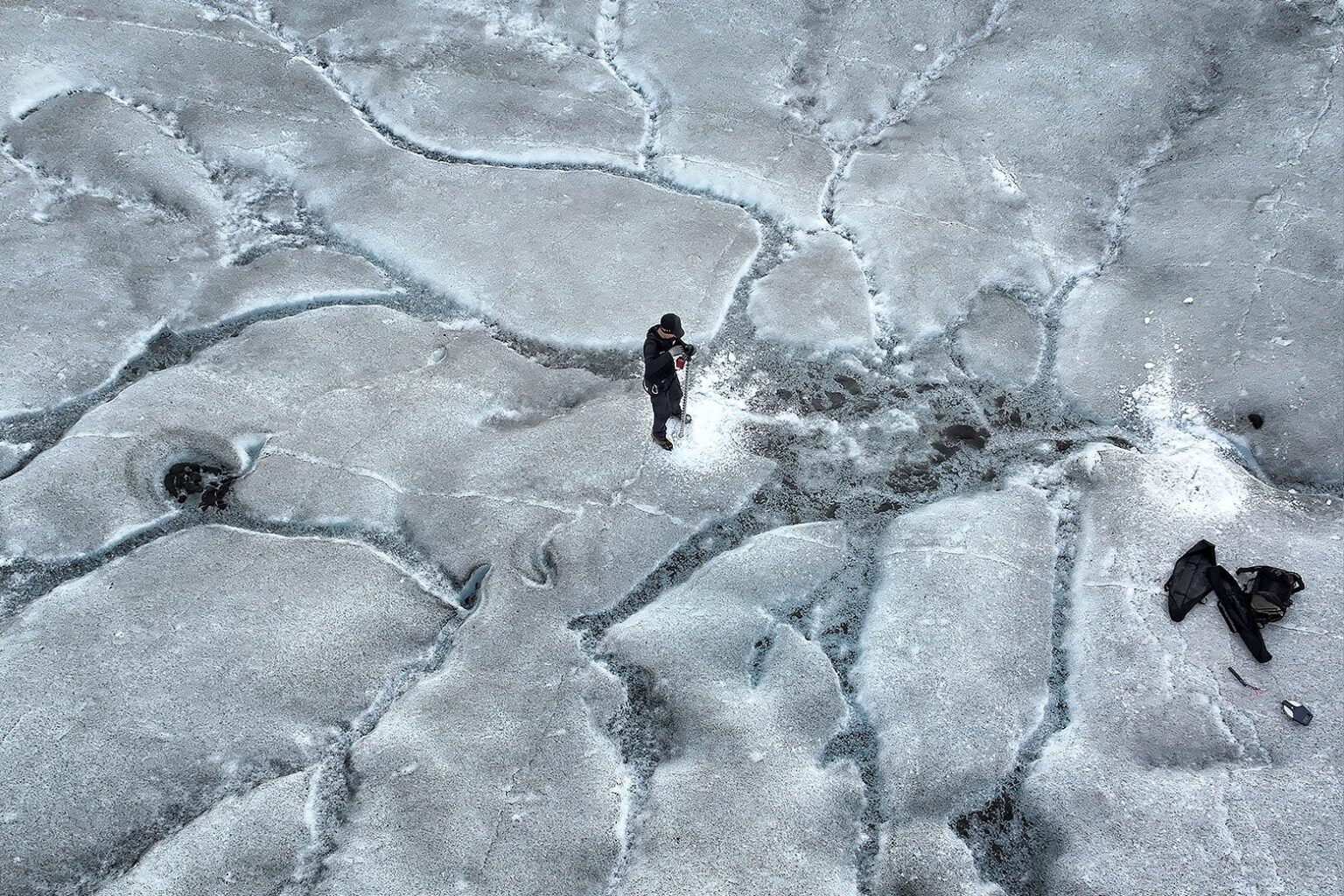
Glaciologists go to glaciers in the summer to measure how the year was. If you do it multiple years in a row, somehow you become attached to the glacier, and you’re curious how he is doing. It’s a bit like a friend, and if you then suddenly don’t need to go anymore to the glacier—because it has become so small that you have to abandon your measurement program—that can be pretty emotional, even for scientists that always try to be objective and just put the numbers forward.
Myself, I have a glacier—the Morteratsch Glacier, in southeast Switzerland, where I did my master’s thesis more than 10 years ago. We returned to the same glacier two or three times a year, and it’s always very depressing to be able to stand on a location where the year before there was still more than 10 meters of ice. You really see the collapse of the glacier happening in front of your eyes.
Marianne Lavelle
The U.S. Has a Great Warning System for Deadly Weather. Trump Wants to Destroy It.
Read More
Would it ever be possible for these glaciers to come back to life, so to speak?
The glaciers that are responding fastest now would also respond fastest to the climate cooling. So if it would get much colder, or if you would get more snow, then some glaciers could actually start to regrow again. But there’s a caveat: Some glaciers create their own climate because they increase the altitude. If you remove the glacier because of global warming, the landscape will get lower and lead to an additional warming—which means it would need to become much colder than it previously was to start that glacier growing again.
It’s sad news. Is this a time to mourn, or can anything be done?
-
The Real Reason Trump Is Dismantling the Research Center That Helps Keeps You Safe From Extreme Weather
-
This Content is Available for Slate Plus members onlyIt’s One of the Hardest Confrontations Anyone Can Have. It Might Be One Good Use of a Controversial Technology.
There are some hopeful signs here. One is that we have actually turned away from a previous worst-case scenario. A couple of years ago, we had projections for a warming of 6 degrees by the end of the century. And now we don’t show these anymore, because it’s extremely unlikely that we’ll go in that direction. Now we’re showing this 4-degree warming as worst case, and very likely we’re also not going that direction; we’re heading towards 2.7 degrees. So we are, very slowly—too slow, I would say—heading in a better direction to limit warming and to keep as many glaciers as possible.
Also, we’ve found there is a huge difference between the most optimistic and most pessimistic scenario. Every 0.1 degree of additional warming will cause us to lose thousands of additional glaciers. So if we can limit the warming to, say, 2 degrees instead of 2.7, we can save tens of thousands of glaciers. That should really be motivation to take action and not be like, We’re going to lose them anyway, it doesn’t matter anymore. It should be clear that it still matters what we’re doing today and in the years to come.

Sign up for Slate’s evening newsletter.