
Hi, Reddit! We’re a mix of comet researchers and mission team members from across NASA and our partner organizations; we’re observing comet 3I/ATLAS, the third interstellar object ever discovered passing through our solar system. These objects have long been expected to exist – our technology is just now getting better to detect them more frequently!
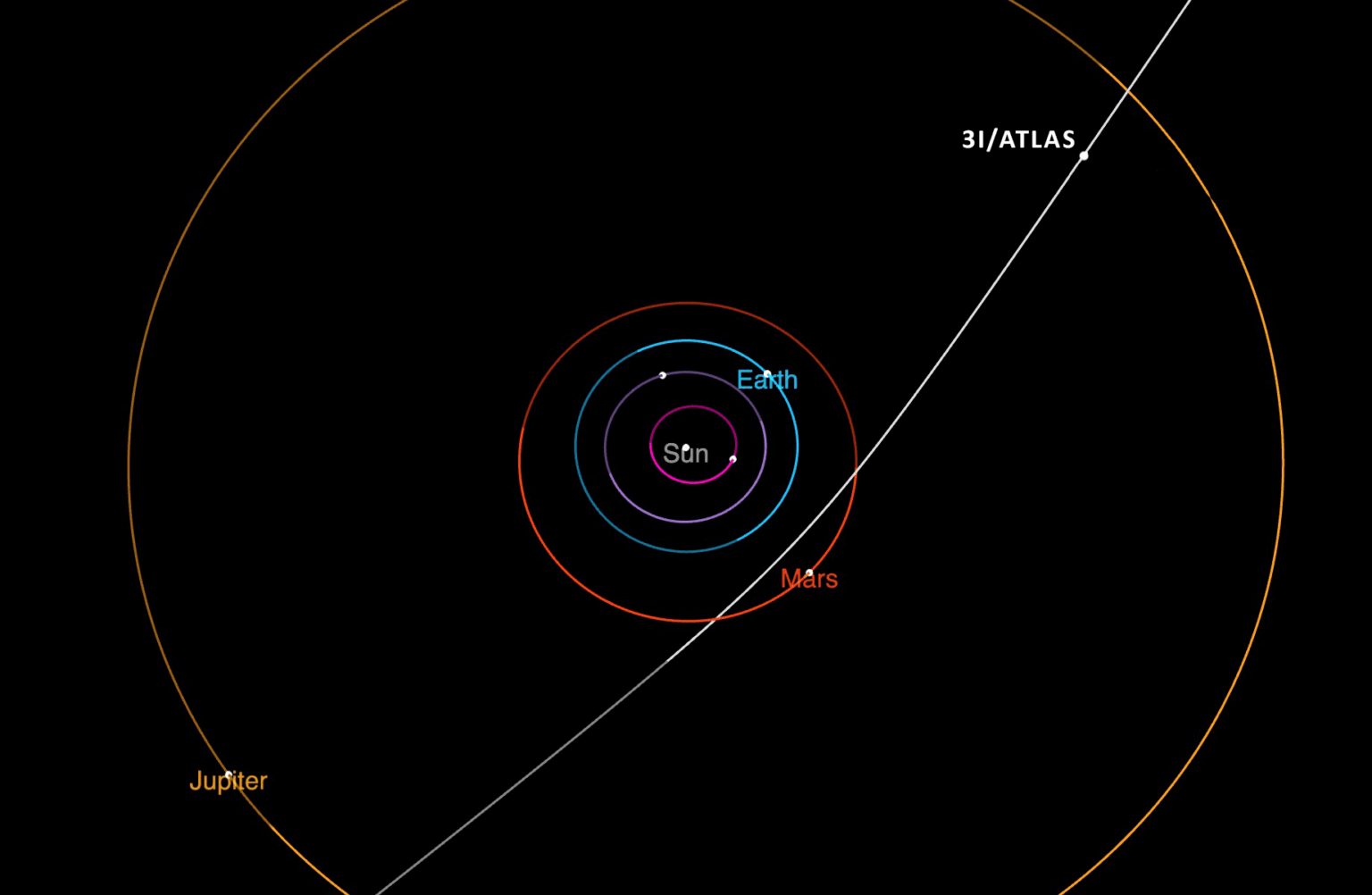
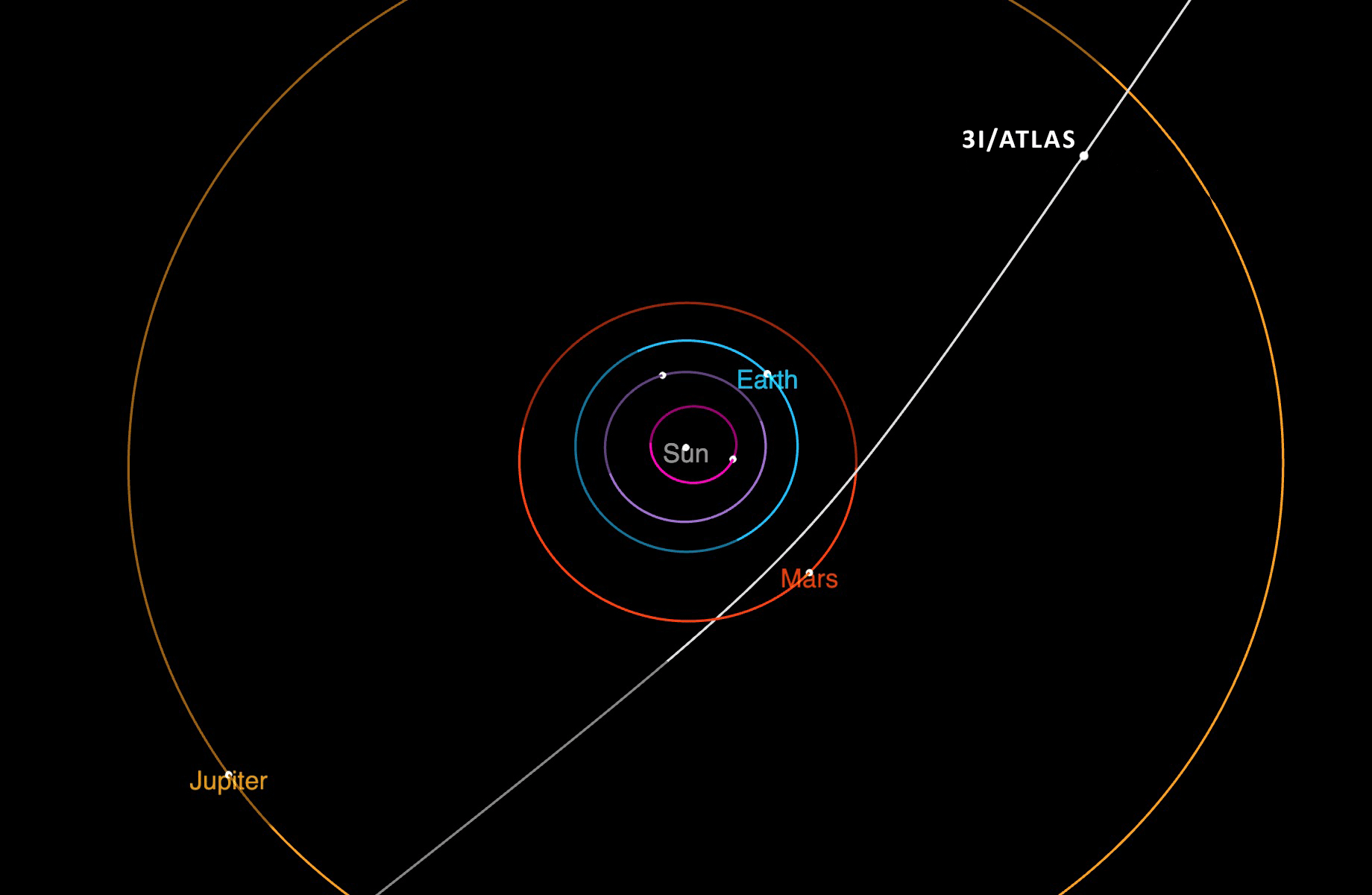
Comet 3I/ATLAS is making its closest approach to Earth on Dec. 19, but don’t worry: it poses no threat. It won’t come closer than about 170 million miles – nearly twice the distance between Earth and the Sun. What it will do is give us a unique chance to study material from another solar system and learn more about what planets elsewhere in the galaxy are made of.
Nearly 20 science missions and research teams are tracking and studying 3I/ATLAS as it moves through the solar system, and so far, everything points to it being exactly what it looks like: a really cool interstellar comet.
Curious how we study 3I/ATLAS, what we’re learning, or what questions we’re hoping to answer? Ask us anything! ☄️ We’ll be taking questions in both English and Spanish.
We are:
- Dr. Karl Battams, Principal Investigator, SOHO mission/LASCO instrument and NASA Sungrazer Project, U.S. Naval Research Laboratory (KB)
- Dr. Davide Farnocchia, Asteroid and Comet Orbit Scientist, Solar System Dynamics Group, NASA JPL (DF)
- Dr. Kathy Mandt, Lab Chief, Planetary Systems Laboratory, NASA Goddard (KM)
- Dr. Stefanie Milam, Project Scientist for Policy and Science Community, James Webb Space Telescope, NASA Goddard (SM)
- Dr. Tom Statler, Lead Scientist for Solar System Small Bodies, NASA Headquarters (TS)
- Dr. Gerónimo Villanueva, Associate Director of the Solar System Exploration Division, NASA Goddard (GV)
PROOF: https://x.com/NASA/status/2001782779130867749
We’ll be back from 1:30 – 3:00 PM EST (1830 – 2000 UTC) to answer your questions. Thanks!
AMA: We’re NASA experts studying comet 3I/ATLAS – the interstellar object passing through our solar system. Ask us anything!
byu/nasa inspace
46 Comments
If 3I/ATLAS shows elemental or molecular signatures that differ from solar system comets, what would be the most revolutionary implication for how planets and stars form elsewhere?
Would you have new observations during the closest approach to earth, today?
Hey there, Now would you perhaps be willing to answer these anomalies with proper reasoning
that we are waiting for months now
**Geometric Coincidences:**
1. The retrograde trajectory of 3I/ATLAS is aligned to within 5 degrees with the ecliptic plane of the planets around the Sun, with a probability of 0.2% (as discussed [here](https://arxiv.org/pdf/2507.12213)). This suggests that the trajectory may have been planned.
2. The arrival time of 3I/ATLAS was fine-tuned to bring it to 29 and 54 million kilometers from Mars and Jupiter, respectively, and be unobservable from Earth at perihelion (as discussed [here](https://arxiv.org/pdf/2507.12213)).
3. The forecasted perijove distance of 3I/ATLAS during its encounter with Jupiter on March 16, 2026 is 53.6 million kilometers, close to Jupiter’s Hill radius, 53.5 million kilometers (as discussed [here](https://avi-loeb.medium.com/a-remarkable-new-anomaly-of-3i-atlas-420065c2cddf)). This match includes the non-gravitational acceleration that 3I/ATLAS displayed near perihelion. The rare coincidence might mean that 3I/ATLAS intends to release technological devices at Jupiter’s Lagrange points — where fuel requirements are minimal.
4. Analysis of the Hubble Space Telescope image from July 21, 2025 (as discussed [here](https://watermark02.silverchair.com/staf2054.pdf?token=AQECAHi208BE49Ooan9kkhW_Ercy7Dm3ZL_9Cf3qfKAc485ysgAAA3YwggNyBgkqhkiG9w0BBwagggNjMIIDXwIBADCCA1gGCSqGSIb3DQEHATAeBglghkgBZQMEAS4wEQQMixQX1dT8M6VhhBncAgEQgIIDKXM7tk2vb5IeUe-V_1jKdVNBMtl12wJNSzEHmJATsLD7HzrUesPsO9FySWXGAHHDFQH0EToiHTa_wi1EmAYvprpJKf4BMcLndbRmxjWK-EUMbrqWa4ZGWV2VaE58He6E-xcpx3FNl4XkjCH-n65BbCK74-3BtJnibO1wAY4VDdqFvPLuBScPGsihsw6GVB8SVNVInvkiylkhPZ-DCzzpbuUJ3qrTzBvR-jtcYVuoeCIrROKr1EV-cRBTxvLjhiRbwDuRgYs8d4dgqQ1UbYQI40oF2ShiIN5GXjOwVusBBE0gnXSF9LdZnXR6iEcOYpXHY8bwmxJcOPHCuonNh6gwCyy0xJI2sjCjsdYaPmBqoznYLZzov8T5KIrONBr7ZnG8q7vcFkx7_A0Fki8k-cZDjLCE7qqXuRott3CKJ_4xnjmdfuSZjqBYOb7F-2JDiJV7tUYZqT7tq7EJamSJxN-feSHy6LUFKe8BPK06-aErfcj_um1kuLnYFzh11RnLkLOxb4SJaLA94k99iz9ijeXXRcCBMANtdIS1cJdRCQW4_axxa61xYwmpGwIlZlQWVuI85v_6hWtVO6HiS5RTkZMGADlN7qoUMgF6qHmoQj9QH1zbd2UJ00ayrQ1Fj2BGQ6YOJLUT6RyFgZs98v5Wj7CuW9IHXo4Zw_vle6h_ODvGeGTiXhFVACXoln39L6At-DzJRXGlJLm38vXwT8ZoPyuajjtcxbZvdJzo0bwYnJ31Wa2j4IWMIGqTgHwXdB6-y-AUIGrTSafVGdbdd6lfCtS3PRL77hRCDeOyeOrh9whGZZM1tVUrXw6gGwrNnqmoGhPOoH_Pemgg5ToVwXtAFH1PA-VtD-FBwWs-kJgWuzc05_t_hbGZDNcn-eoTBv2JKsFRXYUmCEpZxGCHD0rINXS5xxcRM6Z5lzntmsRlPfHhM6YxLhJmHBrzUbWpT4ZdGxJ6a63bqJ4VhgcSVXcmGGXieypaZ9QMOVasxB6Ex2PDrF4T9dfSOcujidcA8YKOOpg346m27AikXeRGe4TQZiGiYprMpUOk8moBBfCU5suZl2kK2X5bNKOK8e3C)) suggests that the anti-tail before perihelion must have been in the form of a tightly collimated jet that is about ten times longer than it is wide. This is similar to the tight collimation observed in the latest post-perihelion images. It is difficult to understand how the sublimation of pockets of ice as a result of illumination by sunlight would lead to tightly collimated jets out to a million kilometers. No known comet exhibited a physical sunward jet of this length. For a technological object, a beam of particles might be used to mitigate the risk from the solar wind that would otherwise impact its surface at a relative speed of order 500 kilometers per second and release a hundred thousand times more energy per unit mass than explosives.
5. At large distances, the rotation axis of 3I/ATLAS was aligned to within 8 degrees with the sunward direction when it entered the solar system (as reported [here](https://arxiv.org/pdf/2512.12819)). The probability for that is 0.5%.
6. The observed wobble of the pre-perihelion jet in the direction of the Sun (as reported [here](https://arxiv.org/pdf/2512.12819) during July and August 2025) requires the base of the jet to be within 8 degrees from the sun-facing pole, with probability of 0.5%.
You know what it REALLY is don’t you? Why aren’t you guys all over this with photos? The internet should be lit up…
7. The existence of a prominent jet towards the Sun on the way of 3I/ATLAS out of the solar system requires a similar coincidence near the opposite pole of the rotation axis. The fact that a tightly collimated jet appears as the sunward anti-tail both before and after perihelion (while reversing direction at perihelion relative to the direction of motion), has a tiny probability of occurring at random, equal to the square of 0.5% or 0.000025.
[](https://medium.com/plans?source=upgrade_membership—post_li_non_moc_upsell–e6810be9b3d8—————————————)8. The launch base of the post-perihelion anti-tail jet resided on the nightside of 3I/ATLAS before perihelion and the base of the pre-perihelion anti-tail jet is now on the nightside of 3I/ATLAS after perihelion. For these bases to be active only when facing the Sun, they must be well insulated on the nightside for a period longer than several months. However, heat would naturally flow by conduction throughout the body of a natural comet, making this insulation requirement difficult to satisfy.
9. The gravitational deflection of 3I/ATLAS by 16 degrees at perihelion, is exactly twice the opening angle of the anti-tail jet. This coincidence allows the wobbling jet around the rotation axis to generate an anti-tail in the direction of the Sun before perihelion and a counter jet on the opposite pole after perihelion, with a jet opening angle of 8 degrees on both poles.
10. 3I/ATLAS arrived from a direction coincident with the radio “Wow! Signal” to within 9 degrees, with a probability of 0.6% (as discussed [here](https://avi-loeb.medium.com/was-the-wow-signal-emitted-from-3i-atlas-d18d4f0d1f1e)).
**Composition Anomalies of the Gas Shed by 3I/ATLAS:**
11. The gas plume surrounding 3I/ATLAS contains much more nickel than iron, as found in industrially-produced nickel alloys, and a nickel to cyanide ratio that is orders of magnitude larger than for thousands of known comets, including 2I/Borisov (see [here](https://arxiv.org/pdf/2510.11779)). This might indicate a technological origin for these abundances.
12. The gas plume surrounding 3I/ATLAS contains only 4% water by mass, whereas water is a dominant constituent in familiar solar-system comets (as discussed [here](https://iopscience.iop.org/article/10.3847/2041-8213/ae0647/pdf)). The plume might have resulted from the sunlight releasing the ices and dust that accumulated on the surface of a technological object during its journey through cold dense clouds of the interstellar medium.
**Unusual Physical Properties:**
13. The nucleus of 3I/ATLAS is much more massive than [1I/`Oumuamua](https://en.wikipedia.org/wiki/1I/%CA%BBOumuamua) and [2I/Borisov](https://en.wikipedia.org/wiki/2I/Borisov), while moving faster than both (as discussed [here](https://iopscience.iop.org/article/10.3847/2515-5172/adee06/ampdf) and %5Bhere%5D(https://arxiv.org/pdf/2509.21408)). There might not be enough rocky material in interstellar space to deliver a natural iceberg of this mass once per decade to the inner solar system (as discussed [here](https://iopscience.iop.org/article/10.3847/2515-5172/adee06/ampdf)). This suggests that 3I/ATLAS may have targeted the inner solar system rather than being drawn at random from the reservoir of interstellar icebergs.
14. 3I/ATLAS shows extreme negative polarization, unprecedented for all known comets, including 2I/Borisov (as discussed [here](https://arxiv.org/pdf/2509.05181)). This unusual polarization may be related to its unusual anti-tail.
15. Near perihelion, 3I/ATLAS brightened faster than any known comet and was bluer than the Sun (as discussed [here](https://arxiv.org/pdf/2510.25035v1)).
(also when are we having clear pictures of Our friendly interstellar visitor)
Thanks
Hi NASA!
Could you tell us what is something special about this particular comet 3I/ATLAS than any others?
And how accurately do you calculate the distances and trajectories of these comets flying near us?
Thank you for the reply
Will it ever pass through our solar system again in the future at any point?
Why do you continue to call it a comet when that nomenclature is used for something with a defined specific tail pattern? Do you feel there would be a better way to refer to it, something like interstellar object?
Not going further in alien narrative still i have presented the anomalies formally presented and calculated by Prof. Avi Loeb in this comment section
and viewing it as a natural object still what answers have you gathered to explain these anomalies
[https://www.reddit.com/r/space/comments/1pqkjrd/comment/nuweqai/?utm_source=share&utm_medium=web3x&utm_name=web3xcss&utm_term=1&utm_content=share_button](https://www.reddit.com/r/space/comments/1pqkjrd/comment/nuweqai/?utm_source=share&utm_medium=web3x&utm_name=web3xcss&utm_term=1&utm_content=share_button)
[https://www.reddit.com/r/space/comments/1pqkjrd/comment/nuwetu2/?utm_source=share&utm_medium=web3x&utm_name=web3xcss&utm_term=1&utm_content=share_button](https://www.reddit.com/r/space/comments/1pqkjrd/comment/nuwetu2/?utm_source=share&utm_medium=web3x&utm_name=web3xcss&utm_term=1&utm_content=share_button)
[https://www.reddit.com/r/space/comments/1pqkjrd/comment/nuwevbw/?utm_source=share&utm_medium=web3x&utm_name=web3xcss&utm_term=1&utm_content=share_button](https://www.reddit.com/r/space/comments/1pqkjrd/comment/nuwevbw/?utm_source=share&utm_medium=web3x&utm_name=web3xcss&utm_term=1&utm_content=share_button)
due to listing all the anomalies i was not able to compact them in a single comment which made me create multiple comments so for convenience i have put them here in this one
Hope our hardworking team of scientist on whom the whole world is looking upto at this moment will answer these anomalies with proper reasoning
and thanks for working for we the people Team Nasa
I with many others are looking for answers from NASA about these anomalies
Your work is really appreciated
Also we are looking forward for better pictures of 3I/ATLAS in the coming days
Thanks once again
Wil it be possible to “chase” one of these interstellar objects and perhaps land on it, despite the ridiculously fast speed this one’s going through our solar system?
If 3i/atlas were extraterrestrial technology, would you tell us?
Can the 3i/atlas alter our system in any way?
I just finished writing my master’s thesis on using synthetic aperture radar to analyze asteroid composition.
Have you utilized radar to analyze 3I/ATLAS? If so, what kinds of data have you gleamed from it?
Do you agree it would have been more fun if it was some abandoned alien container ship? Had it been, what would have been the best way to study it, or even capture it?
What instruments and observatories were used to study 3I/Atlas, and what were the key findings?
Do we know what star system (if any) this comet came from? Or is there too much gravitational clutter between here and its origin that we can’t work that out?
Could it be part of an Exoplanet which once had life on it ? Any input from SETI ? Can we retask Hubble Telescope for better quality pics please ?
This is more of a psychology question, but I’m sure NASA has studied it.
Why do you think that interstellar objects like 3I/Atlas and topics like aliens are so divisive among the public? What is it about this topic that gets people so on edge and so passionate?
We know that NASA’s stance has been strong and stable throughout. That it’s a comet and there’s nothing to see here. —> Do you think more reporting and transparency around 3I/Atlas could have prevented some of the claims of artificial origin?
I am so incredibly grateful that you all would take the time to read through this page and answer some of our questions.
My question is, when you became aware of 3i/Atlas for the very first time, what was your gut reaction? We get all these amazing questions and answers about the incredible science you guys do, but how did you FEEL when you learned you’d have this opportunity? How did you feel when you knew you’d get another chance to study an interstellar visitor?
As just an enthusiast, I can tell you I have been following this story with so much passion and interest, I can only imagine how 3i/Atlas has changed the water cooler conversations. Keep up the amazing work and please stay curious
Can you comment on what is being done to try to combat the misinformation surrounding this comet. I’d love to get your feelings on the peddlers of misinformation like Abi Loab. What can NASA do to make sure we don’t get another Heavens Gate cult incident? Thank you for doing this AMA.
Will it get a name like ʻOumuamua did? Is there any thought of having some pre-approved names to pick from immediately after discovery, rather than having 4i/ATLAS and 5i/Rubin and 6i/Rubin and 7i/Rubin etc?
What is the current estimated size and mass of the body of 3i Atlas, how were those measurements made and what is the degree of confidence in these estimates?
Are you making plans to have a mission lying in wait, prepped and ready to go, for when **4I/<something>** eventually shows up?
Close flyby, or even sample return?
There have been other missions where we collected dust samples from comets. We’ve also had spacecraft collect samples from asteroids.
Can you talk about the difficulty / feasibility of a mission to do something similar with an interstellar object? How much advanced notice would we need? Are either of these missions possible on an object like 3I Atlas?
anyone in your line of work making any predictions about how many more of these are likely to be found now that the Rubin Observatory is online?
I’d think that these currently rare interstellar objects are much more common than we’re aware of, but that’s just a guess on my part.
I’ve read various size estimates on Atlas. Do you already have all the data to churn out your best nominal or does it take further analysis? I know the nucleus is a challenge with comets so I’m curious as to the methodology and timeline. It’s now getting farther away, so I’m unsure of how much more data will come in
what surprised your team most once you started tracking 3I/ATLAS closely?
It’s fascinating to comprehend the speed of the chicxulub impact. Is there anything limiting the speed of objects in space? Theoretically could speed be limitless?
How frustrating has Avi Loeb’s approach to studying this comet been for you in terms of fueling the Internet misinformation machine and frustrating attempts at genuine science communication.
Hello! Could we see some photos of atlas !
Do we know largely what it’s made up of?
The biggest argument for why it’s trajectory isn’t implicative is because “any trajectory is improbable”.
I see there are mission specs here, so you understand the importance of a calculated route in the scope of a mission.
Being on the ecliptic makes an intersection calculation from basically impossible to “doable if you’re really smart.” Now combined with the highest recorded speed, intersection of TWO planets, and a trajectory refinement from “agnostic, physics-based” outgassing to a tighter uncertainty band to a specific region.
It’s trajectory not only accomplishes these things, but maintains key hidden observation windows from the specific planet that contains 99% of observers in our solar system. Further more, the planets it’s intersecting are the planets WE study the most (outside our own). Not because of chance or convenience, but because those planets are inherently more implicative in the specific context of humanity and our solar system.
Routes (and here, trajectories) naturally encode information about the underlying mission plan. This information can be reversed engineered to deduce properties of the original mission plan. Things like “operational efficiency, observational obfuscation, key target proximity”. These properties separate chance from intent. How do you justify a random rock from forever away, from forever ago, maintaining improbably context-rich features in the SPECIFIC LOCAL CONTEXT OF OUR SOLAR SYSTEM, AND HUMANITY?
The equally improbable route of “pass within .3 of Venus, .3 of Saturn, and keep observation obfuscation from Mercury” carries NONE of the local contextual-weight significance.
How can you justify a “rock” maintaining improbably high locally contextually rich features, as if it has a priori knowledge.
What happens to an improbable trajectory, when multiplied with improbable context (specific to us, and our solar system)?
If I pelted you in the face with a snowball, would you assert “the snowball is made of natural elements, therefore that was a natural and random interaction”?
My challenge to you – can you craft a trajectory, with the same movement constraints as 3I/ATLAS (speed, deviation from straight, etc.), with the same current orbital period of our planets, that also passes that close to the 2 most observationally relevant planets (besides Earth), while also maintaining as much “hiddeness” from earth (closest approach to Mars is hidden by straight line from Atlas to Mars to Earth with deviated error accounting for retrograde motion, hidden from only Earth of the inner planets at perihelion, and it’s approach to Jupiter L1 gate hidden by straight line from earth to atlas to Jupiter with error deviation also accounting for retrograde motion), that isn’t within some 1% error of the original trajectory?
If you CANT INTENTIONALLY do that, how the hell are you going to assume that happened by chance…
“Intrastellar” objects orbit the Sun. What, if anything, does 3I/ATLAS orbit? Any guesses as to its recent history?
What ideas do you have for NASA to be able to deploy a probe the moment a new Interstellar Object is discovered?
– Is the object’s composition significantly different than stellar objects?
– Is it possible to glean isotope information from observing the off-gasses?
Why can some amateur in their backyard take better photos of 3I/ATLAS compared to what NASA can do?
Or why haven’t we seen better pictures from NASA?
Is there any way to determine approximately which part of the Galaxy it came from? Some kind of bounded diameter in light-years?
And how much energy would an object like 3I/Atlas release if it were to impact the planet?
How many interstellar objects tumbling through our neighborhood should we expect to see going forward each year?
Could long exposure to galactic cosmic rays alter organic chemistry in ways that mimic biological signatures?
Then why do we on get pictures of a green or white dot of atlas
What are your feelings about the “alien object” controversy? Bemusement? Annoyance? Something else?
Realmente el cometa no presenta riesgo para la tierra? Podría ser una nave como lo dice un astrofísico ?
How often does our solar system produce interstellar comets similar to 3i atlas that travel to other star systems? Is it something that can be tracked or do we just have to estimate the number?
Can we expect higher resolution images from the JUNO satellite orbiting Jupiter as 3i Atlas makes its close approach?
Has NASA registered any gravitational or energetic anomalies near Jupiter’s orbit that persist independently of known celestial bodies and appear to follow non-random, cyclic patterns