

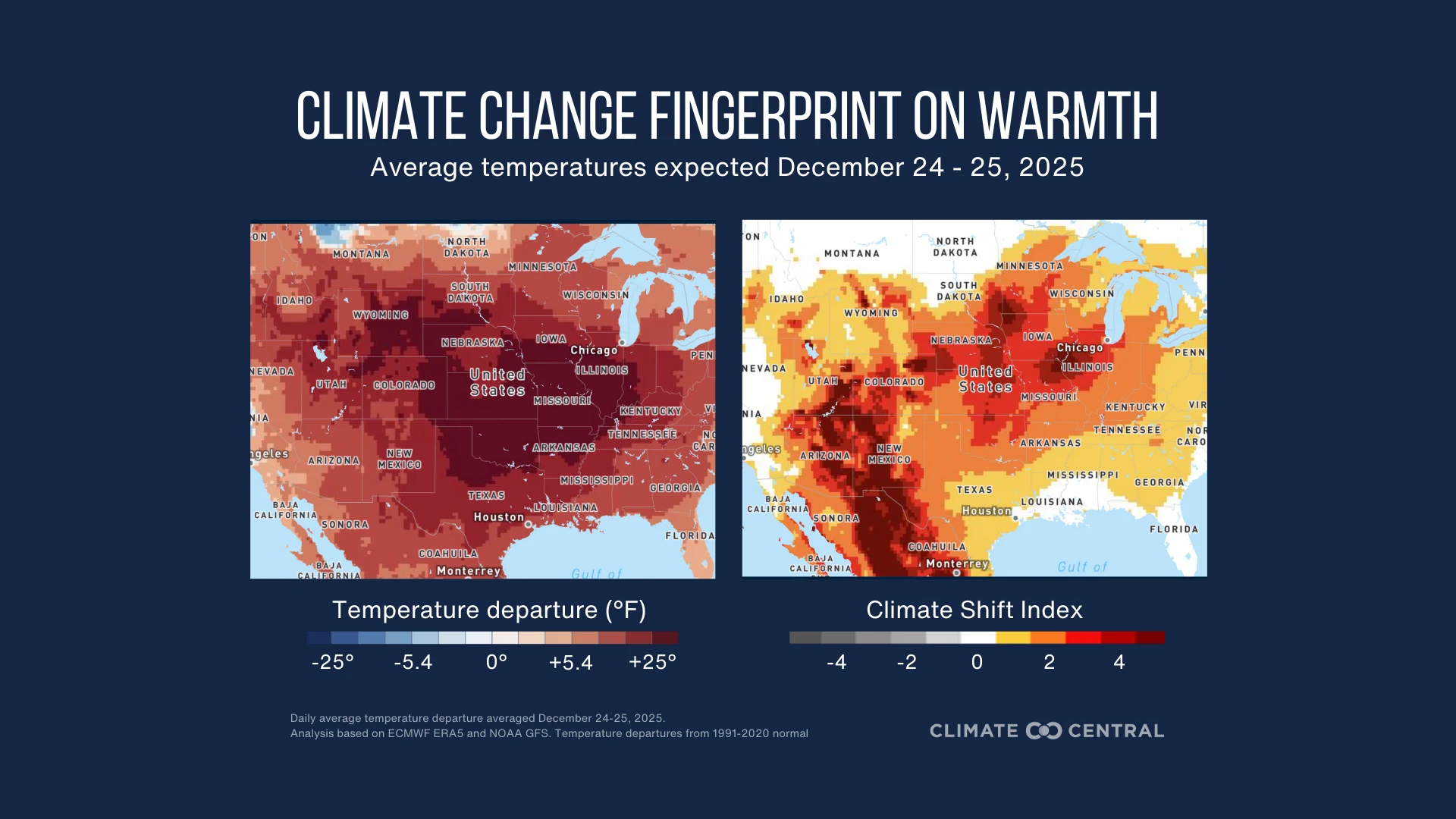
The U.S. has had a fairly chilly December so far, but things are heating up for the holidays. Christmas is expected to be exceptionally warm across a majority of the United States, particularly the Great Plains.
A Climate Central analysis shows that this unusual holiday warmth, running 20°F to 35°F above average, is at least two to three times more likely to occur due to human-caused carbon pollution.
Note: This event may continue beyond December 25, 2025. Use the Global Climate Shift Index map to stay updated on heat in your region.
How unusual is the forecasted heat?
-
Above-average temperatures are forecast across much of the country during the holiday, but the core of the warmth — where departures from normal will be the largest — is anticipated to extend from the Front Range of the Rockies into the Central Plains and Upper Midwest.
-
Over Christmas Eve and Christmas Day, daily high temperatures in these regions are forecast to range between 20°F and 35°F above the 1991-2020 climate normals.
-
Much of the western and eastern U.S. is also expected to experience unusual warmth, 5°F to 15°F above average.
-
-
Holiday high temperatures are anticipated to reach the 60s to 80s from the Plains to the Gulf Coast. For many, this warmth will challenge or break daily high temperature records.
-
On Christmas morning, low temperatures are expected to range from 40°F to the mid-60s, or up to 25°F above average for late December.
How has climate change influenced this heat?
-
Climate Shift Index (CSI) levels of 3 are forecast across the Central and Northern Plains, Upper Midwest, and the Southwest, meaning human-caused climate change made this warmth at least 3 times more likely.
-
CSI levels of 5 — the highest possible — are forecast in portions of Missouri and throughout the Southwest and Mexico, signaling an exceptional climate-influenced event.
-
🎅 What does this mean for Mr. Claus? 🎅
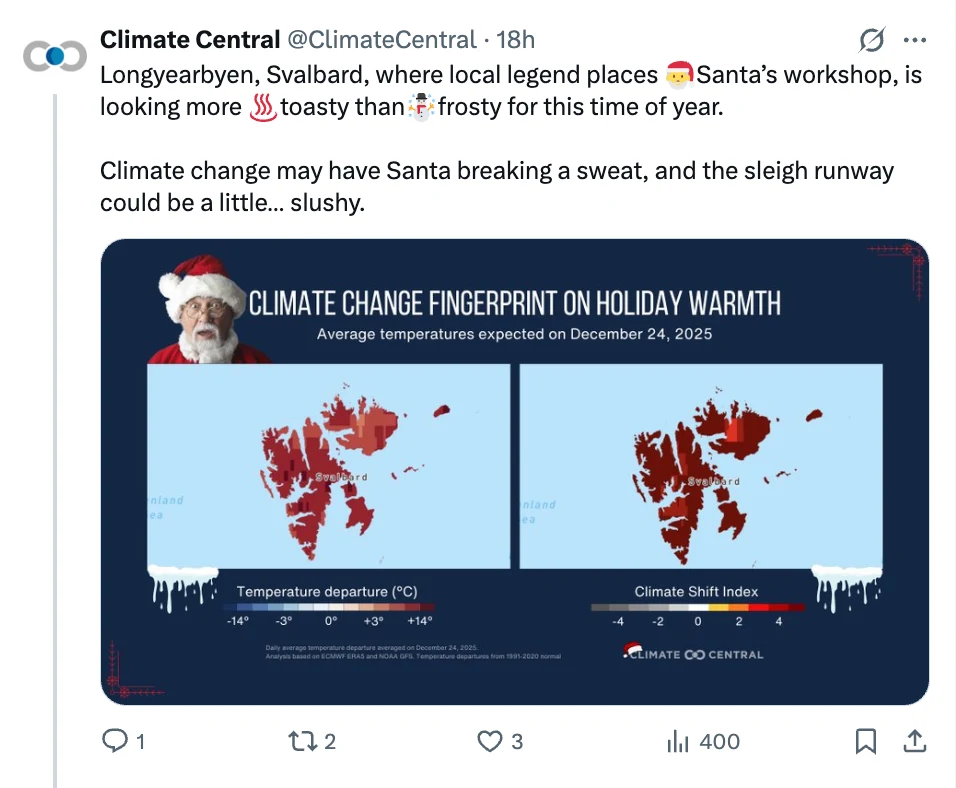
Share Santa’s climate update here.
To request an interview with a Climate Central scientist, please contact Abbie Veitch at aveitch@climatecentral.org.
How do we know climate change is influencing this heat?
The Climate Shift Index uses peer-reviewed methodology and real-time data to estimate how climate change has increased the likelihood of a particular daily temperature.
Reporting resources
-
Bring this high-resolution data into your on-air broadcasts. → Access the Climate Shift index in KML format
-
Winter has warmed in 98% of 244 U.S. Cities. → Explore the Data
-
For an in-depth guide about how to report on attribution science and extreme weather types → World Weather Attribution’s reporting guide
-
For the latest research-backed messaging to use while reporting on climate change → Potential Energy’s Guide to Reporting on Unnatural Disasters