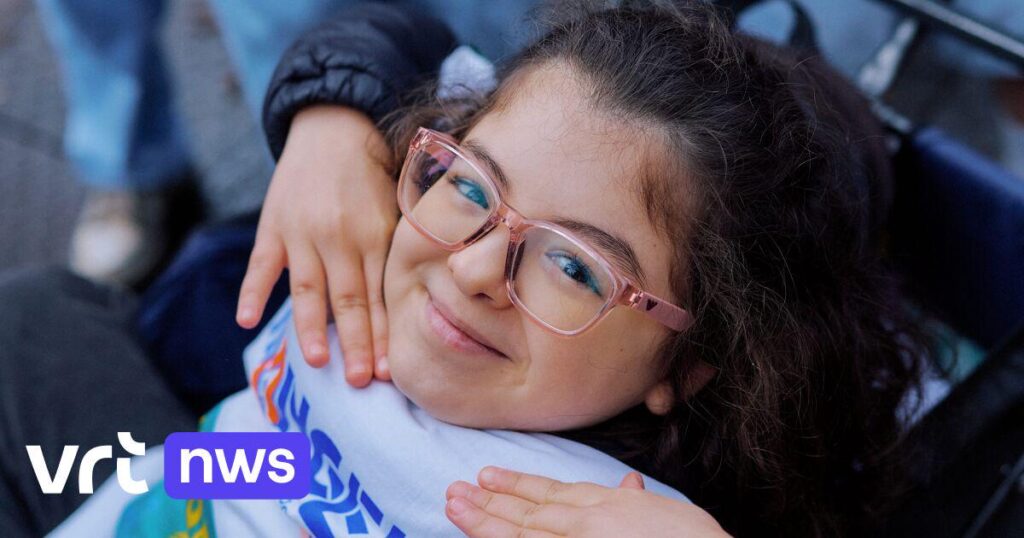
Too few people with non-European roots volunteer to donate stem cells, making it difficult for patients of that origin to find suitable donors. That is according to Pierre Zachée of the Belgian stem cell registry, following the testimony of Hafsa, an 11-year-old girl who cannot find a suitable donor to cure her rare blood disease.
The teachers of 11-year-old Hafsa Bidri from Heist-op-den-Berg made an emotional appeal this morning on the Warmste Huis telethon in Genk. **‘To all Moroccans in Belgium: register as a stem cell donor so that Hafsa can live longer. She wants to be a doctor, but she will never have that chance if we don’t find a donor.’**
Hafsa has beta thalassaemia major, a life-threatening blood disorder in which haemoglobin is not produced properly. Haemoglobin is the protein that transports oxygen from your lungs to the rest of your body and removes carbon dioxide.
Hafsa now needs a blood transfusion every two weeks to stay alive while she waits for a suitable stem cell donor. But she just can’t find one.
**Why is it so difficult to find a suitable stem cell donor?**
Patients who need a stem cell transplant can only be helped with stem cells from a donor with the same tissue type. This is a major challenge, as there are tens of thousands of possible combinations of tissue types. The ethnic tissue type must also match.
‘Doctors always look within the family first to see if anyone is a suitable stem cell donor. The chance of this is 1 in 4. Outside the family, there is a 1 in 50,000 chance of finding a suitable match,’ says Vincent Verbeecke of the Red Cross Flanders.
No one in Hafsa’s family has been found with a suitable tissue match, her teachers say. So Hafsa has to look for a match in the global database of registered donors.
‘But the big problem is that there is a shortage of registered stem cell donors with African, Turkish and mixed roots,’ says haematologist Pierre Zachée, vice-chairman of the Belgian stem cell registry.
‘If you have a Caucasian background, a European one, you have a 96 per cent chance of finding a match in that global database. For people of other ethnicities, that drops immediately to 66 per cent. If you have mixed roots, it is even more difficult to find a match, because the genetic variation is even greater.’
‘For patients from these ethnic target groups, it’s like looking for a needle in a haystack, especially if immediate family members are not eligible,’ says Zachée. ‘It also makes no sense for people of entirely European descent to register as stem cell donors for Hafsa. The chance that they can help her is 0 per cent.’
For years, the Red Cross has been specifically looking for donors with African, Turkish or mixed roots. ‘We are putting a lot of effort into this, with targeted campaigns specifically aimed at these target groups,’ says Professor Zachée. ‘Almost our entire campaign budget goes towards this.’
‘But for some reason, we find it difficult to reach these groups. Cultural differences probably play a role. And there are very few stem cell registries in African countries, which means that there are far fewer people from those countries in our global database.’
**How can you become a stem cell donor?**
* Are you between 18 and 40 years old? Then you can register via Stamceldonor.be.
**Why can’t you be older than 40?**
Because haematologists prefer younger donors, as they yield more stem cells and also give better results. Donors are also automatically removed from the registry once they reach the age of 60.
* If you are eligible to donate, you will undergo a medical examination by a doctor and a blood test.
* Once your registration is complete, you will be entered into a global database.
* If there is a match, you will be contacted and, after a final check, you will be given medication for a few days to increase the number of stem cells from your bone marrow entering your bloodstream.
* During the donation itself, blood is taken, the stem cells are extracted and the blood is returned to your body. This procedure takes about 4 hours.
* The chance that you will actually be called upon as a donor is not that great. Last year, 30 Belgians donated stem cells, the year before that 37.
The_Maghrebist on
Bedankt, ik ga mezelf registreren.
Bahaz on
FYI: the stem cell donation process has changed a lot in recent years. It’s not so debilitating as you might think if you last looked this up or watched a medical drama years ago.
I registered after a similar call for donors for Asian donors. The red cross has a really good explanation from a professor as a part of the registration process. Please register if you feel up to it, a lot of the clinics that register donors in the global database are in Western countries, so the potential donors currently slants heavily Western origin.
Murmurmira on
Damn, that really sucks that your origin is so important for this. Last time I did an ancestry DNA test, the result lit up literally the whole world except south Africa and Oceania. Every single other continent is represented in my blood. Now I’m scared to get sick lol.

4 Comments
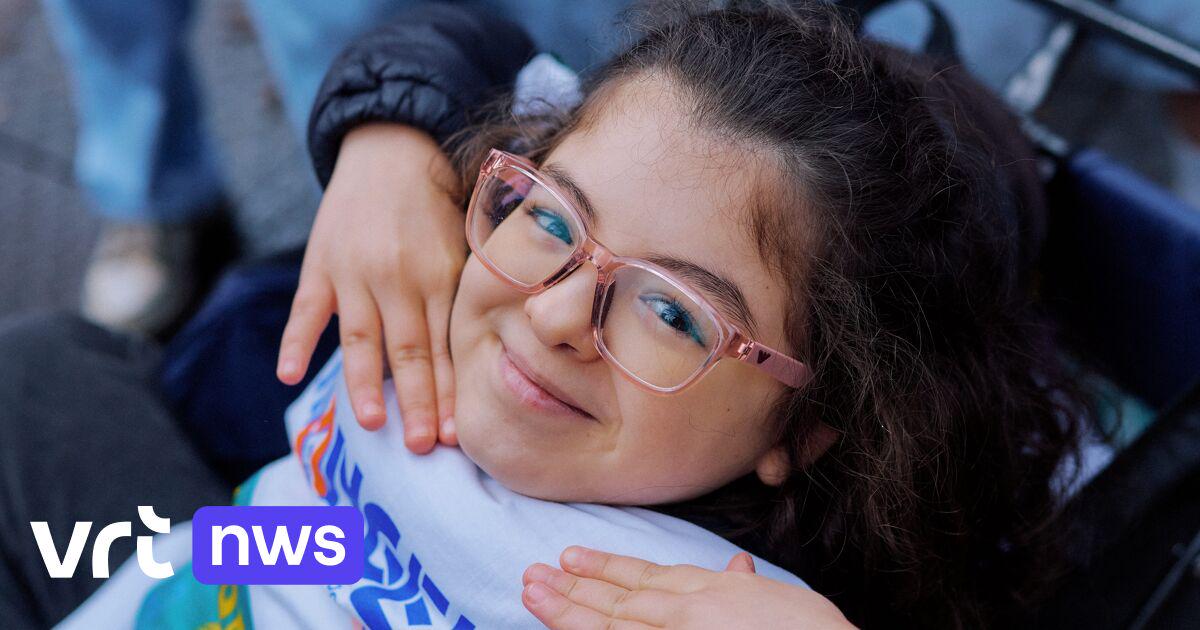
Too few people with non-European roots volunteer to donate stem cells, making it difficult for patients of that origin to find suitable donors. That is according to Pierre Zachée of the Belgian stem cell registry, following the testimony of Hafsa, an 11-year-old girl who cannot find a suitable donor to cure her rare blood disease.
The teachers of 11-year-old Hafsa Bidri from Heist-op-den-Berg made an emotional appeal this morning on the Warmste Huis telethon in Genk. **‘To all Moroccans in Belgium: register as a stem cell donor so that Hafsa can live longer. She wants to be a doctor, but she will never have that chance if we don’t find a donor.’**
Hafsa has beta thalassaemia major, a life-threatening blood disorder in which haemoglobin is not produced properly. Haemoglobin is the protein that transports oxygen from your lungs to the rest of your body and removes carbon dioxide.
Hafsa now needs a blood transfusion every two weeks to stay alive while she waits for a suitable stem cell donor. But she just can’t find one.
**Why is it so difficult to find a suitable stem cell donor?**
Patients who need a stem cell transplant can only be helped with stem cells from a donor with the same tissue type. This is a major challenge, as there are tens of thousands of possible combinations of tissue types. The ethnic tissue type must also match.
‘Doctors always look within the family first to see if anyone is a suitable stem cell donor. The chance of this is 1 in 4. Outside the family, there is a 1 in 50,000 chance of finding a suitable match,’ says Vincent Verbeecke of the Red Cross Flanders.
No one in Hafsa’s family has been found with a suitable tissue match, her teachers say. So Hafsa has to look for a match in the global database of registered donors.
‘But the big problem is that there is a shortage of registered stem cell donors with African, Turkish and mixed roots,’ says haematologist Pierre Zachée, vice-chairman of the Belgian stem cell registry.
‘If you have a Caucasian background, a European one, you have a 96 per cent chance of finding a match in that global database. For people of other ethnicities, that drops immediately to 66 per cent. If you have mixed roots, it is even more difficult to find a match, because the genetic variation is even greater.’
‘For patients from these ethnic target groups, it’s like looking for a needle in a haystack, especially if immediate family members are not eligible,’ says Zachée. ‘It also makes no sense for people of entirely European descent to register as stem cell donors for Hafsa. The chance that they can help her is 0 per cent.’
For years, the Red Cross has been specifically looking for donors with African, Turkish or mixed roots. ‘We are putting a lot of effort into this, with targeted campaigns specifically aimed at these target groups,’ says Professor Zachée. ‘Almost our entire campaign budget goes towards this.’
‘But for some reason, we find it difficult to reach these groups. Cultural differences probably play a role. And there are very few stem cell registries in African countries, which means that there are far fewer people from those countries in our global database.’
**How can you become a stem cell donor?**
* Are you between 18 and 40 years old? Then you can register via Stamceldonor.be.
**Why can’t you be older than 40?**
Because haematologists prefer younger donors, as they yield more stem cells and also give better results. Donors are also automatically removed from the registry once they reach the age of 60.
* If you are eligible to donate, you will undergo a medical examination by a doctor and a blood test.
* Once your registration is complete, you will be entered into a global database.
* If there is a match, you will be contacted and, after a final check, you will be given medication for a few days to increase the number of stem cells from your bone marrow entering your bloodstream.
* During the donation itself, blood is taken, the stem cells are extracted and the blood is returned to your body. This procedure takes about 4 hours.
* The chance that you will actually be called upon as a donor is not that great. Last year, 30 Belgians donated stem cells, the year before that 37.
Bedankt, ik ga mezelf registreren.
FYI: the stem cell donation process has changed a lot in recent years. It’s not so debilitating as you might think if you last looked this up or watched a medical drama years ago.
I registered after a similar call for donors for Asian donors. The red cross has a really good explanation from a professor as a part of the registration process. Please register if you feel up to it, a lot of the clinics that register donors in the global database are in Western countries, so the potential donors currently slants heavily Western origin.
Damn, that really sucks that your origin is so important for this. Last time I did an ancestry DNA test, the result lit up literally the whole world except south Africa and Oceania. Every single other continent is represented in my blood. Now I’m scared to get sick lol.