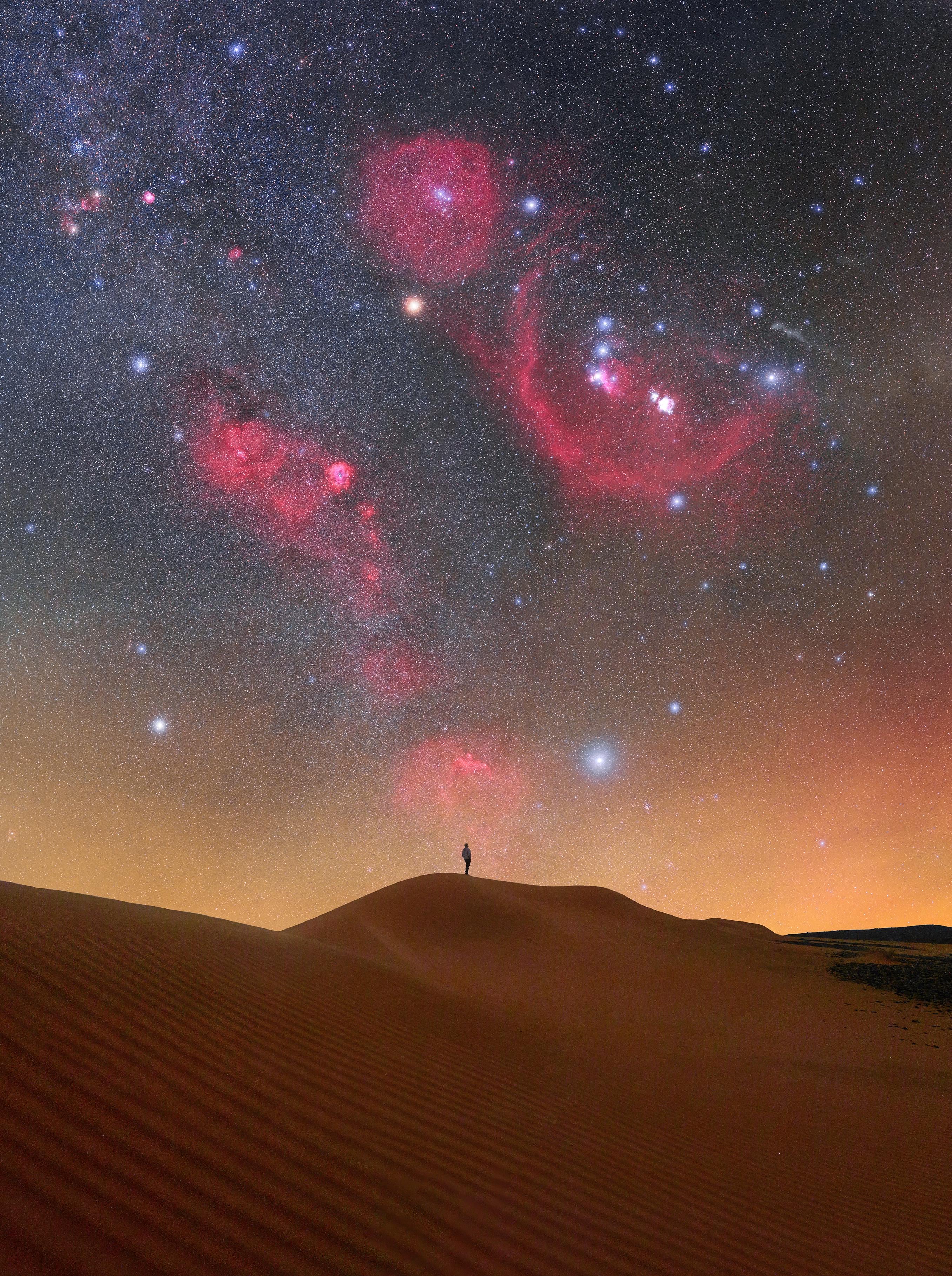
I captured Orion rising above the Sahara in one of the darkest skies on Earth
https://i.redd.it/makxom12gd8g1.jpeg

I captured Orion rising above the Sahara in one of the darkest skies on Earth
https://i.redd.it/makxom12gd8g1.jpeg
7 Comments
I shot this picture in the eastern part of Morocco, near the Algerian border, during an astrophotography trip. The sky there was exceptionally pure, with absolutely no light pollution (Bortle 1).
If you’re interested, you can find more of my work on [Instagram](https://www.instagram.com/tinmar_g/).
This image was taken during the first night of the trip. We reached this desert by 4×4, driving off-road through remote landscapes, and found the perfect place to set up camp at the base of a dune. The scenery was truly breathtaking.
Arriving on site felt almost unreal. There was nobody around, just the desert stretching endlessly around us. The spot was slightly elevated, offering a panoramic view over the desert valley. In the distance, we could see a man traveling with a camel caravan.
In this picture, you can see the Orion constellation, also called Amanar by Amazigh people (local communities). It is written as ⴰⵎⴰⵏⴰⵔ.
The panorama was captured using a 50mm lens and is composed of 16 tiles for the sky and 9 for the foreground.
Each tile of the sky consists of a stack of two pictures with 30 second exposures, plus another 30 second exposure using a glow filter. I also captured additional frames with an Ha filter to bring out the red nebulae. I used an equatorial mount to be able to track the sky with the 50mm lens without star trails.
—-
As a reminder, the sky looks very different to the naked eye than it does in long-exposure astrophotography. With unaided vision, you can easily recognize the shape of Orion and notice a few of the brightest nebula regions as very faint, diffuse glows, but you cannot see the deep reds or the intricate structures shown here.
The prominent red emission visible in this image comes from H-alpha light, captured through long exposures. This wavelength is emitted by ionized hydrogen in nebulae and is largely invisible to the human eye at night. Camera sensors, however, are far more sensitive and can accumulate this faint light over time, revealing the true extent of these vast hydrogen clouds.
Even without these vivid colors, standing under a Bortle 1 sky remains an unforgettable experience, with the Milky Way arching overhead and the constellations shining with exceptional clarity.
—-
The Bortle Scale is a nine-level system used to measure light pollution and the quality of the night sky at a given location. It ranges from Class 1, representing the darkest skies available on Earth, where the Milky Way appears highly detailed and the zodiacal light is visible, to Class 9, which corresponds to inner-city skies where only the brightest stars and planets can be seen.
—-
📷
Canon 6D (astro-modded) – Skywatcher Star Adventurer – Sigma ART 50mm
Sky settings: ISO 2500 – f/1.8 – 30s
Foreground settings: ISO 4000 – f/4 – 80s
Incredible work and thank you for the detailed write up. Always interesting to read how folks create the art they do.
Barnard’s Ring! So beautiful and so impossible to see most places these days.
Absolutely gorgeous! I always love seeing pictures of Orion because that’s what we named our son. You did an awesome job!
That honestly is one of the most awe inspiring, beautiful things I have ever seen.
I felt emotion just from realizing all that you had captured.
Wow, I find it so fascinating they built the pyramided exactly after Orion’s Belt. And how the scorpion poisoned him with a sting on his way up so he died. Orion was Sagittarius best friend, that’s why he has an bow and arrow on the hunt for the scorpion for killing his best friend.
Today is my birthday and I’m Sagittarius, and many of my friends who respect me the most are Scorpion star sign.
What a shot, it’ truly is magical
I think images like this should be banned. This is processed to within an inch of its life. Just like the gorgeous northern light pictures that gets posted whenever it happens. Real life, what you can see with your eyes look _nothing_ like this.