
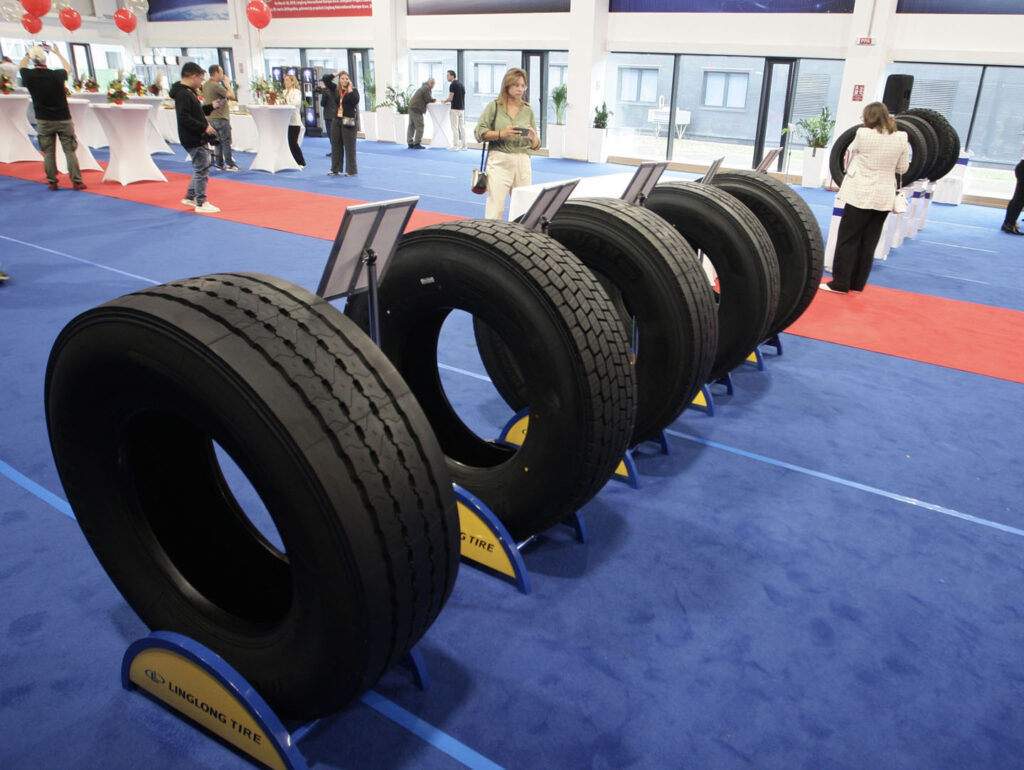
American ban on the import of tires produced in Serbia in a Chinese factory Linglong, formally based on suspicions of the use of forced labor, appears at first sight as an isolated commercial and moral intervention. However, viewed from another perspective, it appears to be a symptom of a much deeper crisis of contemporary capitalism. This decision is not an expression of the universal struggle for human rights, but an instrument of imperial market regulation, in which moral discourse is used as an ideological veil to redistribute market flows in favor of dominant capital.
The US does not question the global system of labor exploitation, but intervenes selectively, when the exploitation comes from a competing power center, in this case China.
Redirection of goods
The essential consequence of the ban is not the disappearance of goods, but their diversion. Capital cannot allow the produced value to remain unrealized, so goods that cannot enter the American market necessarily flow to other areas of accumulation. European Union, as the largest relatively open consumer market in the world, becomes a natural shock absorber of that surplus. Thus, Chinese tires produced in Serbia, together with other industrial products, are increasingly directed towards Europe, increasing supply and pressure on prices. This process is often referred to as dumping in public discourse, but from a Marxist perspective it represents the legal movement of capital in conditions of global competition and a crisis of value realization.
In such conditions, European producers enter into a structurally unequal relationship. They operate under higher wages, stronger union structures, and stricter environmental and social regulations, which have historically been won through decades of class struggle. They are opposed to capital that uses peripheral and semi-peripheral zones, such as Serbia, where labor rights are weaker, wages are lower, and the state is ready to subsidize foreign investments.
Deindustrialization
In the long term, this relationship does not lead to market “equilibrium”, but to deindustrialization. Decline in profits, reduction in investment and plant closures are becoming inevitable, especially in sectors such as the auto industry, tire manufacturing, metallurgy and chemical industry.
As in all previous waves of deindustrialization, the first and hardest blow is the working class. Layoffs, short-time work, agency work, and the breaking of collective agreements are becoming standard adjustment mechanisms. Unions are weakening, and workers are fragmenting into competing groups without common bargaining power. This process is not a historical anomaly, but a repetition of patterns seen in the American Rust Belt, in Great Britain after neoliberal reforms, and in Southern Europe after the 2008 crisis. The difference is that today that process is moving towards the very core of the European Union.
The logic of competitiveness
Under the pressure of global competition, European states and companies increasingly accept the logic of “competitiveness” as a political dogma. Wages are frozen, collective agreements are diluted, work is flexible, and social protection is weakened in the name of attracting investments. Thus, the working class is drawn into a global race to the bottom, in which it is implicitly told that it must accept worse working conditions in order to keep production within national borders.
In this way, the European social model is being dismantled, which was not the result of technical development or cultural uniqueness, but of the concrete balance of forces between labor and capital in the post-war period.
Deindustrialization affects not only jobs, but also the fiscal foundations of European countries. Less industry means less tax revenue and contributions, leading to structural budget pressures. States are responding by cutting public services, reducing social benefits and increasing indirect taxes, such as VAT, which disproportionately affect the poorer sections of society. Workers thus pay for the crisis twice: as producers, through a drop in wages and job security, and as citizens, through more expensive living and the collapse of public systems.
Political consequences
Material insecurity inevitably produces political consequences. The growth of extreme right, nationalism and anti-EU movements is not an expression of the “irrationality of the masses”, but a political articulation of social disintegration. European integration, based on the assumption of constant growth and convergence, is beginning to disintegrate under the pressure of conflicting national interests. States are reaching for protectionist measures, while the common market is losing cohesion. This process represents the real breakdown of Europe — not as an immediate collapse, but as a long-term structural erosion.
In this context, Serbia and Linglong are not an exception, but a model. Low wages, weak labor rights, foreign capital and export-oriented production form the paradigm of contemporary peripheral accumulation. Linglong is not a deviation of the system, but its rational form. If this model becomes dominant in European supply chains, the distinction between core and peripheral workers ceases to exist. The European worker is reduced to the status of a peripheral worker, without real protection and bargaining power.
Dominant geopolitical analyses, which interpret this process through the US-China conflict, strategic autonomy or security of supply chains, function as an ideological mask. They shift the focus from class relations to interstate rivalry, portraying states as the main actors, while the real bearer of power — global capital — hides in the background. Such a discourse does not raise the question of production ownership, worker control or democratic investment management, but legitimizes the existing order in which profits are privatized and losses are socialized.
What about worker solidarity?
The American ban on the import of Chinese tires from Serbia, therefore, does not destroy Europe by itself. It only exposes the systemic fragility of an order in which capital circulates freely, while workers around the world are forced to compete with each other in giving up their own rights. Without international workers’ solidarity and political control over capital, Europe will not be destroyed by external enemies, but by the internal logic of capitalism to which it has been subordinated for decades.
The fight against forced labor, modern slavery and the systematic exploitation of migrant workers, including organizing migrant workers in Serbia, is not a secondary humanitarian issue, but the central line of defense of the global working class. Organizing migrant workers into unions, not just as workers but as political subjects with the right to collective decision-making, breaks a key mechanism of capitalist domination: the production of layers of workers deprived of rights, voice and stable legal status, who serve as a constant threat to everyone else.
Deportation policies in the US and the European Union, implemented under the slogans of security and border control, function as a conscious class strategy that keeps migrant workers in a state of permanent blackmail, at the same time necessary for the functioning of the economy and systematically excluded from full labor and political rights. Opposing those policies through union organizing, international solidarity and political struggle not only protects migrant workers today, but directly undermines the global race to the bottom, breaks the discipline of labor through fear and insecurity, and lays the material foundations for the restoration of worker power in the factories of Serbia, the logistics centers of Europe, the fields and warehouses of the USA and industrial zones around the world.
The author is a sociologist and a member of the Zrenjanin Social Forum of UGS Nezavisnost