
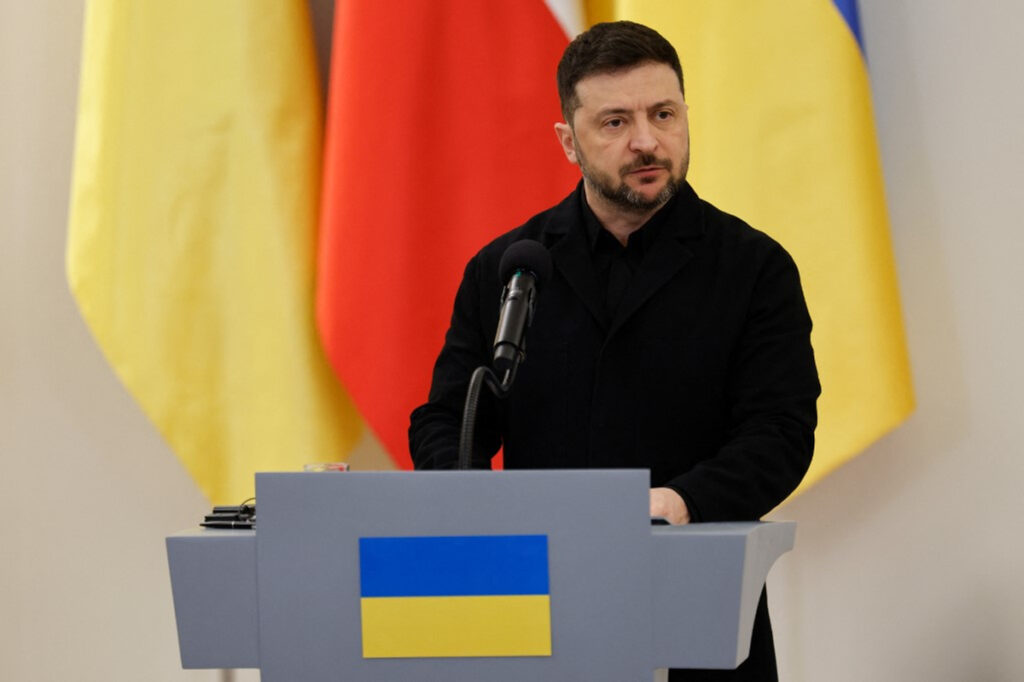
Volodymyr Zelensky has said that “careless” behavior “could lead to the ruin” of relations between Poland and Ukraine, which have been marred by historical grievances, adding that this is what Russia wants.
In an interview on Friday during a visit to Warsaw, the Ukrainian president said “there can be no hostility” with Poland, which despite differences with its neighbor has been one of Kyiv’s staunchest backers during the war with Russia.
Follow our coverage of the war on the @Kyivpost_official.
“Russia very much wants the alliance between Poland and Ukraine to be destroyed,” Zelensky told public broadcasters TVP Info, Polish Radio and the PAP press agency.
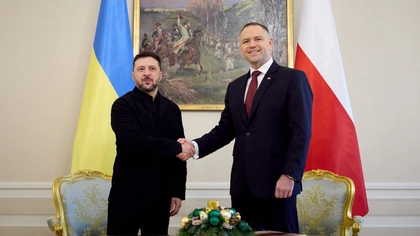
The Ukrainian head of state met his Polish counterpart, Karol Nawrocki, for the duo’s first-ever bilateral talks during the visit, which was prompted by an invitation from the latter.
Nawrocki, a nationalist historian-turned-president, has had a bumpy relationship with Ukraine, especially over the divisive legacy of the bloody Volhynia Massacres.
Over 100,000 Poles were killed by Ukrainian nationalist paramilitaries between 1943 and 1945 in the Volhynia region, then part of occupied Poland but now in western Ukraine.
‘Not just words’
After meeting Nawrocki on Friday, Zelenskyy said Ukraine was ready to speed up exhumations of Polish victims – a key demand of Nawrocki’s.
Zelensky later told the public broadcasters: “Steps are being taken, not just words and declarations: Exhumation processes are ongoing and I don’t think Ukrainians are blocking or will block these processes.”
Other Topics of Interest
Poland-Ukraine Presidential Meeting Signals Trouble for Russia
After weeks of friction, Zelensky ultimately agreed to visit Poland and meet his Polish counterpart. The visit turned out to be politically significant for Warsaw and Kyiv – and bad news for Moscow.
He emphasized the presence of both Ukraine’s and Poland’s respective historical remembrance institutes at Friday’s meetings with Nawrocki.
On the same day, reconnaissance work began at a village in Ukraine’s Rivne province, where dozens of massacred Poles are thought to be buried.
“We have a lot more in common – obviously, we have tragic aspects in our common history but we also have a lot that unites us,” Zelensky added.
A new chapter?
Nawrocki said during his election campaign early this year that he would not support Ukraine’s bid to join the EU and NATO without progress on historical issues.
Since coming to power, he has put forward a law banning controversial symbols linked to World War II-era Ukrainian nationalist groups and their figurehead, Stepan Bandera.
He also vetoed a law extending support for Ukrainian refugees in Poland, prompting the government to make a new proposal tightening access to welfare while prolonging legal provisions allowing those who have fled war to stay.
Zelensky said his first meeting with Nawrocki was “positive” despite the previous tension.
“I think that after overcoming a certain distance, we will only strengthen our relationship as politicians and leaders of our countries – we talked about this a lot today,” he said. “I would very much like what we have built so far to be not ruined in any way.”
Although he described the talks as “very cordial,” Nawrocki – in a possible nod to his nationalist voter base – said that many Poles feel Warsaw’s extensive support for Ukraine since Russia’s full-scale invasion in 2022 has not been sufficiently appreciated.
‘Stronger cards’
Zelensky, who is facing pressure at home and abroad, also met Donald Tusk, Poland’s prime minister, during his trip to Warsaw.
On Thursday night, Tusk was in Brussels as EU countries opted to fund a landmark €90 billion loan to keep Ukraine afloat – a deal based on borrowing rather than the long-mooted loan using frozen Russian assets that many wanted.
Zelensky thanked Poland and Ukraine’s other allies for supporting the EU initiative, saying it was “very important” for his country’s future.
The decision “demonstrated unity” among the majority of European leaders, despite “skepticism” by some of them, he said.
Tusk said Ukraine, armed with the loan, now has “stronger cards” in relation to Russia.
“For me, it is absolutely obvious that your fight is our common fight – for Europe, Poland, Ukraine,” Tusk said. “The most terrible thing for Russia is that we are together, because together they are not able to defeat us.”
See the original of this report by Sion Pennar for TVP World here.