
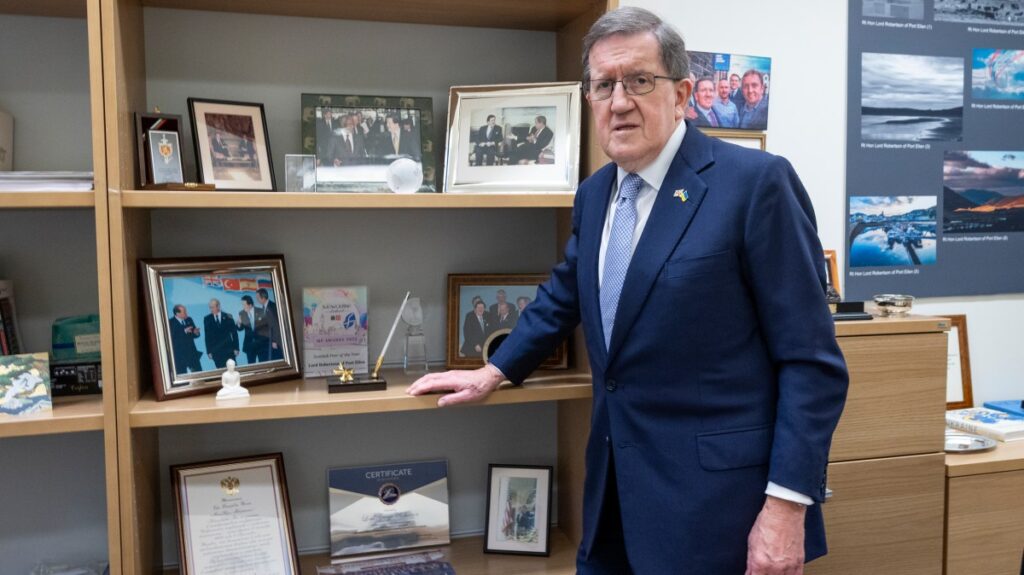
On Lord Robertson of Port Ellen’s bookshelf is a photograph of him with Vladimir Putin in 2002, two years after Putin became president of Russia. At the time, Robertson was the secretary-general of Nato, the world’s most powerful military alliance.
“’We’re doing all right. He’s on our side’,” he said, speaking from his office in Westminster.
The world has changed a great deal since.
Robertson has a torch on his key ring, in case the lights go out, and some spare money, in case the ATMs stop working in London.
“We are under attack,” Robertson, 79, said. He is now a Labour peer and has met Putin nine times.
“He (Putin) is a very different individual to the one that I did business with.”
“Time” had changed him, he said. “The pandemic. Thinking, overthinking of the role of Russia in the world. That the Soviet Union had the respect of the big countries in the world. It was even feared.”
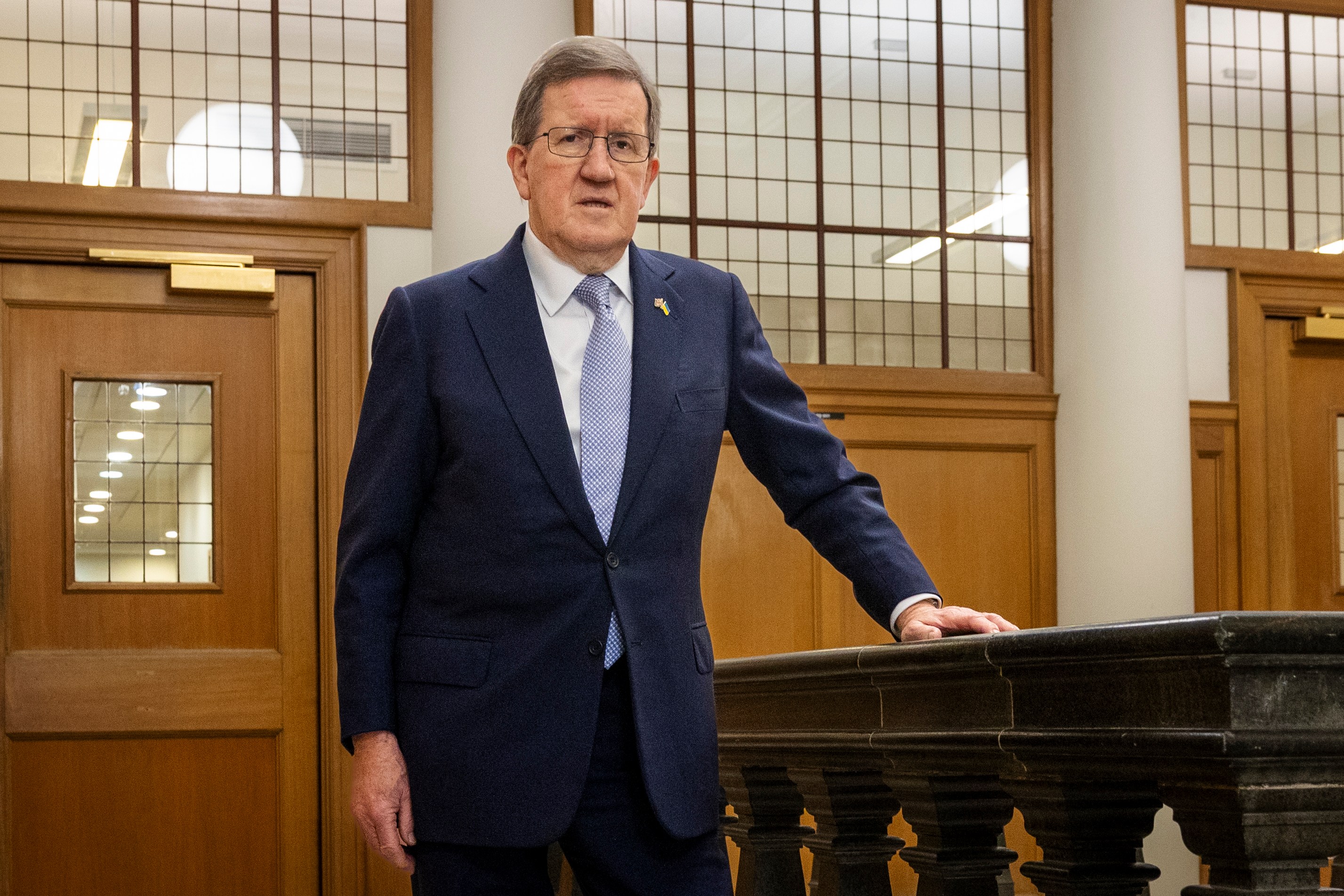
Robertson believes the West is being tested
JOSHUA BRATT FOR THE TIMES
He said it must have been a “dagger to the heart” when President Obama said in 2014, after Putin annexed Crimea, that Russia was no more than a “regional power”.
“The Vladimir Putin I met had a very thin skin,” said Robertson, who was a defence secretary in the 1990s in Tony Blair’s government.
Russia’s war on Ukraine has cost more than a million lives. Earlier this week, the new chief of the defence staff, Air Chief Marshal Sir Richard Knighton, issued a rallying cry to the nation, saying more British people needed to be ready to fight.
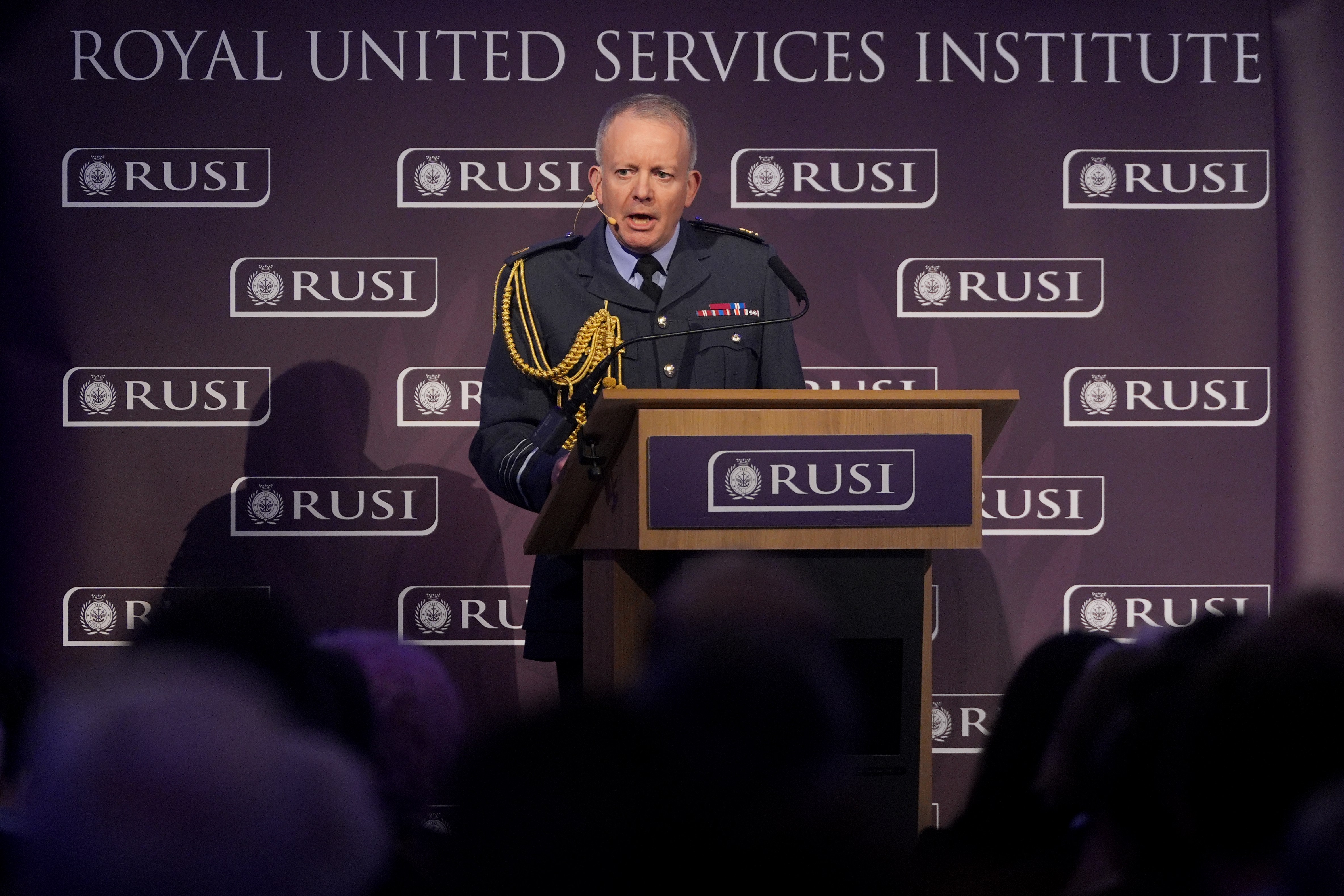
Air Chief Marshal Sir Richard Knighton speaking at the Royal United Services Institute
YUI MOK/PA
The strategic defence review (SDR) that he co-authored was described by Sir Keir Starmer as a blueprint to make Britain a “battle-ready, armour-clad nation”.
Since its publication, in June, Russia has sent about 20 unarmed drones into Poland and sent warplanes into Estonian skies.
Closer to home, the Russian spy ship, Yantar, has used lasers to disrupt RAF pilots tracking its activity north of Scotland.

The Russian vessel Yantar, a specialist reconnaissance ship that carries two unmanned submersible vehicles
DAN ROSENBAUM/MOD/AFP/GETTY IMAGES
“I think we are being tested. They’re going to the edge of what they think is acceptable. They won’t go across that line, at this point,” Robertson said of Russia.
Targeted assassinations, cyberattacks, sabotage and disinformation campaigns are all examples of Moscow’s so-called grey zone activities.
“That’s the way in which you undermine western societies. There is no doubt at all, there is a challenge to the West,” he added.
In September, the leaders of China, Russia and North Korea appeared in public together for the first time at a massive military parade in Beijing. It was a show of solidarity.
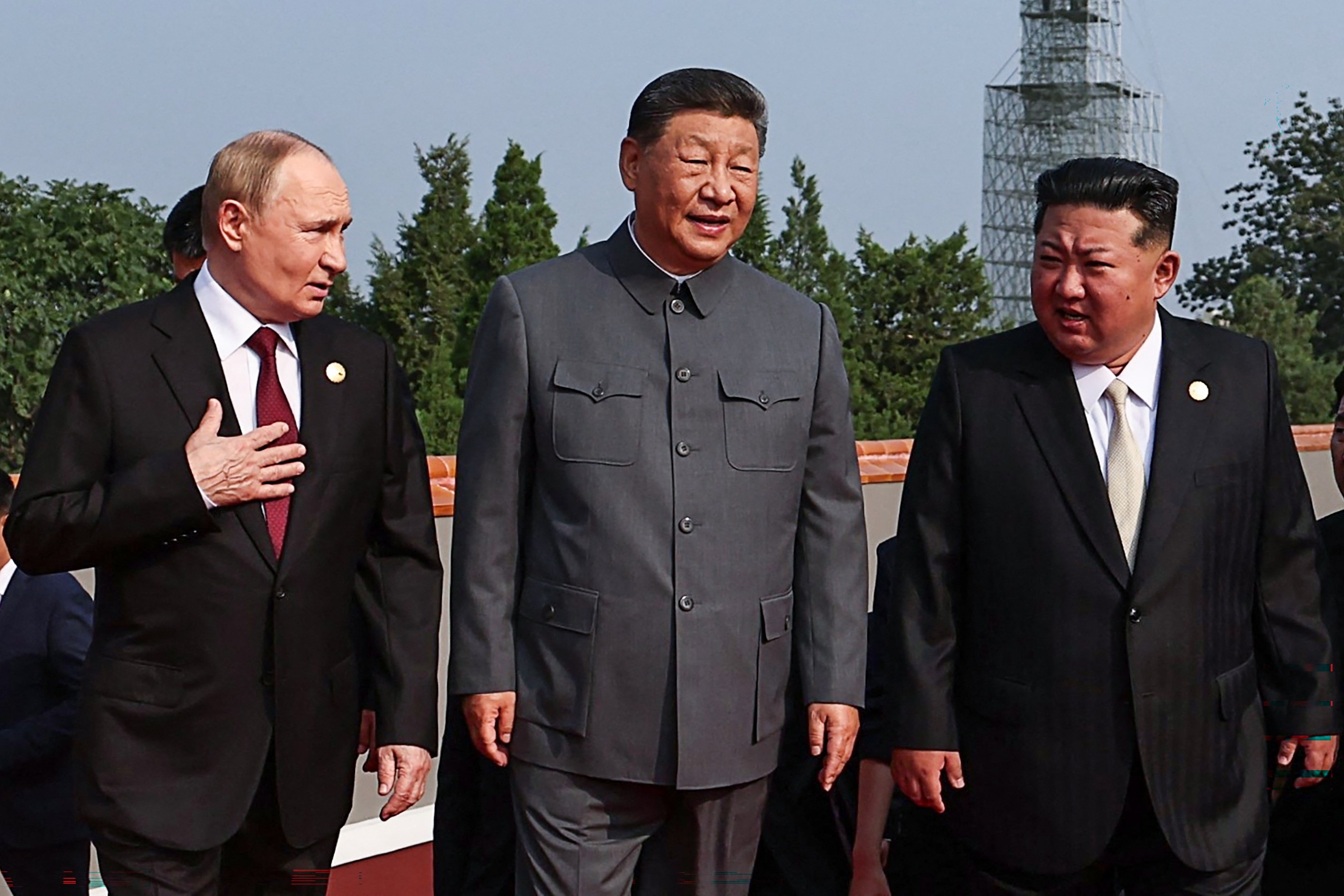
Putin with Xi Jinping, China’s President, and North Korea’s leader, Kim Jong-un, before a military parade in Beijing
ALEXANDER KAZAKOV/POOL/AFP/GETTY IMAGES
“They probably hate each other,” said Robertson, but said they were there because, for them, it was “convenient to attack the West and what the West stands for — democracy, free speech and open societies”.
“They are collaborating more and more as time goes on,” he added.
Robertson believes the British public needs to be prepared for a significant attack on the homeland by Russia.
“With our adversaries becoming bolder and our critical national infrastructure becoming more fragile and much more on a knife edge, we need to be much much better prepared than we are today,” he said “It won’t be enough to wait to until the lights go out and the hospitals shut and the data centres melt because the air conditioning has gone out and the traffic lights have stopped and the ATMs don’t work anymore.
“At that point, people will expect government to have done something,” he said.

Robertson says the public needs to be prepared and to have “resilience” in case of civil emergencies
JOSHUA BRATT FOR THE TIMES
Earlier this year, areas of Spain and Portugal were plunged into darkness after the most severe blackout in Europe in the past 20 years.
The blackout was blamed on a power surge, which occurs when there is too much electrical voltage in a network, although Robertson said that was not what everybody believes.
“Maybe it was. What it was was a wake-up call to them and to us about what you need to do,” he said.
• Britons should stock up ready for war, says ex-Nato chief
Robertson was as “ready as I could be”, with torches in every room, a battery-powered radio and a stockpile of food and water.
He said it was also the case in the UK that the public needed to have “resilience” in case there were civil emergencies or financial disasters.
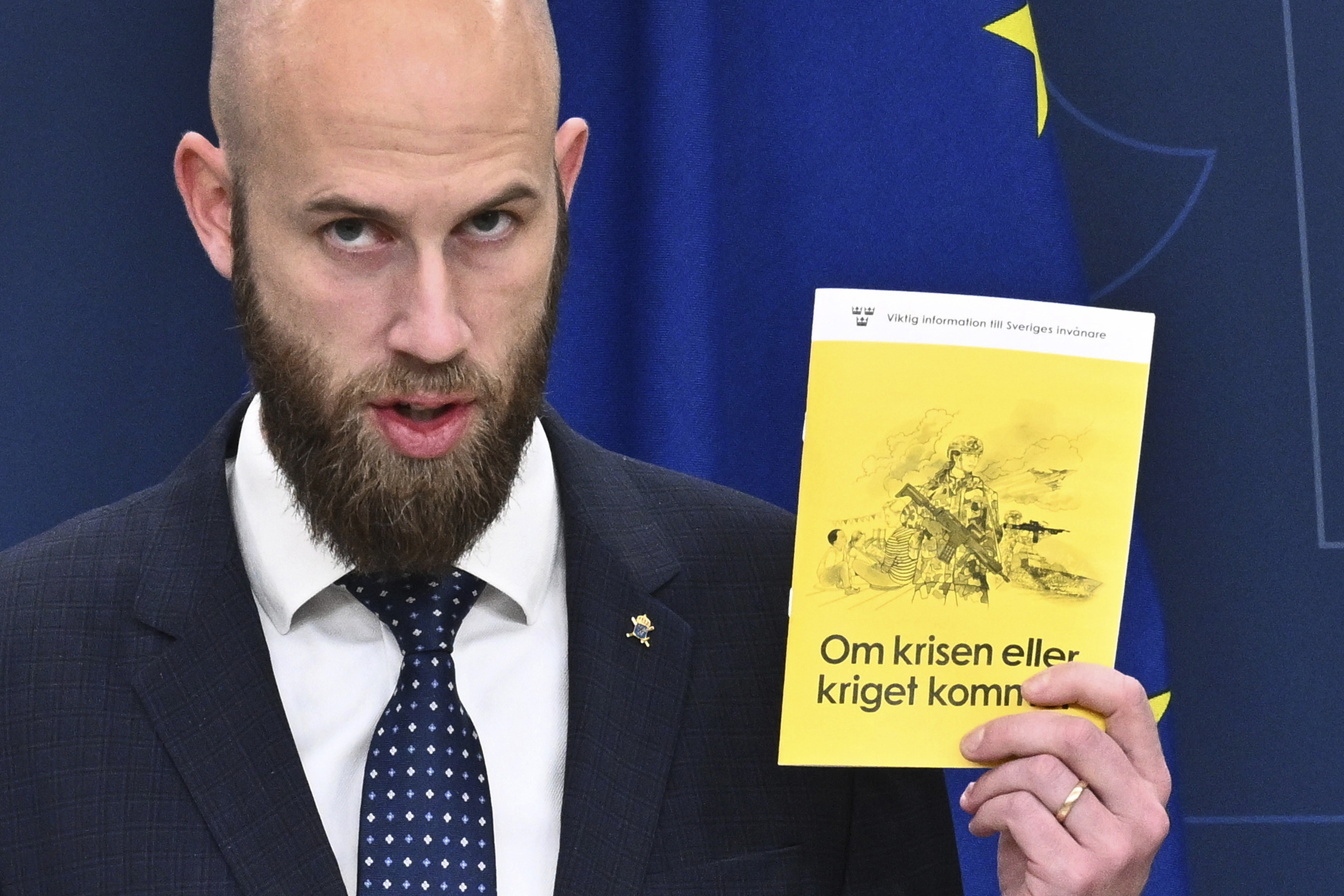
Carl-Oskar Bohlin, Sweden’s minister for civil defence, with the booklet “If Crisis or War Comes”
CLAUDIO BRESCIANI/TT NEWS AGENCY/AP
Following Knighton’s speech at the Royal United Services Institute (Rusi) this week, he suggested the government could start to engage the public by issuing booklets to prepare UK citizens for war, such as Sweden’s recent If Crisis or War Comes.
The booklet provides public guidance on survival, covering emergency kits and where to find shelter, as well as general wartime advice.
Robertson believes there is a “genuine momentum” to follow through with the “ambitious” recommendations in the SDR. As it stands, however, he said the armed forces were “underprepared”.

A Ukrainian soldier looks for the enemy’s drones on his position near the frontline town of Kostyantynivka
IRYNA RYBAKOVA/UKRAINE’S 93RD MECHANIZED BRIGADE/AP
“That is gradually being changed, and more money is going to be available the year after next. Things will change at that point,” he said.
Critics have warned that for this year and next, there is no new money for defence, and the services are having to make cuts at a time when Russia is on the warpath.

Russia’s war on Ukraine has cost more than a million lives
STRINGER/REUTERS
Robertson was the first and only head of the alliance to invoke Nato’s collective defence clause, known as Article 5, in the wake of the 9/11 attacks. Under Donald Trump’s presidency, the relationship between the US and Europe has waned.
Does he think Nato would be prepared to invoke Article 5 now? “If necessary, yes. The Article 5 line is there, and it is bright red.”