
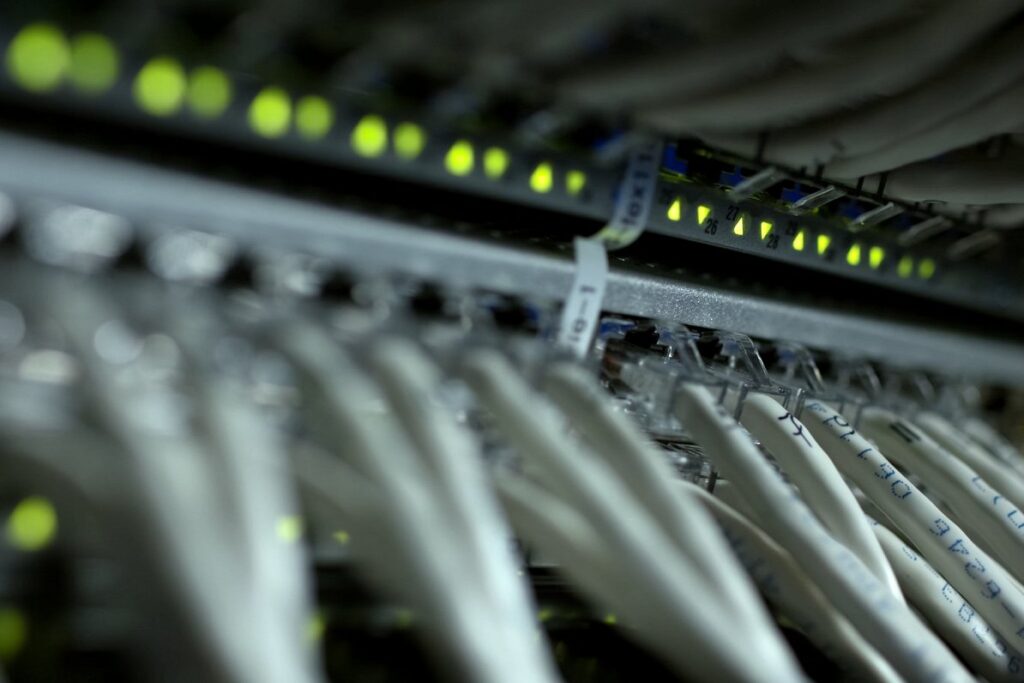
Datakom’s supercomputer cluster consists of a combination of two systems, capable of reaching a claimed performance of two ‘petaflops’ (we looked it up and apparently a petaflop is one quadrillion floating-point operations per second, which, to be honest, leaves us very much none the wiser).
In other words, the system is capable of performing two quadrillion calculations per second, which is probably quite fast, even if a ‘petaflop’ does sound like a particularly inelegant way of entering a swimming pool.
“This is a real, full-fledged supercomputer that is now available to any company in the Baltics. Compared to Apple’s currently most powerful Studio computer, which has 100 CPU cores, this supercomputer has 12.3 thousand computing cores connected via an exceptionally fast data-transfer network, thus enabling near real-time operation between processors,” said Datakom’s Head of Business Development, Edijs Tanons.
He notes that not so long ago—back in 2020—such performance was available only to the world’s wealthiest companies, which could afford to use one of the most powerful supercomputers in the world. Today, technological progress makes it possible to access this enormous computing power.
“It is no longer an exclusive resource for global giants alone. Now any ambitious Baltic company or public institution can deploy such an AI powerhouse in its own data centre, conferring full data sovereignty. This is a truly significant milestone in the development of Baltic IT infrastructure,” said Tanons.
The primary purpose of a supercomputer like this is to serve as a foundation for running private, independent AI models, ranging from adapting large language models to the Latvian language through to analysing sensitive data in the financial and defence sectors, without relying on public cloud services.
Select text and press Ctrl+Enter to send a suggested correction to the editor
Select text and press Report a mistake to send a suggested correction to the editor
Tell us about a mistake