
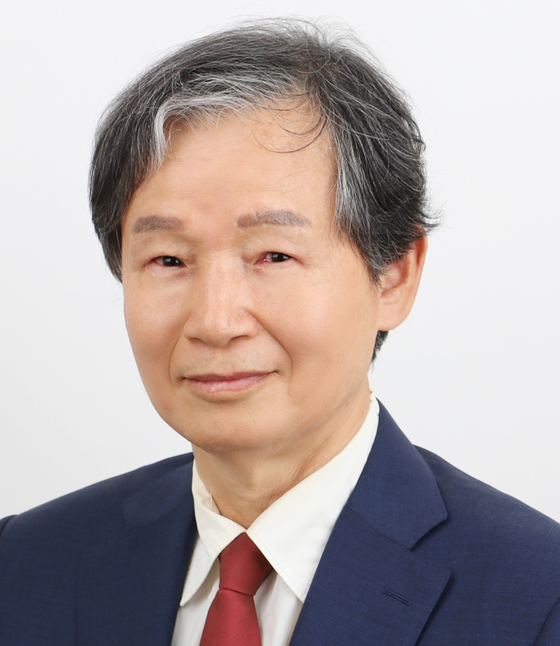
Choi Doo-whan
The author is the CEO of EnableFusion and a former president and CEO of POSCO ICT.
Seoul, 2040. One scenario is a nightmare. Power shortages force Samsung and SK hynix to relocate AI semiconductor fabs to Southeast Asia. Across the industry, a bitter phrase circulates: “World-class technology, but no electricity to run it.” Data center permits have languished for years. Korea has slipped out of the global AI race. Young people lament that a semiconductor powerhouse has been reduced to an energy-weak state. Korea’s “lost decade” is unfolding.
The alternative future looks entirely different. An AI megacluster operates around the clock, sustained by a stable power supply. Countries around the world benchmark Korea. The nation becomes “the TSMC of energy,” exporting precision energy systems globally. Korean youth dream of standing at the center of a global energy revolution.
![With Sector Modules 6 and 7 in place, teams are moving to the next phase, welding 1,200 in-vessel attachments - “bosses” - for diagnostics and sensors, and bolting 124 splice plates to connect thermal shield panels. Working from a new four-level in-vessel platform, engineers are preparing the chamber that will soon host the world’s most powerful fusion reactions. [ITER]](https://www.byteseu.com/wp-content/uploads/2025/12/296fa449-1b9c-4466-93a0-4925000b66c8.jpg)
With Sector Modules 6 and 7 in place, teams are moving to the next phase, welding 1,200 in-vessel attachments – “bosses” – for diagnostics and sensors, and bolting 124 splice plates to connect thermal shield panels. Working from a new four-level in-vessel platform, engineers are preparing the chamber that will soon host the world’s most powerful fusion reactions. [ITER]
What separates these two futures is not luck or technology — it is choice. In 2025, which path will Korea take?
Sam Altman has warned that AI models beyond GPT-5 will require gigawatt-scale power. This is no exaggeration. By 2030, AI data centers are projected to consume nearly 10 percent of global electricity. Technology giants such as Microsoft, Google and Amazon are already competing fiercely for power access. In the United States, data center approvals are backlogged for years. In parts of Europe, permitting has been suspended altogether. Power has become synonymous with AI competitiveness, and industrial survival is at stake.
Energy security itself is being redefined. In the past, it meant stable access to oil and gas. Today, it means large-scale, carbon-free electricity. In the future, energy sovereignty will be inseparable from technological sovereignty and national competitiveness. Korea’s dilemma is stark. The country leads the world in semiconductors and AI technology, yet depends on imports for 94 percent of its energy. In the AI era, nations without secure energy supplies inevitably fall behind.
Existing solutions fall short. Renewable energy suffers from intermittency, high storage costs and land constraints. Fossil fuels clash with carbon-neutrality goals. Nuclear fission raises persistent concerns over safety, radioactive waste and fuel import dependence. Incremental fixes are no longer enough. An entirely new energy paradigm is required.
Fusion offers a combination unmatched by any other energy source. Its energy density is overwhelming: one liter of seawater can yield energy equivalent to roughly 300 liters of oil. Because its fuel is derived from seawater, fusion enables true energy independence. It produces no carbon emissions and generates only minimal radioactive waste. Crucially, runaway reactions are physically impossible, eliminating the risk of catastrophic explosions.
Fusion is no longer a distant dream. In 2022, the National Ignition Facility at Lawrence Livermore National Laboratory achieved net energy gain for the first time. ITER aims to begin operations in the mid-2030s. Korea’s KSTAR set a 100-second superconducting fusion record in 2024, while China’s EAST continues to break operational benchmarks. Scientific feasibility is no longer in doubt.
Capital markets confirm this shift. In 2025, private investment in fusion surpassed $15 billion. Companies such as Commonwealth Fusion Systems, TAE Technologies and Helion Energy are racing toward commercialization. High-profile investors, including Bill Gates, Sam Altman and Jeff Bezos, have committed substantial capital. When investment moves at this scale, commercialization is no longer theoretical.
The tipping point has been crossed. Fusion was once dismissed as “always 30 years away.” Today, industry consensus points to commercialization in the 2030s. The central question has shifted from “Is it possible?” to “Who will get there first?” Although initial investment requirements are large, the long-term benefits are decisive: near-zero fuel costs, high operational stability and a clear path toward total cost competitiveness. These fundamentals explain why first-mover advantage matters.
Fusion is also humanity’s most complex engineering challenge. It requires ultra-precision components supplied by thousands of firms and an unprecedented level of technical integration. No single nation can succeed alone. International cooperation diversifies risk, eases financial burdens, and accelerates progress. It is not optional but imperative.
Strategic alliances allow complementary strengths to converge. The United States contributes innovation through private fusion leaders. Korea brings world-class ultra-precision manufacturing capabilities, proven through KSTAR and ITER component deliveries. Japan adds advanced materials and critical component technologies. Together, these strengths generate synergy far greater than their individual parts. This is why trilateral cooperation among the United States, Korea and Japan is so important.
Geopolitically, such alliances strengthen energy independence across the free world and counter the weaponization of energy by authoritarian states. In an era when energy security is national security, technology alliances become security alliances. This cooperation is also essential to maintaining an advantage over China, which is investing more in fusion than the free world combined.
![President Lee Jae Myung tours the Korea Institute of Fusion Energy in the Daedeok Research and Development Zone in Daejeon on Nov. 7, inspecting KSTAR (Korea Superconducting Tokamak Advanced Research), the world’s first superconducting nuclear fusion research device. [PRESIDENTIAL OFFICE]](https://www.byteseu.com/wp-content/uploads/2025/12/a39e4494-612f-4fbc-8a56-338bcaf71555.jpg)
President Lee Jae Myung tours the Korea Institute of Fusion Energy in the Daedeok Research and Development Zone in Daejeon on Nov. 7, inspecting KSTAR (Korea Superconducting Tokamak Advanced Research), the world’s first superconducting nuclear fusion research device. [PRESIDENTIAL OFFICE]
Time is the decisive variable. Solo commercialization may take 20 to 30 years, but cooperation can compress that timeline to 10 to 15 years. This decade-long difference determines national destiny, separating decline from leadership and the first future from the second.
The world is already choosing. The United States, China, Europe and Japan are pouring billions into fusion. The question is no longer whether fusion will arrive, but who will dominate when it does. First movers will define the rules.
Korea now faces its own decision. One future leads to chronic power shortages, industrial relocation and a lost decade of dependency. The other offers energy independence, leadership in fusion manufacturing and secured dominance in the AI era. Between these two futures lies only one variable: the choice made today.
In the 21st century, energy security is survival. Fusion is inevitable. Cooperation is essential. Korea’s reality in 2040 will be shaped by decisions taken now. Without energy security, no nation can secure its future. The time to choose is now.