
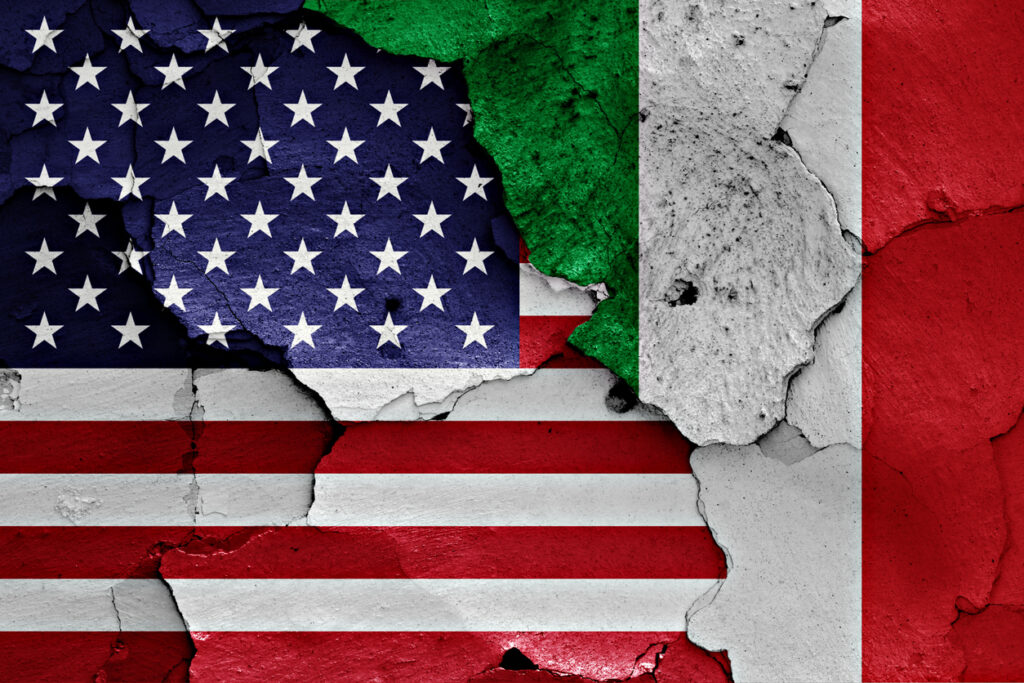
Italian American leaders urge restraint and dialogue as freshman senator wobbles on ultimatum-style limits and as Rome presses on with citizenship restrictions.
U.S. Sen. Bernie Moreno has found himself at the center of a growing national controversy after introducing legislation that would alter long-standing U.S. federal law by barring dual citizenship.
Under the proposed bill, anyone who holds citizenship in a second country would be required to renounce that foreign citizenship within a year or risk losing their U.S. citizenship.
“One of the greatest honors of my life was when I became an American citizen at 18, the first opportunity I could do so,” Moreno said in a statement when first announcing the bill. “It was an honor to pledge an Oath of Allegiance to the United States of America and ONLY to the United States of America! Being an American citizen is an honor and a privilege—and if you want to be an American, it’s all or nothing. It’s time to end dual citizenship for good.”
The proposal, filed on Dec. 1 and known as the Exclusive Citizenship Act of 2025, sparked immediate criticism from national Italian American organizations and constitutional law experts. In response, Moreno has sought to clarify his stance, describing the measure as applying only to future naturalized citizens rather than to all dual citizens (although this explanation is not consistent with the wording of his bill).
Two leading Italian American groups, the Conference of Presidents of Major Italian American Organizations (COPOMIAO) and Italian Sons and Daughters of America (ISDA), both headed by Hon. Basil M. Russo, were among the most vocal in objecting to the ultimatum-based legislation, both at its inception and as recently characterized by the senator.
“Italian Americans who choose to obtain dual citizenship do so out of familial pride, to celebrate heritage, language, customs and traditions,” said Russo. “To force Americans to erase their pride in their heritage to ‘prove’ their loyalty is nothing more than a political stunt. This bill serves no purpose because it solves no problem.”
In the Italian American context, dual citizenship often enables cultural exchange, travel, property ownership and participation in civic life on both sides of the Atlantic (ties that advocates and researchers say enrich, rather than diminish, U.S. civic life).
As the bill moves forward, currently referred to the Senate Judiciary Committee, heritage leaders have stressed that they will continue to advocate not only against restrictive measures but also for recognition of the diverse ways Americans honor their heritage while remaining fully loyal citizens.
From Washington to Rome, Dual Citizenship at a Crossroads
Russo and his peers noted that the issue of citizenship did not stop at U.S. borders: Italy itself recently tightened its rules for citizenship by descent, limiting eligibility to children and grandchildren of Italian citizens and cutting out great-grandchildren and future generations.
That change effectively cuts off the path for millions of Italian Americans, including those who have spent years collecting documents and preparing applications for dual citizenship, a process that often costs thousands of dollars in legal and translation fees.
COPOMIAO’s and ISDA’s leaders initiated direct correspondence with Italian Prime Minister Giorgia Meloni over the matter, and Russo plans to meet with Italy’s Ambassador to the U.S., Marco Peronaci, to discuss the issue at length, in the pursuit of compromise.
In 1930, immigrant families banded together to create the Italian Sons and Daughters of America (ISDA), now one of the most prominent and financially successful Italian American organizations in the nation. In the last decade, we built a 725,000-strong social media community, grew our not-for-profit fraternal association, ISDA Financial Life, to nearly a half billion dollars in member assets, co-founded the Russo Brothers Italian American Filmmaker Forum (RBIAFF), and launched the fastest-growing Italian American publication (La Nostra Voce).