
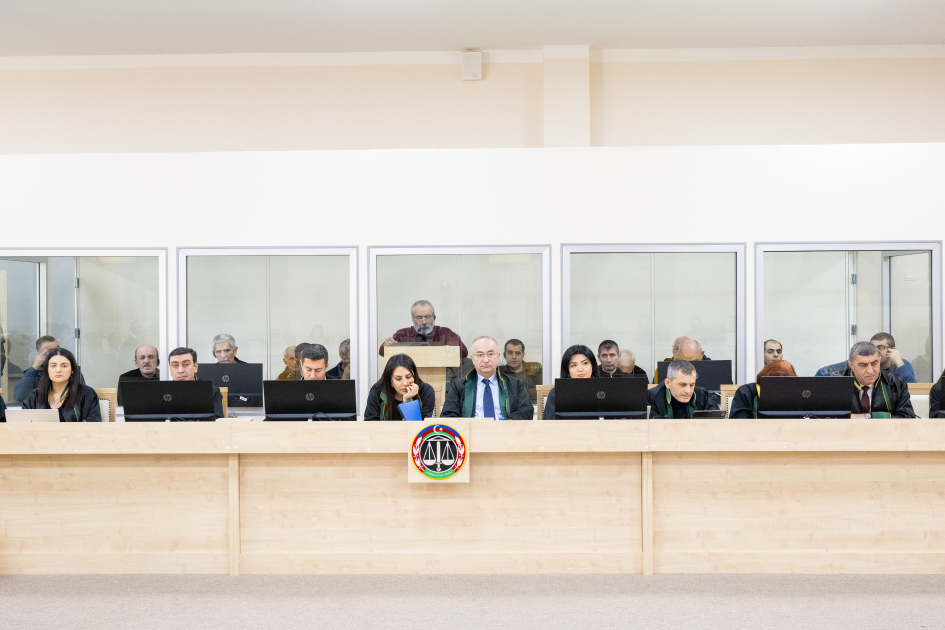
BAKU, Azerbaijan, December 22. The open court
hearing in the criminal case against citizens of the Republic of
Armenia—Arayik Harutyunyan, Arkadi Gukasian, Bako Sahakyan, Davit
Ishkhanyan, David Babayan, Levon Mnatsakanyan, and others—accused
of war crimes, crimes against peace, crimes against humanity,
including planning and waging an aggressive war, genocide,
violations of the laws and customs of war, terrorism, financing of
terrorism, illegal seizure of power, unlawful retention of
authority, and numerous other offenses committed as a result of
Armenia’s military aggression against Azerbaijan, continued on
December 22, Trend
reports.
The session was held at the Baku Military Court under the
chairmanship of Judge Zeynal Aghayev, with judges Camal Ramazanov
and Anar Rzayev and reserve judge Gunel Sadigova.
Each of the accused was provided with interpreters in their
preferred language and defense attorneys, ensuring full compliance
with procedural rights.
The hearing was attended by the accused, their defense lawyers,
some victims, their legal heirs and representatives, as well as
prosecutors representing the state prosecution.
The presiding judge, Zeynal Aghayev, stated that the hearing
continued with the final statement of the accused.
It was mentioned that due to the adjournment of the previous
hearing, accused David Babayan will continue his statement during
the current hearing.
Babayan presented his counterarguments in response to the
prosecution’s statements. He said that the accused persons are
innocent.
“I don’t consider myself guilty of any charges,” Babayan
noted.
He also expressed his gratitude to his defense attorneys and
translators.
The accused, Levon Mnatsakanyan, said he wanted to deliver his
final statement in Russian. He was provided with the opportunity to
speak in Russian.
“Karabakh (referring to the so-called regime—ed.) asked Armenia
to act as the guarantor of its security, and from that period
onward all operations along the line of contact were conducted in
accordance with plans prepared by the General Staff of Armenia
(meaning the General Staff of the Armed Forces—ed.). I mentioned
during the court hearings here that I was drafted into the military
in 1992. Taking my officer rank into account, I was appointed
deputy commander of a battalion. Nothing else was required to be
appointed to this position. However, the prosecution claims that I
was appointed based on some other parameters,” he said.
The accused also commented on the prosecution’s statements
regarding the participation of mercenaries on their side during the
war.
“As far as I know, they were not mercenaries. They were all
volunteers; no one recruited them into service, and they weren’t
paid,” he explained.
Besides, Mnatsakanyan spoke in court about the statements made
against him by victim Ilham Mammadov (it should be recalled that
during his testimony at the court hearing held on October 2,
Mammadov said that he had been beaten and subjected to torture by
servicemen of the Armenian armed forces, and that among the
officers who beat him, an officer named Levon had displayed
particular cruelty. In response to questions from prosecutors
representing the state prosecution, the victim pointed to
Mnatsakanyan and said that he was the person who had shown cruelty
(ed.). He said that Mammadov hadn’t been tortured.
He also denied the prosecution’s claims that he participated in
planning a military attack in Shushakand during the 44-day war in
2020 and stated that he didn’t take part in any military operations
at all in 2020 or 2023.
“Yes, I was indeed there (at the school where the meeting was
held in Shushakand—ed.). However, I arrived very late, after the
meeting had already begun. I had no connection to the meeting. I
was not invited there. In the office at that school, I was
discussing civil defense issues with the heads of civil defense
headquarters of nearby villages. We were talking about evacuating
the population from there. They (those holding the meeting—ed.)
came there and asked for a room to hold a two-hour meeting. The
chairman allocated that office to them. That is, he made use of my
absence and gave them the office I was using. When I arrived, the
meeting was already underway. I entered the room and sat aside with
Artur Aghabekyan. This was simply a coincidence.
From the meeting, it became clear to me that three reserve
battalions, one tank battalion, and one artillery division had been
prepared for combat. As a result of that operation, the road was to
be blocked where supply operations were being carried out, that is,
where the military personnel were being provided with supplies. The
person responsible for the armed forces preparing the attack on
Shusha was Samvel Babayan. They discussed all the issues,
determined the timing of the operation, and left. They set the time
for 5 a.m. the next day. After the organizers left, the
participants began to express dissatisfaction, saying that the
preparatory work had not been fully carried out and that they were
not fully ready. They said they had not been given time to properly
prepare for the operation and therefore were refusing to
participate. I asked why they were saying this now and why they had
not said it during the meeting. I did not receive an answer from
them and didn’t interfere in their work. I thought that this was
their own matter,” the accused said.
Speaking about the April battles that took place in 2016, the
accused said that at that time he was an ‘army commander’
(commander of the largest formation of the Armenian armed
forces—ed.). He denied the prosecution’s evidence and the
statements of the victims regarding the April battles and said that
they did not attack the positions of Azerbaijani servicemen.
The court proceedings will continue on December 23.
Fifteen defendants of Armenian origin are accused in the
criminal case concerning numerous crimes committed during the
aggressive war waged by the Armenian state—including the
aforementioned criminal association – on the territory of
Azerbaijan, in violation of domestic and international legal norms.
These crimes were committed for the purpose of military aggression
against Azerbaijan and were carried out under the direct leadership
and participation of the Armenian state, officials of its state
institutions, its armed forces, and illegal armed formations,
through their written and verbal orders, instructions, and
guidelines; material, technical, and personnel support; centralized
management; as well as under strict control and under the
leadership and direct or indirect participation of Robert Sedraki
Kocharyan, Serzh Azati Sargsyan, Vazgen Mikaeli Manukyan, Vazgen
Zaveni Sargsyan, Samvel Andraniki Babayan, Vitali Mikaeli
Balasanyan, Zori Hayki Balayan, Seyran Musheghi Ohanyan, Arshavir
Surenovich Garamyan, Monte Charles Melkonyan, and others.
The following individuals—Arayik Vladimiri Harutyunyan, Arkadi
Arshaviri Ghukasyan, Bako Sahaki Sahakyan, Davit Rubeni Ishkhanyan,
David Azatini Manukyan, Davit Klimi Babayan, Levon Henrikovich
Mnatsakanyan, Vasili Ivani Beglaryan, Erik Roberti Ghazaryan, Davit
Nelsoni Allahverdiyan, Gurgen Homeri Stepanyan, Levon Romiki
Balayan, Madat Arakelovich Babayan, Garik Grigori Martirosyan, and
Melikset Vladimiri Pashayan—are being charged under the following
articles of the Criminal Code of the Republic of Azerbaijan:
Article 100 (planning, preparing, initiating, and waging a war of
aggression); Article 102 (attacking persons or organizations
enjoying international protection); Article 103 (genocide); Article
105 (extermination of the population); Article 106 (enslavement);
Article 107 (deportation or forced displacement of population);
Article 109 (persecution); Article 110 (enforced disappearance of
persons); Article 112 (deprivation of liberty contrary to
international law); Article 113 (torture); Article 114 (mercenary
service); Article 115 (violation of the laws and customs of
warfare); Article 116 (violation of international humanitarian law
during armed conflict); Article 118 (military robbery); Article 120
(intentional murder); Article 192 (illegal entrepreneurship);
Article 214 (terrorism); Article 214-1 (financing terrorism);
Article 218 (creation of a criminal organization); Article 228
(illegal acquisition, transfer, sale, storage, transportation, and
possession of weapons, ammunition, explosives, and devices);
Article 270-1 (acts threatening aviation security); Article 277
(assassination of a state official or public figure); Article 278
(forcible seizure and retention of power, forcible change of the
constitutional structure of the state); Article 279 (creation of
armed groups not provided for by law); and additional articles.
Stay up-to-date with more news on Trend News
Agency’s WhatsApp channel