
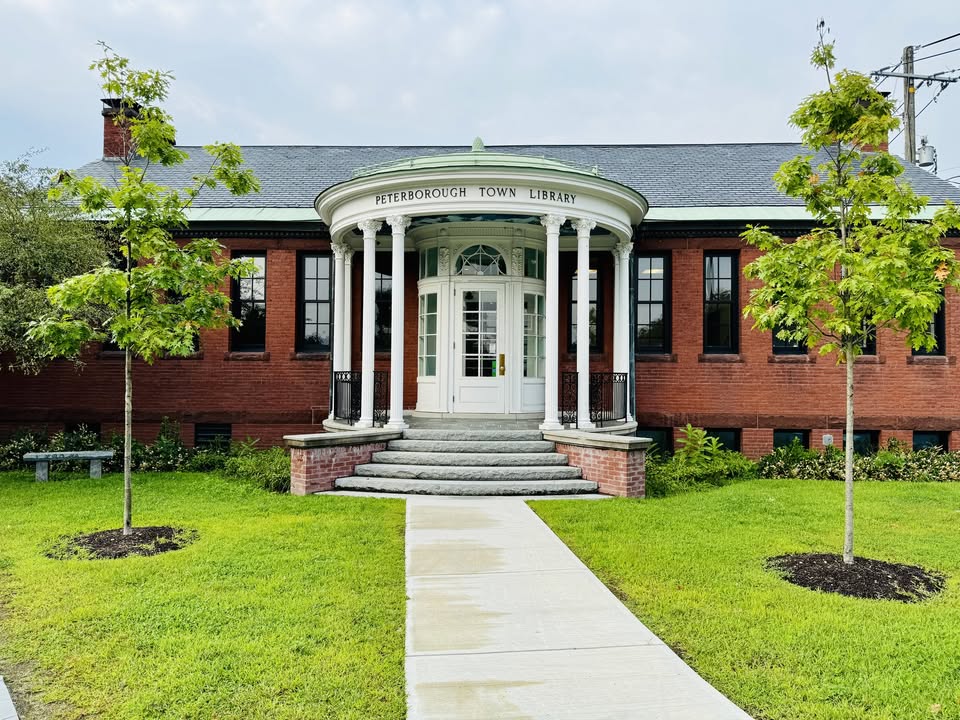
Property taxes topped the list of concerns during a legislative listening session hosted by representatives from the New Hampshire State Legislature at the Peterborough Town Library on Thursday, Dec. 18.
Other topics raised by attendees included energy costs, the Affordable Care Act, voter turnout, and concerns about political party effectiveness.
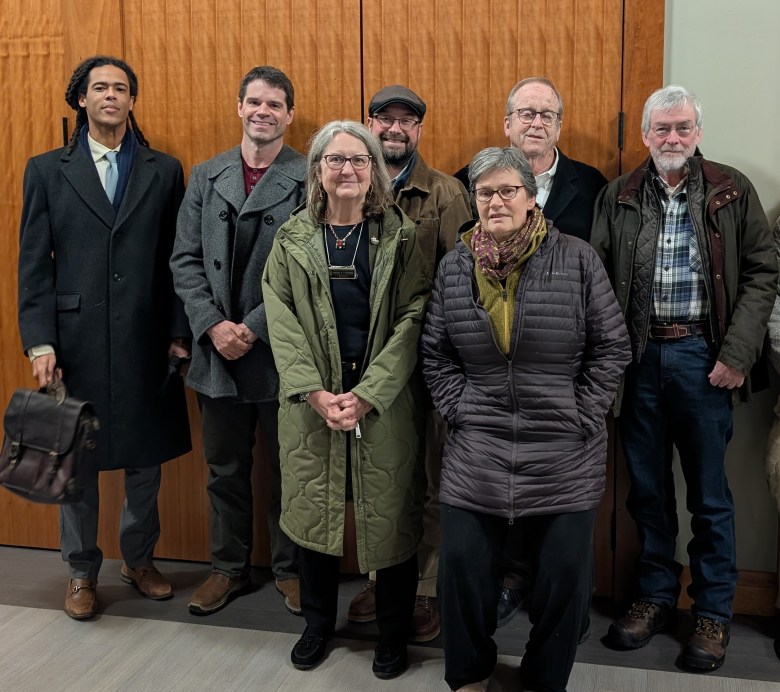 From left to right: State Representatives Jonah Wheeler, Jared Sullivan, Wendy Thomas, Nick Germana, Molly Howard, Tom Schamberg, and Peter Leishman at the listening session hosted inside the Peterborough Town Library, Dec. 18. Photo Credit: TYLER DION
“We’re not here to campaign, we’re not asking for donations, we’re not here to debate. We just want to know what’s on your mind; the good, the bad, and the ugly,” said Hillsborough County District 12 Rep. Wendy Thomas at the start of the session.
Tax Rates
Rep. Peter Leishman from Hillsborough District 33 said the Legislature has limited direct influence over local tax rates, emphasizing that budget decisions begin at the municipal level.
“The direct impact the Legislature has on tax rate decision-making is minimal,” Leishman said. “The town has a meeting, the selectmen vote on a budget, and then the budget gets pushed out to us. It all starts with the town selectmen and the school board.”
Leishman added that since 2022, $128 million has been directed to Education Freedom Accounts. He said towns should look at these freedom accounts to offset property taxes for schools. “If the $128 million of State funds wasn’t being directed to EFAs, it could go back to communities to offset local school taxes.”
A Peterborough resident questioned lawmakers about the state’s long-standing commitment to “The Pledge,” asking whether it remains necessary to adhere to the decades-old promise. “The Pledge” refers to New Hampshire politicians’ commitment not to support broad-based taxes such as an income or sales tax.
Speakers noted that New Hampshire remains the only state without either an income or sales tax. Thomas addressed the issue, saying the state has sufficient revenue potential if its tax structure were rebalanced.
“New Hampshire has plenty of money if we level the playing field,” Thomas said, referring to the tax system. “We need companies and wealthy people to pay their fair share, and we need to stop subsidizing education for wealthy people.”
Thomas added that she and her colleagues want to revive discussion around interest and dividend taxes, and that failure to do so would result in “death by a thousand cuts.”
Although not formally on the panel, five-term Rep. Tom Schamberg also weighed in, focusing on education funding and its impact on property taxes.
“We must invest in affordable housing, child care, health care, and similar issues,” Schamberg said. “But the number one concern we need to address is your property tax bill that is related to public education. It’s caused by the inefficient monetary support we get from Concord. The message that needs to be delivered is that Democrats will reduce your property taxes associated with public education.”
Rep. Molly Howard of Hillsborough’s District 31 added that adopting progressive taxation could have broader economic benefits.
Energy Costs
Panel members also addressed energy costs.
Cheshire District Rep. Nick Germana criticized Republican opposition to renewable energy development, calling it a major obstacle to lowering energy prices.
“Opposition to renewable energy is religious dogma among Republicans,” Germana said. He said that reducing energy costs requires diversification of the state’s energy portfolio. “When the market shifts in one area, you can look at another area. The refusal to invest and to actively seek and destroy what little infrastructure we have in renewable energy is mind-boggling.”
Thomas referenced House Bill 682, which passed earlier this year, saying it effectively blocks offshore wind development in New Hampshire. “As Nick said, we need to diversify, but they’re not doing that. They’re putting all of their eggs into nuclear energy,” she said.
State Rep. and State Senate candidate Jared Sullivan, who attended the session as an audience member, also spoke about the impact of rising energy costs on residents.
“I’ve used less energy this year than I did the previous, yet my energy bill has gone up 13%,” Sullivan said, adding that his electricity is supplied by Eversource.
Voter Turnout and Party Deficiencies
Panelists also discussed internal Democratic Party challenges and low voter turnout, particularly among younger voters.
Leishman noted that Democrats currently hold a significant minority in the New Hampshire House, which he said hampers their ability to effect change.
“Democrats of the House are a 41-person minority,” Leishman said. “The Republicans are better at messaging. We need better leadership in the state, but unless we have the numbers, we are not going to change. People need to go to Concord to speak out. We need like-minded people in the legislature.”
Thomas warned that failure to win the next election cycle could have long-term consequences for the party in New Hampshire.
“We’re showing up; it’s painful in Concord these days, but we’re showing up,” she said.
When asked what Democrats are doing to re-engage voters, Thomas cited a political guide she developed. The guide explains “how the government is designed and how you can get your voice heard. It outlines writing a letter to the editor, protesting, contacting your legislators, and remembering to always reference the title of the bill in question,” she said.
Germana said that reaching independent voters is crucial. “We need to bring them over to our side,” he said. “By working with your democratic committee, you can get a list of independent voters. You can also talk to your neighbors about shared concerns, like energy costs and property taxes. That’s going to be a big key to turnout for the blue wave next year.”
Hillsborough District 33 Rep. Jonah Wheeler said, “The Democratic Party can’t handle retrospect. Once it’s mentioned, you get pushback and are told you’re hurting the party’s electoral chances.” He highlighted how New York City Mayor Zohran Mamdani won the recent mayoral election, saying Mamdani presented “an unabashed vision of the future, unbought by the wealthy forces of New York City that have calcified its Democratic Party.”
Affordable Care Act
An audience member raised concerns about the Affordable Care Act and its impact on older residents living on annual incomes of less than $23,000.
Howard addressed the issue by emphasizing what she sees as the core focus of the legislation.
“We need to focus on the individual worker. Not the working class, but the workers,” Howard said. “They’re the drivers of the economy and this country. By talking about ‘the working class,’ it’s easy to overlook the actual worker. We need to support the Affordable Care Act. We owe it to our workers.”