
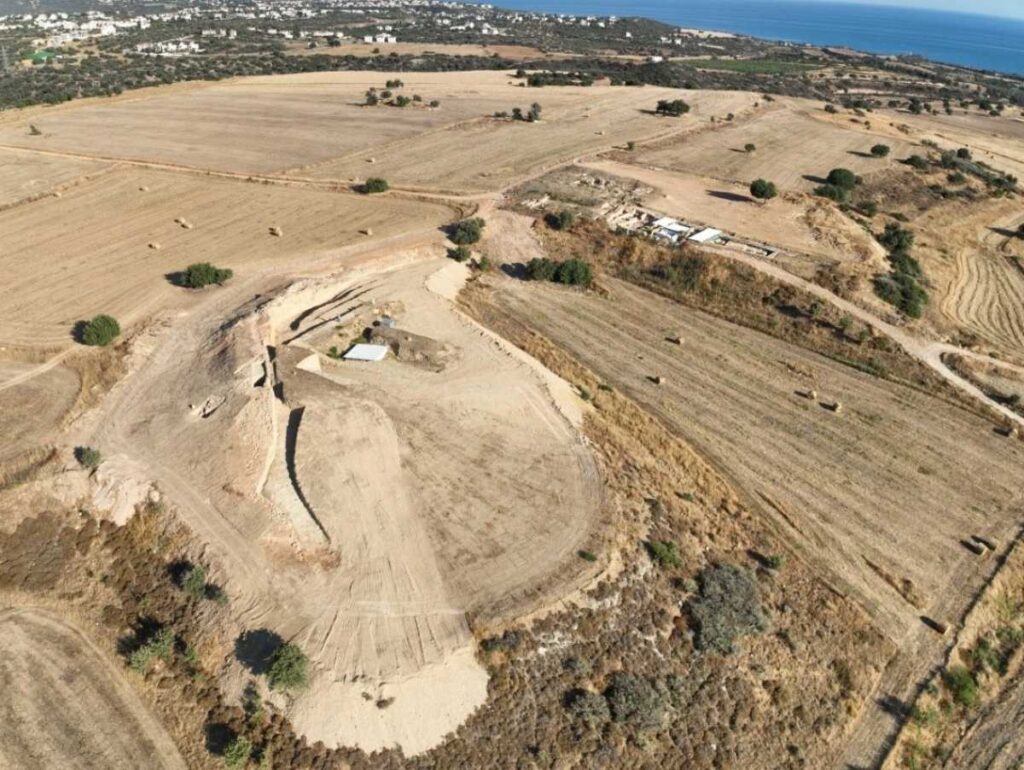
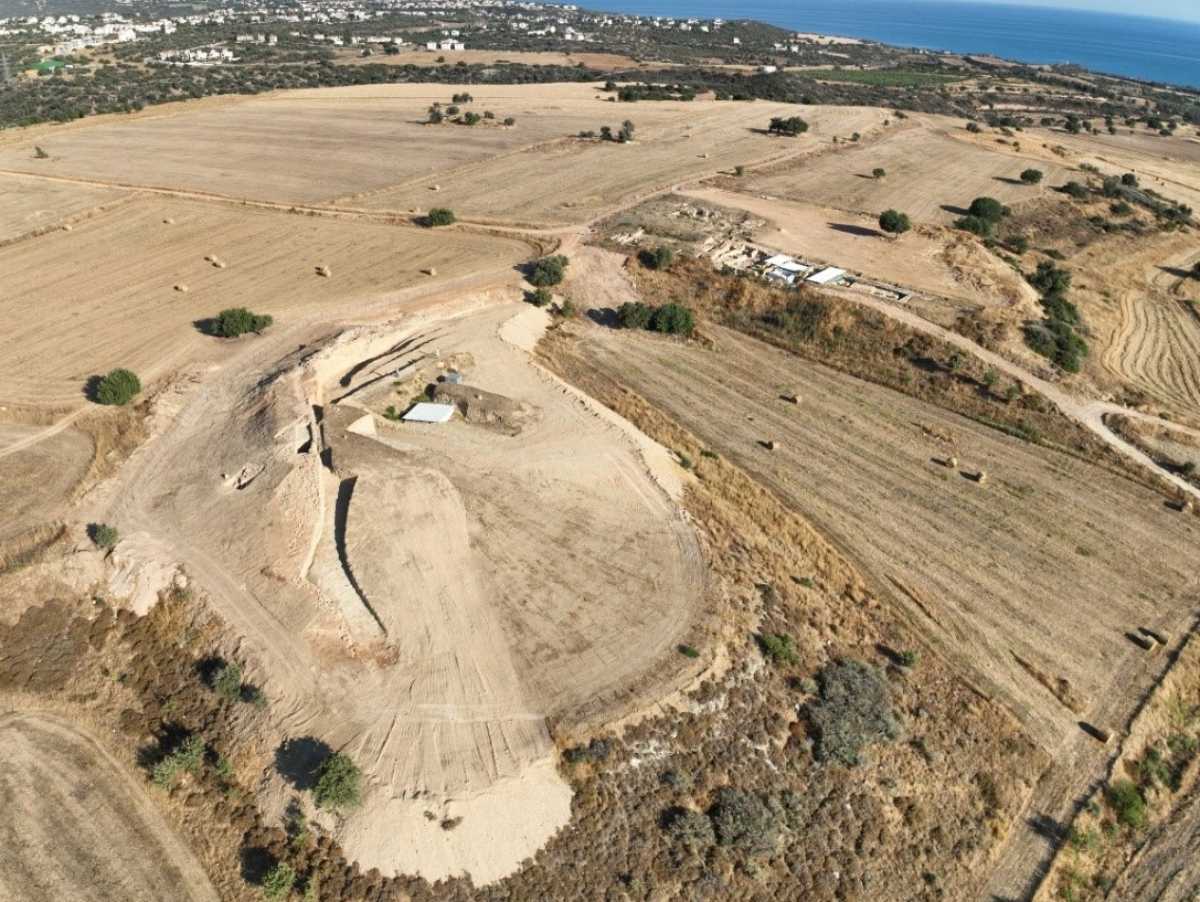
Aerial view of Laona and Chatziaftoulla excavation area at ancient Palaepaphos in Cyprus. Credit: Department of Antiquities
Archaeologists in Cyprus have announced a major discovery following extensive excavations of rare fortifications at ancient Palaepaphos (Greek: Παλαίπαφος), one of the island’s most historic ancient centers. The work, carried out at Kouklia–Chatziaftoulla and Laona, revealed rare defensive and administrative structures that have survived almost untouched for more than 2,000 years.
The excavation was led by Emerita Professor Maria Iacovou of the University of Cyprus, in cooperation with the Department of Antiquities under the Deputy Ministry of Culture.
Excavations uncover massive fortification system
Researchers uncovered large towers positioned between the Laona tumulus and the Chatziaftoulla plateau. These towers appear to belong to a vast fortification wall that once protected the acropolis of ancient Paphos during the Cypro-Classical period in the 5th and 4th centuries BC.
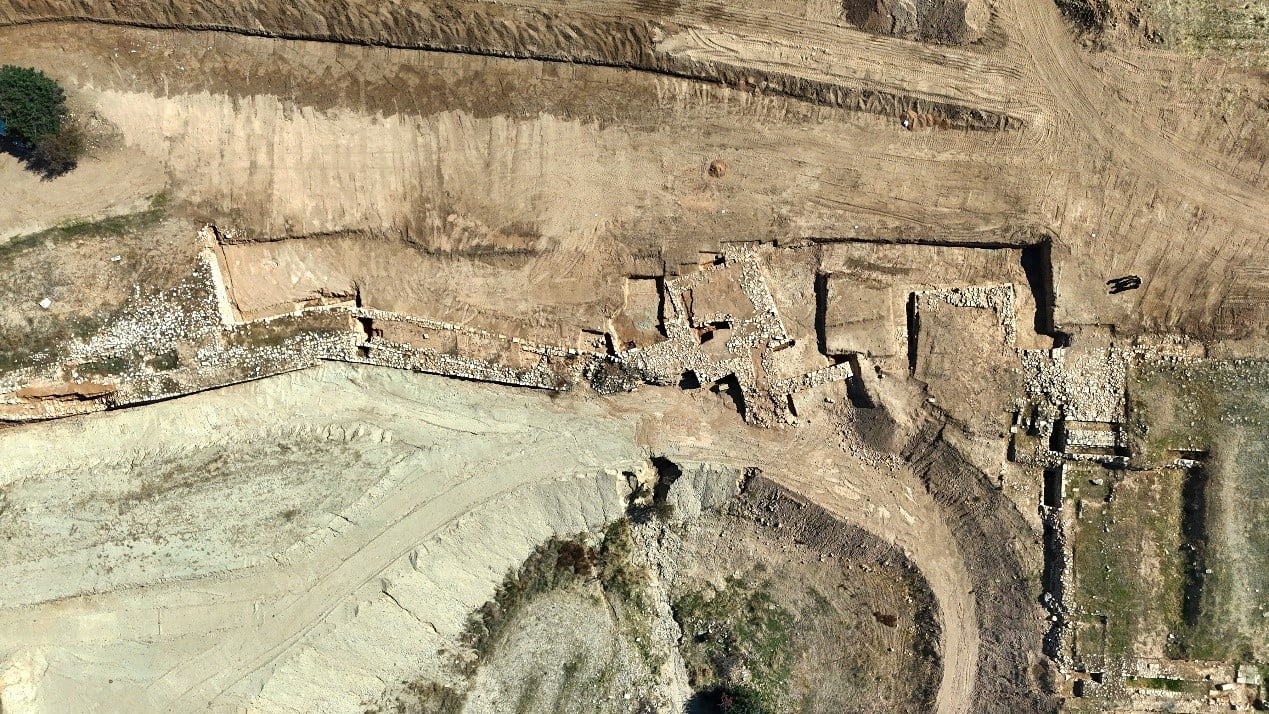
Three towers on the eastern (outer) face of the wall between Laona and Hadjiabdulla. Credit: Department of Antiquities
Excavations took place in two phases, spring and autumn, and finished in October 2025. Archaeologists say the discovery confirms that ancient Paphos was a powerful, well-organized city with strong defenses and planned military structures.
Protection measures secure historic landscape
In the same period, Cyprus’ Department of Antiquities completed a unified protective enclosure around the expropriated areas that preserve the urban fabric of the ancient city. The fenced zone aims to protect monuments and support long-term research.
Inside the protected area, archaeologists continue to investigate key sites, including the palace complex at Chatziaftoulla, an industrial complex to its west, the Laona tumulus, a unique “pseudo-monument,” and the massive Laona wall, which is nearly five meters wide and preserved with staircases beneath its northern and eastern sides.
A network of towers also formed part of the Acropolis wall, protecting the palace and marking a boundary between the administrative center and the nearby necropolis.
Architecture shows skill, scale, and ambition
The newly uncovered defensive structures show high technical skill. The towers and exposed wall sections were built with worked stone blocks and remain preserved to heights of up to two meters. The Laona tower is almost square, measuring about nine by 8.8 meters (28.8 feet), and still preserves walls up to two meters (6.5 feet) high.
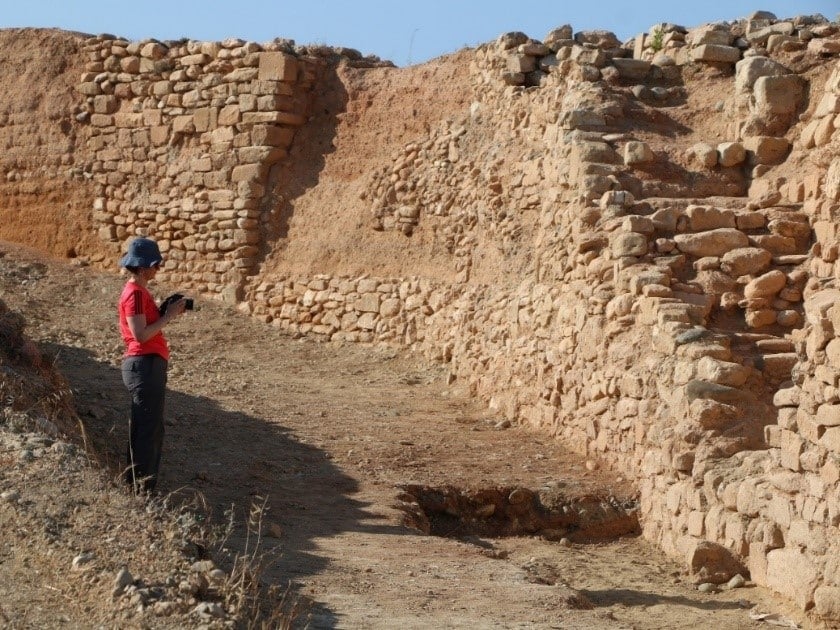
The large wall in Laona (interior view) with one of the staircases. Credit: Department of Antiquities
Inside, archaeologists found a wide staircase leading to the top of the tower, framed by stone parapets and constructed with mudbrick steps, highlighting practical and advanced engineering.
A rare case of ancient preservation
Experts describe the site as a rare survival case in Mediterranean archaeology. No new monumental structures were built over it after 300 BC. As a result, the palace, industrial area, towers, and walls remained hidden beneath only about half a meter of soil in the fields of Kouklia for centuries.
Researchers believe the tumulus may have been completed in the 3rd century BC, after administration shifted to Nea Paphos. Beneath its summit, parts of the ancient wall still stand more than four meters (13 feet) high.
Discovery deepens understanding of Cyprus’s past
Archaeologists say the discovery reshapes knowledge of ancient Cyprus. The findings reveal a wealthy, politically strong city-state marked by defensive power, technical ambition, and organized urban planning.
Ongoing study is expected to provide deeper insight into the political history, economy, and daily life of ancient Paphos, reinforcing its role as one of the most significant archaeological landscapes in Cyprus.