
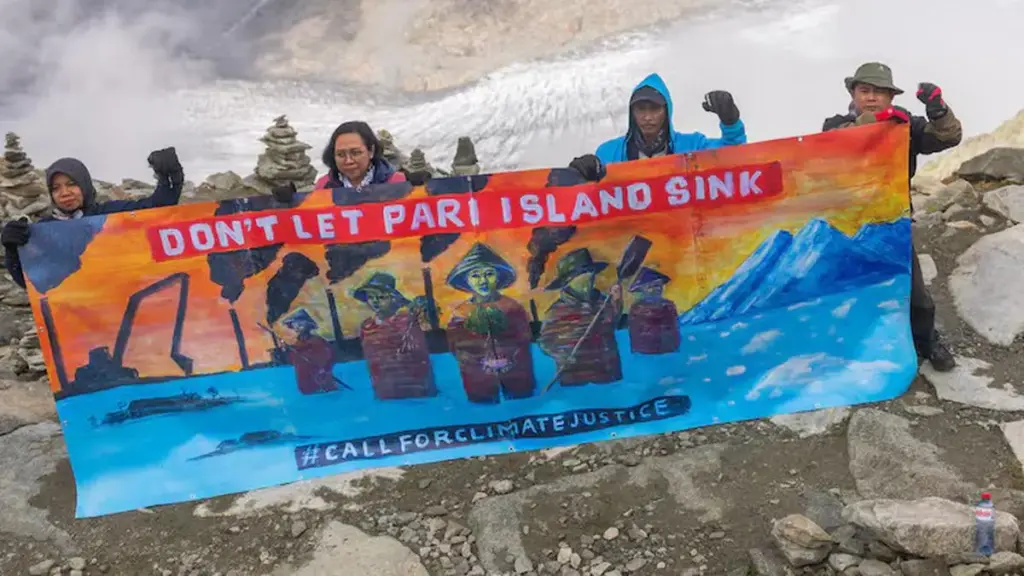
For the first time in Switzerland, a court has ruled that a climate lawsuit against a large corporation was admissible. On Monday, December 22, 2025, the Cantonal Court of Zug, Switzerland, admitted all the demands in the climate case against Holcim Group filed by four Indonesian fishers from Pari who are threatened with the loss of their home and livelihoods owing to sea level rise. In their complaint filed in 2023, they argued that Holcim significantly contributed to carbon dioxide emissions and the climate damage they have suffered, while demanding costs of flood protection measures and a reduction of CO2 emissions by the company. The case also marks the first time that a Swiss corporation can be held legally accountable for its role in climate change. The fishers are supported by Swiss Church Aid, known as HEKS/EPER, the Indonesian environmental organisation, Wahana Lingkungan Hidup Indonesia (WALHI), and the European Center for Constitutional and Human Rights (ECCHR), an independent, non-profit legal and educational organisation, according to a statement from HEKS.
Holcim was responsible for 0.18 per cent of global carbon dioxide emissions from 1854 to 2023, per historical data analysed on the Carbon Majors database. According to a report by HEKS/EPER, it was the biggest player within the cement and concrete industry and among the top 50 largest CO2 emitters in the world. Since 1950, Holcim has emitted over 7 billion tonnes of CO2, which accounts for 0.42 per cent of all global industrial CO2 emissions, or twice as many emissions as produced by the whole of Switzerland during the same period.
The case has been argued since September 2025, and the court’s ruling rejected Holcim’s procedural objections and acknowledged that the fishers deserved legal protection. The ruling was welcomed by the Pari islanders and makes it clear that the complainants—Ibu Asmania, Pak Arif, Pak Edi, and Pak Bobby—have a right to have their case heard by a court.
“We are very pleased. This decision gives us the strength to continue our fight,” said Ibu Asmania in a statement. The court rejected Holcim’s arguments that decisions regarding climate protection should not be negotiated in court and also that Pari island was doomed anyway, clarifying that “every single contribution is essential for counteracting climate change”, according to the HEKS statement. The objection that other cement and concrete producers might generate more emissions if Holcim reduced its own emissions did not convince the court either. This ruling is subject to appeal in the High Court of the Canton of Zug, but the court admitting the case was an important step towards greater climate justice, stated HEKS.
Also Read | Why India’s forests are not storing enough carbon
Responding to the development, Sebastien Duyck, senior attorney, Center for International Environmental Law (CIEL), who has been monitoring the case, said it showed that climate polluters were not above the law. During the hearing in September, the company’s legal representative publicly mocked the complainants by throwing four Swiss francs to settle the case after one of the complainants testified to the impacts of climate change on their lives. The significance of the decision would extend beyond Switzerland and echo other recent cases such as that of the Peruvian farmer Saul Luciano Lliuya against RWE in Germany, he said.
Pakistan farmers’ case
Meanwhile, in another development, 43 farmers in Sindh, Pakistan, are suing two German carbon majors for their role in fossil fuel pollution that is warming the planet with devastating consequences. It was the repeated flooding in 2010 and then in 2022 that devastated large parts of Sindh, which turned the tables for some farmers. They decided it was time to tackle the root cause of the problem, which they understood well, that is, climate change, which was affecting their annual harvests and depriving them of crops and their livelihoods.
Like many other farmers, Abdul Khaliq Laghari lost his entire harvest in the floods in 2022 in Pakistan. Hailing from Kherpur Natan Shah village in the Dadu district of Sindh province, the 54-year-old farmer and teacher now works as a daily wage labourer and is in debt after the floods, which also killed his livestock. He is a member of the National Trade Union Federation (NTUF), a farmers’ union. The 43 farmers hail from the districts of Dadu, Larkana, and Jacobabad. Another petitioner, Ghulam Fizan from Larkana district, lost most of her three-room house and crops and now lives with her family in a single room. She is indebted, and since she did not own the land she cultivated, she cannot even claim compensation. She has now set up a village committee on climate justice.
The farmers’ decision to target two major European polluters—RWE, a power company, and Heidelberg Materials, a cement company, in Germany—among the biggest emitters of carbon dioxide in Europe and demand compensation of 1 million euros for the loss of two harvests, came after extensive discussion on the ways to change their situation from one of despair to one of making polluters responsible, according to Karin Zennig, climate justice expert at Medico International. Medico has been working in Pakistan with two local organisations, NTUF and HANDS Welfare Foundation, since 2010.
The case builds on the fact that the floods in Pakistan, which killed 1,700 people and displaced some 33 million, resulted in a third of the country lying submerged for months—an area equivalent to two-thirds of Germany. The damages were estimated to be $30 billion, according to information from Medico. In Sindh province, crops were destroyed, and livestock that survived died of starvation. Pakistan has contributed less than 1 per cent of global greenhouse gas (GHG) emissions; it ranks first among the top 10 countries most affected by extreme weather events in 2022, according to the Global Climate Risk Index. It suffers from extreme weather events such as heatwaves, droughts, and floods.
By admitting claims against Holcim, the Zug court has opened the door to corporate accountability for historical emissions and climate damage abroad.
| Photo Credit:
Arnd Wiegmann/REUTERS
Zennig said that while Medico was a development aid organisation, it was also concerned about structural issues of poverty, health, and livelihoods, and it repeatedly witnessed the widespread impact of floods in Pakistan. While disaster relief in the form of better resilience and building stronger houses was a priority after the floods in 2010, in 2022, everything that was repaired or rebuilt was destroyed in the catastrophic floods. Village assemblies held meetings to discuss the repeated impact of climate, against which no amount of rebuilding or reconstruction could sustain in the long run.
The decision to get to the root of the problem came from the farmers, Zennig said, and they trained their attention to fixing responsibility on those who had caused the problem in the first place. While the decision to go to court or hold the companies to account came from the farmers, it was not possible for them to step up matters on their own, and therefore, they are now supported by Medico and legal teams from ECCHR.
This case bucks the trend in climate cases, which usually demand that companies reduce their emissions or prevent future damage, by demanding compensation for the loss of two seasons of their harvest of rice and wheat crops. Their claim relies on a principle in the German civil code under section 823, which calls on the perpetrator of a harmful act to compensate for the damage caused. It relies on a legal precedent in the case of the Peruvian farmer Saul Luciano Lliuya against RWE, when a regional court in Hamm accepted that a company could be held liable under the German civil code for climate-related damages abroad. Building on the polluter pays principle, the farmers contend that the companies had a legal obligation to minimise the harm from emitting greenhouse gases and pay proportionately for the damage caused by them. The case will rely on existing data and attribution science and will commission experts to correlate the floods to climate change and fossil fuel pollution.
According to the Carbon Majors database, in terms of historical emissions from 1854 to 2023, RWE contributed 0.38 per cent of global CO2 emissions, and in 2023, Heidelberg Materials accounted for 0.15 per cent of global GHG emissions. In German law, the petitioners first make a demand to the companies to redress the damage caused to them by climate change for which fossil fuel pollution from the carbon majors was responsible. The 43 farmers had sent a formal notice to the companies demanding that they acknowledge their liability and their intention to compensate the claimants. If after four weeks the companies refused the request, the farmers could approach a German court of law. Zennig said that both companies had denied responsibility and did not accept the demand to compensate the farmers. The case will now be filed shortly in a German court.
In response to a query for this article, an RWE spokesperson said: “Our legal opinion is well known: under German law, there is no such thing as civil ‘climate liability’. It would also have unforeseeable consequences for Germany as an industrial location, because it would mean that claims could be made against any German company for all global disasters. As a result, German companies would then be liable for all global climate damage.”
A decade of climate litigation
These two cases mark a decade of climate litigation since the first major success in the Netherlands in a case filed by Urgenda, an NGO, in 2015, where the Dutch government was ordered to scale up its climate ambition and reduction of fossil fuel targets by a court. A new report, “Laying the Foundation for our Shared Future”, by Climate Litigation Network, said climate cases created a legal architecture for climate protection, and a surge in climate lawsuits was forcing governments to set clear rules for national climate action. Governments now have legal duties to keep people safe, pull their weight to limit global temperature rise to less than 1.5°C, protect future generations, and show that their actions match their promises, the report said.
In a statement, Lucy Maxwell, Co-Director of the Climate Litigation Network, said that 2025 “marked a decade since the Dutch Urgenda case—the first time a court, anywhere in the world, ordered a government to take stronger climate action. Ten years on, the world’s highest courts and tribunals are now saying the same thing: climate change is a legal issue; and governments have binding duties to protect people from climate change”.
There have been landmark judgments after which climate targets have been reinforced with amended laws in Brazil, Germany, Ireland, the Netherlands, and South Korea. Some countries, such as the UK and Australia, have rejected fossil fuel projects, and increasingly, communities and individuals are challenging corporate polluters such as Holcim, RWE, Shell, and Total. The report found that those most affected by climate change, including young people, for example, in South Korea and the Pacific Islands, and older generations in Switzerland, have spearheaded legal campaigns.
Also Read | The COP model is creaking under its own rules
The historic verdict by the International Court of Justice in July 2025, which was the culmination of a five-year global campaign by countries such as Vanuatu and the Pacific Island states and their youth, resulted in creating a strong legal framework for governments to form ambitious climate targets and also paved the way for aggrieved countries to claim reparation for loss and damage from polluters.
The failure of the UN climate summits to deliver ambitious fossil fuel reduction targets and scale up finance after the 2015 Paris Agreement has driven legal action to fix accountability and claim compensation in the absence of a binding accountability and enforcement framework. According to the Global Climate Litigation Report: 2025 Status Review, as of June 30, 2025, 3,099 climate-related cases have been filed in 55 national jurisdictions and 24 international or regional courts, tribunals, or quasi-judicial bodies. This continues a trend in climate-related cases filed by 2022 (2,180 cases), 2020 (1,550 cases), and 2017 (884 cases). While cases from the Global South still represent less than 10 per cent in 2025, their share is steadily growing. Since the first recorded climate litigation case nearly four decades ago, litigation covered virtually all aspects of climate governance, biodiversity, and pollution, the report added.
In the absence of committed action and implementation to reduce greenhouse gases, communities on the frontlines of climate disasters seem to have little option but to enforce corporate and state accountability in courts of law.
Meena Menon is a freelance journalist and visiting postdoctoral fellow at Leeds Arts and Humanities Research Institute, University of Leeds.