

WARNING: TEXT CONTAINS DISTURBING DETAILS
Kemal Mrndžić lived a completely ordinary life in America for decades.
He arrived in the Boston suburbs as a refugee from war-torn Bosnia and Herzegovina, but was arrested in 2023.
He is suspected of being one of the guards of the Čelebići camp, where the Serbian civilian population was held and tortured, during the bloody collapse of the SFRY.
He was sentenced to five years in prison. for concealing and making false statements in order to obtain refugee status and later United States citizenship.
“Even if they sentenced him to a year, he was still sentenced,” says Slobodan Mrkajić, a former concentration camp inmate from Čelebić, in an interview with the BBC in Serbian.
Three decades later, the wounds he suffered in the camp still haven’t healed.
“You sit all day, they take you out just to beat you and stretch your legs a little. These are indescribable things, the human mind cannot comprehend them,” adds the 65-year-old who testified against Mrndžić in the US in 2024.
America has now initiated a civil lawsuit against Mrndžić to revoke his citizenship.
Immigrating to the US is a privilege, and if you conceal criminal behavior to fraudulently enter the country, you will eventually be discovered, authorities said.
“One of the specific features of the Yugoslav wars during the 1990s was the existence of a large number of detention centers where civilians were held, including women, children and the elderly,” Jovana Kolarić from the Humanitarian Law Center told BBC Serbian.
“In all of them, there were recorded killings, rapes, beatings, torture and starvation of detainees, held in inhumane conditions – Čelebići is no different.”
About the Čelebići camp
Former barracks of the Yugoslav People’s Army (JNA).
The camp was located on the outskirts of the village of Čelebići, near Konjic, halfway between Sarajevo and Mostar.
From April to December 1992, when it was closed, hundreds of Serb civilians from Konjic and surrounding villages were detained there – mostly men, but there were also women.
Under the control of the Ministry of Internal Affairs of Bosnia and Herzegovina and the Croatian Defense Council At least 14 people were killed, Data is from the Humanitarian Law Center (HLC).
Prisoners were tortured, physically, psychologically and sexually abused.
“They were constantly threatened with murder, taken out to be shot and returned, which is a specific feature of a large number of detention facilities in the former Yugoslavia,” says Kolarić.
“The detainees were made aware at all times that their lives were in danger.”
In Čelebići, they slept on concrete, received little food and water, and sometimes had nothing to eat for three days in a row, according to the portal. Voice of victims, Regional Commission for Establishing the Facts on War Crimes (RECOM).
Slobodan Mrkajić, from the nearby village of Bradina, says he came to Čelebići weighing 120 kilograms and left weighing 50.
“There were days when we didn’t even get a slice of bread, or a small loaf cut so thin you could see through it… I didn’t have a stool for 80 days, so you see what we ate,” says Mrkajić, today the president of the Association of Camp Inmates of the Sarajevo-Romanija Region.
During the daily abuse, they were also “forced to look at the sun”.
“They sat in the sun all day, beaten… And then suddenly he tells you to ‘get up’, and half of you can’t, and if you do get up, you stagger like a drunk,” he recalls reluctantly.
He spent two years and eight months in seven different camps – “in each one, a welcome barricade and a fight,” he says – most of which was in Čelebići, for about five and a half months.
The detainees suffered serious injuries from frequent beatings with various objects – a cable, a chain and a rifle butt, it says. RECOM.
The guards doused some with gasoline, then burned their hands and feet, while they pressed red-hot scissors to the neck of one prisoner.
They were also tortured with objects through which electricity was passed and with a “device for driving or killing horses that produces strong electric shocks.”
It was used as a toy, one detainee said.
One prisoner had his palm branded with a cross, and another had a lily carved into his palm with a knife, the publication states. Camps and other places of detention during the war in Bosnia and Herzegovina.
“Seven of my ribs were broken, my younger brother’s skull was cracked from the beating he received, his eyes were as black as liver,” says Mrkajić.
Several members of his family are on the list killed Serbian civilians from the Konjic municipality during the war in the 1990s.
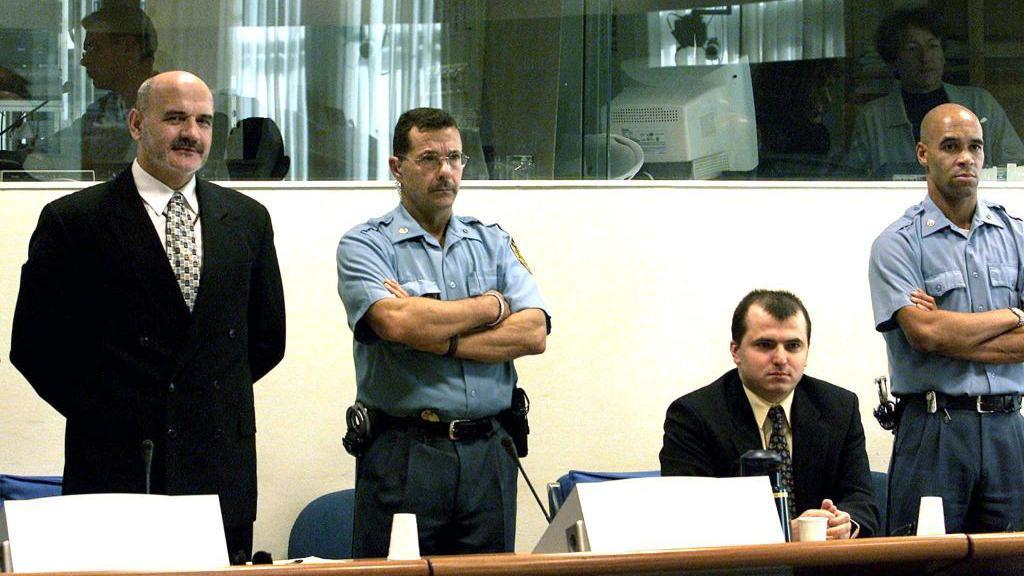
The International Criminal Tribunal for the former Yugoslavia (ICTY) convicted two camp commanders and one guard.
Camp commander Zdravko Mucić was sentenced to nine years in prison, his deputy and later commander Hazim Delić to 18, and guard Esad Landžo to 15 years.
Esad Macić, a member of the Army of Bosnia and Herzegovina, was sentenced in Bosnia to 13 years in prison for a war crime in Čelebići.
Proceedings are underway in BiH against Čelebić. against 10 people: Esad Ramić, Omer Borić, Šefik Nikšić, Adnan Alikadić, Mitko Pirkić, Hamed Lukomirak, Safaudin Ćosić, Muhamed Cakić, Ismet Hebibović and Željko Šimunović.
Getty Images
US authorities claim that Mrndžić was a guard supervisor.
He was questioned about the Celebicis in 1996, but no indictment was filed.
“Conditions in the Celebici prison were extremely difficult,” a statement from a US National Security Agency investigator said.
“Hundreds of prisoners were forced to sit in rows, side by side, on the concrete of a large metal hangar for months, and they slept in the same place, without blankets or bedding.”
Numerous camp inmates testify to the difficult conditions.
They say they were kept in an unlit, airless tunnel for months, and that some were locked in shafts, where they nearly suffocated.
Tunnel 9 – only 1,5 meters wide and 2,5 meters high – contained at least 80 detainees at one point, they write. Center for Democracy and Transitional Justice (CDTP).
Sexual violence has also been recorded, and At least two women were raped.
“They took me to Čelebići on May 27th, we entered the barracks, there was a small room, I saw an unknown man there, who asked me where Lazar, my husband, was.” she stated Grozdana Ćećez, former Čelebić detainee, before the Hague Tribunal.
“I said I didn’t know, he started slapping me, cursing my mother, telling me to take my clothes off, I thought he was going to beat me.”
That’s when she was raped for the first time.
Some of the detainees were exchanged, some were released, and the rest were transferred in December 1992 to Musala prison, a pre-war sports hall in Konjic.
“Kemal Mrndžić is also linked to him, who was also transferred there after the Čelebići camp was closed,” says Kolarić.
About camps and survival
There were around 1.350 camps and other detention facilities in Bosnia and Herzegovina during the war, according to data from the camp inmates’ association.
Of these, 656 detention centers are for the Bosniak population, 523 for the Serbian population, and 173 for the Croat population.
According to estimates from several independent sources, around 200.000 people from Bosnia and Herzegovina, mostly civilians, passed through camps and other detention centers, according to data from the CDTP.
The circumstances in which around 1.000 detainees were killed there have been established, they added.
The camps differ in the length of their operation, the number of detainees, and whether they were under the control of official armies or paramilitary groups and formations, says Kolarić.
In the past, these were only transit centers, where detainees stayed for 24 hours or two or three days, after which they were transferred somewhere else.
There is no record of how many people responsible for crimes in the camps have been arrested and prosecuted, Kolarić adds.
The case of Kemal Mrndžić is not the first in which people have been deported for participating in the war and lying in their document applications, he points out.
This happened in the USA, Australia and Canada.
The procedure is underway for Nadu Radovan Tomanic, a member of the Zulfikar special unit, who will likely be deported from America in early February 2026.
“She also covered up her participation in the war,” says Kolarić.
Most former concentration camp inmates today have a hard time living and no one cares about them, Mrkajić is angry.
“Either a soldier, an invalid, or a concentration camp inmate,” he says briefly.
“They tell me why I don’t write a book about everything I’ve been through – it would be 200 pages for every 24 hours, let alone two years and eight months.”
There are, he adds, more cases like Mrndžić’s that are currently being “pursued”.
During the filming of the documentary Unforgivable, in which Esad Landžo visits former victims with the intention of apologizing to them, Mrkajić suffered a heart attack.
“In front of the cameras, everything… The director says stop, the man is not feeling well,” he says.
“That’s the state I’m in, so I won’t tell you anything anymore.”
In the meantime, he tries to live a normal life – he hunts and fishes and “pushes along with the pills”.
“Three bypasses, a heart attack, diabetes and that’s it, from one day to the next…
“I’ve already been dead 10 times, what if it’s 11th?”
His five grandchildren help him the most.
“They keep me alive,” he concludes.
Follow us on Facebook, Twitter, Instagram, YouTube i Viber. If you have a topic suggestion for us, please contact bbcnasrpskom@bbc.co.uk


News