

Slovakia’s economy is set to remain sluggish, with growth below 1 percent of GDP expected to persist into next year, according to the National Bank of Slovakia (NBS). The weak outlook is already squeezing household finances, while government efforts to stabilise public finances are delivering only limited results.
The central bank governor, Peter Kažimír, has warned that 2025 has been and 2026 will be a “difficult year” not only for the state but for families too.
“We need to acknowledge that – not only for public finances, but for the budgets of every single family,” he said, as quoted by Index.
Real household incomes are falling under the weight of fiscal consolidation, forcing consumers to cut spending – including on basic items such as food – and to run down savings simply to maintain living standards.
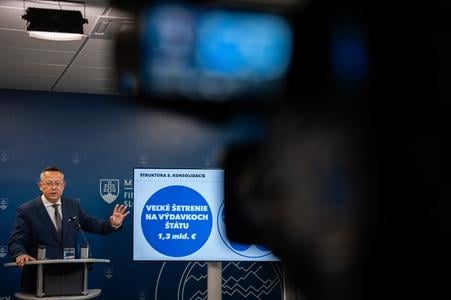
Related article
Most people in Slovakia to feel the pinch of Fico’s third consolidation package
Read more
A recovery in economic growth is being held back by the global economic environment, particularly Germany’s slowdown, which has a strong impact on Slovakia. Fiscal consolidation is also weighing on the economy. While its aim is to reduce the budget deficit, the NBS admits that even a third round of measures will bring only modest improvements.
The deficit is forecast to fall slightly to 4.5 percent of GDP in 2026, but without further action it would rise again, pushing public debt to unsustainable levels. Slovakia’s public debt is expected to exceed 60 percent of GDP this year and continue climbing towards 66 percent by 2028 – a risky trajectory for a small, open economy.
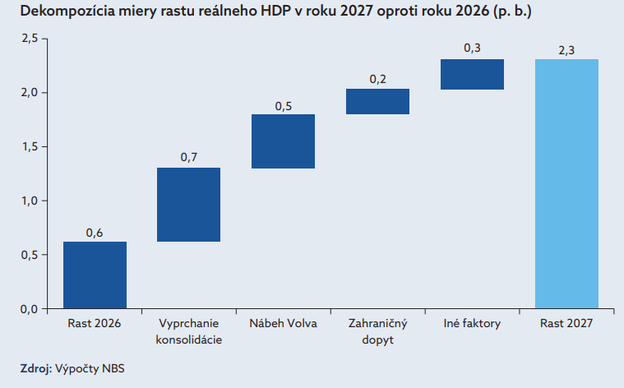
Decomposition of the real GDP growth rate in 2027 compared with 2026 (pp): growth (2026), fading impact of fiscal consolidation, Volvo, foreign demand, other factors, growth (2027). (source: NBS)
“There is a consensus that smaller countries with open economies have a lower threshold than large economies. In our conditions, a debt level of 60 percent of GDP is considered a borderline value,” said Marcel Laznia, an analyst at the Slovak Banking Association, in an interview with Denník N.
The NBS says one-off measures are insufficient and that additional consolidation of at least 0.5 percent of GDP a year may be needed well beyond 2028, meaning austerity is far from over.
VAT increases fall short as tax collection deteriorates
At the same time, higher taxes are failing to deliver their full potential. Although VAT rates have been increased, tax collection efficiency has weakened, reducing the expected gains from both economic growth and consolidation. This year the state is set to collect almost €500 million less in tax revenue from higher VAT and economic growth than forecast.
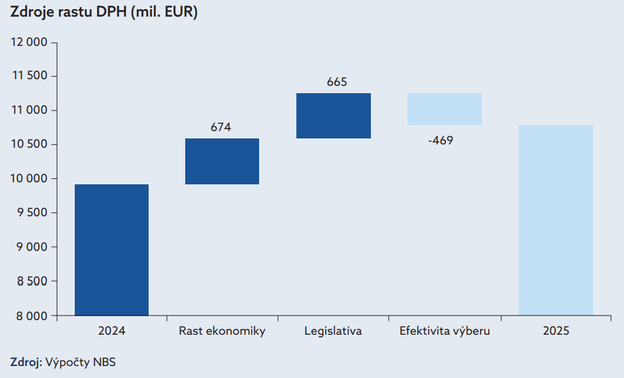
Sources of VAT growth (from left to right): 2024, economic growth, legislation, collection efficiency, 2025 (source: NBS)
Part of the problem lies in the government’s own consolidation measures, which have made the VAT system more complex and expanded exemptions, creating greater scope for tax evasion. Tax collection efficiency in Slovakia improved steadily from 2012, peaked in 2023 and has since declined. According to the NBS, Slovakia could have collected similar revenues this year with a VAT rate around 1 percentage point lower, had collection not deteriorated.
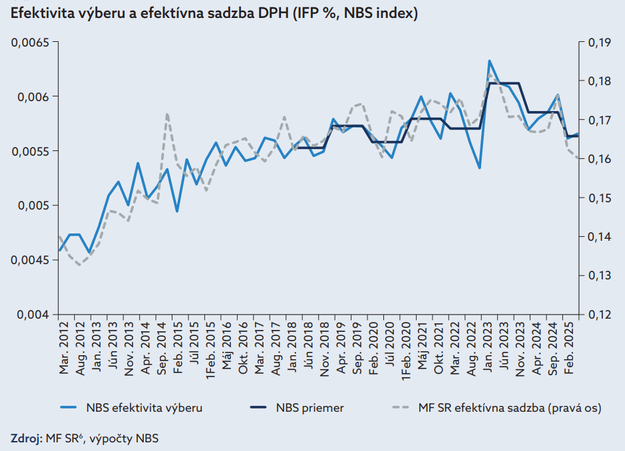
Efficiency of tax collection (light blue) and the effective VAT rate (dashed line) (source: NBS)
Rising spending is compounding the problem. Despite record budget revenues, expenditure is growing even faster, driven by measures such as energy subsidies and 13th pensions. Finance Ministry data show that state revenues rose by €1.56 billion year on year by November 2025, but spending increased by €2.8 billion, worsening the budget balance by €1.24 billion.
Some relief may come in 2027, when parliamentary elections are due and the central bank expects a pause in fiscal consolidation, and in 2028, when economic growth is forecast to accelerate towards 2.5 percent. That rebound is expected to be supported by a recovery among key trading partners and the launch of Volvo car production in eastern Slovakia.
The central bank cautions, however, that any additional consolidation measures after the 2027 election could again dampen growth.
Instead, the NBS’s chief economist, Michal Horváth, says future consolidation should focus on simplifying the tax system and reducing exemptions. The government has partly responded by extending mandatory cash-register reporting to all sellers.
Inflows of foreign workers are increasing
The number of people in work is expected to fall by 20,000 by the end of 2027, driven by adverse demographics, fiscal consolidation and weak economic growth, the NBS says.
-
Employment fell by 0.1 percent quarter on quarter in the third quarter of 2025, driven mainly by declines in industry, trade and services.
-
A mismatch between labour supply and demand persists, with a strong regional dimension.
-
Several regions have recently experienced mass layoffs, contributing to a rise in unemployment. By contrast, firms in western Slovakia continue to face shortages of skilled workers.
-
Labour mobility within the country has yet to improve.
-
Inflows of foreign workers have increased in recent months.
-
The number of economically inactive people is rising, reflecting not only a higher number of pensioners but also more students and people providing care for household members.
-
Short-term survey indicators provide mixed signals: firms’ employment expectations remained slightly positive in the third quarter and early fourth quarter of 2025, while household expectations shifted towards higher unemployment.
Source: NBS
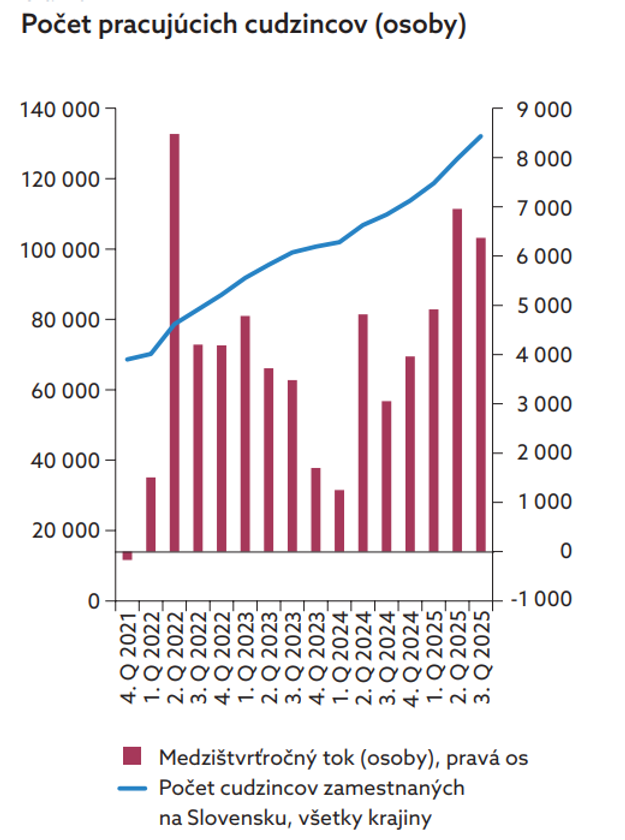
Number of foreign workers (source: NBS)