
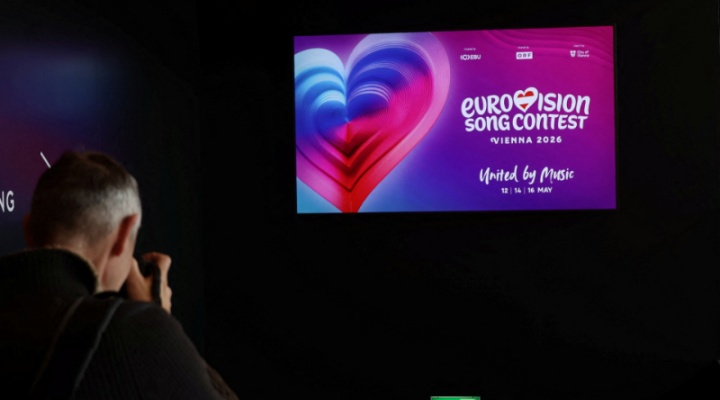
A photographer takes a picture of a TV screen in Wiener Stadthalle, the venue of next year’s Eurovision in Vienna, Austria, Nov. 18, 2025. Photo: REUTERS/Leonhard Foeger
Two collective groups in Belgium and Italy are pressuring their respective countries to withdraw participation in the 2026 Eurovision Song Contest because of Israel’s involvement in the competition, which is set to take place in Vienna, Austria, in May.
A group of 170 Belgian artists and cultural figures signed a petition that called on the country’s national broadcaster RTBF to “honor its public service mission” and pull out of the 70th edition of the Eurovision Song Contest “as long as a state trampling underfoot the very foundations of our common humanity is welcome.” They accused Israel of conducting a “war of extermination waged against the Palestinian people” in the Gaza Strip and of using cultural events to “art-wash” its military actions.
“In our view, this constitutes a serious breach of the ethical and moral obligations of public broadcasters,” read the petition, as reported by French-language Belgian daily La Libre. “Participating in Eurovision allows Israel to maintain the illusion that it is a modern and exemplary Western democracy, and thus to more easily conceal its criminal actions.”
The national broadcasters of Spain, Ireland, Iceland, the Netherlands, and Slovenia have already announced they will not participate in the 2026 Eurovision or broadcast the final on their national television channels, after it was confirmed in early December that Israel will be allowed to compete in next year’s contest.
The union group USB-RAI Coordination, at Italy’s state broadcaster RAI, launched a petition that urged RAI to join the countries “making the courageous decision” to boycott Eurovision 2026 because of Israel’s involvement. The union branch was founded two years ago and has currently around 50 members at the state broadcaster, according to Euronews. Their petition already has more than 7,000 signatures.
“By withdrawing Italy from Eurovision and deciding not to broadcast the event, RAI would not only be taking an ethically and empathetically justifiable stance, but would also be setting a moral example on the international stage,” the USB said in a statement. “Such a gesture would demonstrate how much Italy values human dignity, equality, and justice for all peoples. We would make our voice heard globally, showing that we do not turn a blind eye to injustice.”
Italy is one of the “Big Five” countries (with France, Spain, Germany, and the United Kingdom) that have supported the Eurovision Song Contest since the first competition in 1956. In a statement on Dec. 5, RAI confirmed its participation in the contest and said Italy has “always been among the countries that believed in and invested in the Eurovision Song Contest, contributing significantly, including financially, to its development and international success.”
“In recent years our commitment has grown steadily, testifying to the value we attach to an event that is the longest-running international music show, capable of uniting diverse cultures in a shared celebration,” the broadcaster added. “RAI’s involvement in the competition confirms the determination to strengthen Italy’s role in the promotion of music, culture, and entertainment at international level. RAI supports the participation of the Israeli public broadcaster Kan in the next edition [of the Eurovision].”
On Dec. 11, last year’s Eurovision winner Nemo announced on social media they will return their trophy to the EBU in protest of Israel’s participation in the Eurovision. A day later, Charlie McGettigan, who won the 1994 Eurovision with fellow Irish singer Paul Harrington with the song “Rock ‘n’ Roll Kids,” said he was returning his trophy to the EBU for the same reason.
The Austrian public broadcaster ORF, host of the upcoming Eurovision Song Contest, confirmed last week that it will not prohibit the Palestinian flag in the audience nor censor any booing directed at Israel’s performance.
“We will allow all official flags that exist in the world, if they comply with the law and are in a certain form – size, security risks, etc,” said the show’s executive producer, Michael Kroen. “We will not sugarcoat anything or avoid showing what is happening, because our task is to show things as they are.”
In an effort to pressure Portugal to boycott the 2026 Eurovision, several Portuguese artists announced in a joint statement that they would not go to Vienna to take part in the event because of Israel’s participation.