

Every year-round resident in Ellsworth knows that come summertime, the city is bustling with a significant increase in tourism, affecting everything from traffic, the cost of housing and the number of people simply walking around downtown and spending time in the community.
In those summer months, the patio at Fogtown Brewing Company on Pine Street is a bustling place. The doors are left open, letting fresh air into the taproom, and picnic tables are scattered throughout the outdoor space.
In the fall, the breeze feels much cooler, but the steady business remains, brought by the onslaught of out-of-state leaf peepers and the timeless enjoyment of a beer in autumn.
Once the tourism season draws to a close in November, however, the business sees a steep decline in customers.
“Once we get after that first week in November, we see almost a complete drop-off,” said Fogtown Brewing owner Jon Stein. “We’ll have days where nobody comes in. That will last until about holiday time, so like mid-December through a good amount of January.”
It doesn’t get much better in the new year. From February to April, the brewery sees another decline.
“It’s kind of this dreary, dark, cold, muddy season,” Stein said. “We see a huge drop-off again.”
While most local businesses, regardless of the industry, see a decrease in customers, the impact on the restaurant and bar business and food manufacturers is distinct.
“This is the biggest challenge since we opened. It’s how do we survive the wintertime and how do we make enough money in the summer to sort of subsidize the winter,” Stein said.
The question is a common one, given the fact that so many restaurants across Downeast Maine simply close for the winter months. Places like Bar Harbor see stark evidence of seasonality, but Ellsworth has a more substantial year-round population, over 8,500 residents.
In recent years, more local businesses have tried their hand at the year-round approach, such as Jordan’s Snack Bar, which is offering in-house dining this winter as opposed to their walk-up windows.
The change, which was announced in early November, is just one example of how businesses are responding to the seasonal challenge.
Stein said that Fogtown Brewing probably makes 80% of its revenue from July through September, but he keeps the brewery open in the winter for two reasons, one of which is his staff.
In the summer, Fogtown employs 18-20 people, but seasonal employees have proved a challenge.
“We’re unique because we don’t only have a bar,” Stein said. “We’re also a manufacturing facility, so we’re licensed by like four different state and federal organizations at least because we’re making beer, we’re distributing it, we’re packaging it, we’re selling it through the bar and then we’re also a restaurant. So, all of that means that we have people that are specifically trained.”
This winter, he’s kept on four employees.
“It’s just an attempt to whittle away the overhead to run things as cheaply as possible just because it’s really impossible to make any money in the winter,” he added.
When Fogtown opened nine years ago, Stein said that growth and scale was key during the boom of craft beer making in the 2010s.


Fogtown Brewing Company hosts weekly events to bring in customers, such as live music on the weekends.
COURTESY OF JON STEIN
Since then, Stein said that industry growth has slowed down, the cost of making packaged beer exploded, and people weren’t increasing their craft beer consumption as much as they had been.
“Everything went up,” he explained. “People weren’t necessarily willing to pay that much for a can on the shelves.”
That industry strain has been an added weight on top of being one of the small breweries in the state.
“I increase wages most years to keep up with inflation, and I try to pay everybody fairly. It’s just hugely expensive,” Stein said. “The challenge is to not lose too much money in the winter, but every year, even if we have some really great numbers, there’s still moments of doubt where, without some sort of huge outside investment, it’s not always clear that we’re going to survive to the next year. That’s been the case since we opened our doors.”
Stein said that the other main reason he keeps Fogtown open is for the residents.
“I think we owe it to the community to have things for them to do and a place for people to come where they’re comfortable, where there’s events, where we foster art and music,” he said.
The brewery hosts weekly open mic nights, trivia and live music, as well as other special events. Stein said that although they do sometimes have slow nights, trivia is the most attended.
“All breweries have always been this community hub, and Fogtown is no exception. Our product isn’t just the quality cider or the beer, but it’s the community environment, so we try to provide that outlet, that third space for people to come in, and trivia night really exemplifies that.”
Events are the name of the game at Black Moon Public House on Main Street, which opened in June 2024. In addition to live music multiple days a week, the bar hosts themed nights like cocktails and canvases, gingerbread house decorating and ladies’ nights. While a packed calendar is common all year-round, they often start earlier in the evening in the winter.
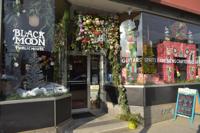
Black Moon Public House welcomes customers inside this holiday season with Grinch-themed holiday decorations.
“You’ve got to really create different events that get people out of the house this time of year,” said Black Moon owner Katina Stanwood. “That’s something that we’ll continue to do throughout the winter.”
The bar has found a familiar routine to maintain interest once the clocks turn back in early November.
“We also use this time of year to make improvements on our menu, make improvements within the building, kind of create an environment even outside that draws people in,” Stanwood said.
She maintains a staff of 10 employees year-round, over 75% of whom have worked for her since the business opened a year and a half ago.
“It’s a dance, but I’m always trying to attract people who are quality to stay in Ellsworth,” Stanwood said. “They don’t have to go to the island. Stay here because we are a year-round business.”
She emphasized that her bar is greatly supported by the local community, and the tourists are just “extra.”
“You know you’re a gateway to Acadia, but you can’t rely on that in Ellsworth,” she said. “It’s too black-and-white, and we have to stay open year-round, so my target is my locals.”
Though she didn’t suggest any worries about lasting through the winter, Stanwood did note that business has been a bit like a “rollercoaster” this season. “One day it’ll be great, the next you’re like, where did everybody go?” she said.
She added that these “little slumps” are normal. “It’s part of business,” she said.
The switch in demand from summer to winter has caused some local owners to look for business elsewhere, in areas that are either not as seasonal or that are seasonal but prosper in the cold weather.
“Ellsworth definitely diminishes,” said Carter Light, founder of Colvard and Company, a sausage company based on Buttermilk Road. “The island is pretty brutal. All the seasonal restaurants that buy from us shut down or they go to limited menus because they’re all trying to do the same thing, so our focus right now is retailers in less seasonal areas or focusing on the seasonal areas but for the winter.”
Light said that business can drop 40% in just a couple of months.
“We all went from this insane summer season where everybody’s just pushing and pushing to the winter, where it’s like okay, we’ve got to figure out what to do now.” Light said. “It just hurts. We’re all in the same boat.”
Light opened Colvard and Company in 2016, but before that, he was a chef at Coda, a restaurant in Southwest Harbor that closed in 2021 due to the pandemic.
“We started going into this wholesale part mostly because it’s more stable than a restaurant,” he said.
He added that in the summer, Coda would serve 200 people a night. In the winter, that number would drop to around 20.
“June, July, August, September and October are your big months, and the rest you’re filling in the blanks, for lack of a better term,” Light said.
Now, Colvard and Company distributes its products to both restaurants and retail stores, employing 13 workers year-round. They augment sales by selling at specialty shows and events; this past fall, they attended Oktoberfest at The Anheuser-Busch Brewery, Common Ground Country Fair and the Maine Harvest Festival in Bangor.

Colvard and Company Sausages for sale at John Edward’s Market Inc. on Main Street in Ellsworth.
Light also works with distributors, who help ship the products farther.
“If you can sell products to other people in other parts of the state, you can still keep people employed here,” Light said. “They’re still producing a product to sell, we’re just not able to sell it here.”
He said they’ve expanded to states like New Hampshire and are still looking for more.
“We’re so thankful to be in [local businesses], but it’s just not enough to keep 10, 12, 13 people employed. So, you have to look to other areas,” Light said. “Orders are larger and that gives us the ability to not have minimums.”
A minimum is the lowest dollar amount or amount of product that a distributor will sell in a single sale.
“Because we’re looking in bigger areas, we can say, just spend $50 and we’ll send the truck,” Light said. “Selling to the bigger places help us be more accommodable … to the smaller businesses as well.”
Black Moon is one of those businesses that receives sausage shipments. In another partnership, Light also worked with Stein at Fogtown to set up their pizza program.
Local businesses collaborate in other ways as well, which may not be as visible as selling a product or contributing to a service.
Stanwood calls it “cross-pollination.”
“The more people you have downtown, the more people move around,” she said, encouraging the increase in foot traffic, regardless of which door customers might walk into.
“That’s what it’s all about. It’s not just each individual business. This is all Ellsworth, and the more we offer, the more people are interested in Ellsworth.”
“I believe that it’s our duty to not only bring people into the brewery but to really collaborate with other small businesses and conservation groups and nonprofits to bolster Ellsworth as a vibrant, small downtown,” he said.
Both business owners acknowledged similar events, such as trivia and live music, but said they try to go out of their way to host them on different nights.
Stein added that there is sometimes a “natural competition.”
“There are only so many people in the area, and they can only spend so much money, especially in this economy … [Customers] want quality food, and they want community experience and to see each other and to be a part of the community. But there’s only so many dollars they can put into that.”
“Ellsworth is the main economic engine for the county’s year-round economy and an important component of the seasonal tourism economy,” the business attraction plan says.
Amongst other initiatives in the works for 2026, the city’s Economic Development Director Twila Fisher said that the Ellsworth Business Development Corporation (EBDC), an economic development organization, has resumed its regular meetings and is working closely with the city to support and retain existing businesses.
“A lot of these things take time but are so important, and I think now the city is really starting to realize what a potential boom that tourism can be,” said Stein, who is also a former city councilor. “We give a lot to tourists, we provide all of these roads and services and infrastructure, but we don’t get a lot.”
He, Light and Stanwood all encouraged investment in housing, for both year-round staff and year-round residents, and Stanwood also added that more public transportation is helpful not just for city infrastructure, but also for the people that don’t drive.
“The city can do a lot more to help its businesses harness that tourism energy, those tourist dollars, in a more effective way,” Stein said. “But it really is an interconnected issue.”