
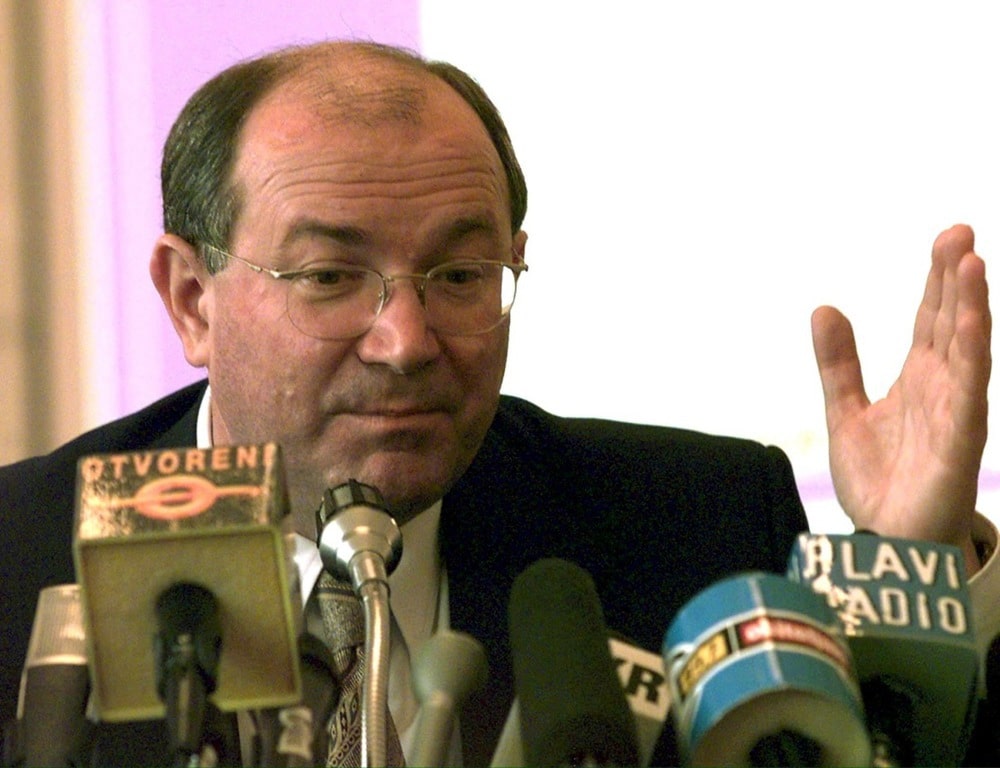
“President Tudjman led the Croatian delegation in Dayton; I was his deputy. It was an extremely competent team: Minister Susak, ambassadors Miomir Zuzul and Ivan Simonovic, my closest associates, and top legal experts,” says Granic.
Milosevic led the Serbian delegation, accompanied by Milan Milutinovic and Momcilo Krajisnik.
On the US side were Secretary of State Warren Christopher, chief negotiator Richard Holbrooke and his deputy, Christopher Hill.
Granic notes that Milosevic and Izetbegovic were in Dayton for the full three weeks, while Tudjman came on three occasions for a total of 11 days. At that time, elections were being held in Croatia, so Granic effectively led the negotiations on behalf of his country.
“The first two days were just negotiations on the peaceful reintegration of the Croatian Danube region,” Granic recalls, adding that the Croatian delegation comprised him, Tudjman and the head of the President’s office, Hrvoje Sarinic.
On the other side were Milosevic and Milutinovic. “Richard Holbrooke led the negotiations,” Granic recalls of the successful mission, which restored Croatia’s eastern border and ended the Serb occupation there that had lasted since 1991.
“The American side accepted, and Milosevic accepted, that the Croatian Danube region would be reintegrated into the constitutional and legal order of Croatia at a precisely set time,” Granic says, of the beginning of the negotiations in Dayton.
Based on these agreements, the Erdut Agreement was later signed on November 12, 1995.
“After that, negotiations were held about the [Bosnian] city of Mostar [where Croats and Bosniaks fought each other], framework agreements on the constitutional order, electoral law, military structure, and everything went according to agreement,” says Granic.
He recalls that establishing Bosnia as a country of three ‘constituent peoples’ – Bosniaks, Croats and Serbs – was his initiative.
“It was very difficult to agree on that with Silajdzic because he wanted a civic state, and I led the negotiations to make it a state of three constituent peoples simply because that was the history of Bosnia and Herzegovina. The Americans gave me their support,” Granic says.
He adds that the most challenging moment came two days before the negotiations ended, when the US said it would submit a proposal for territorial demarcation between the country’s two entities – the majority Serb entity, Republika Srpska, and the majority Croat and Bosniak entity, the Federation of Bosnia and Herzegovina.
In that context, Granic recalls the 1994 Washington Agreement, which ended armed conflict between Bosniaks and Croats.
“It should be noted here that in Washington, it had been agreed that the Federation model would be extended to the whole of Bosnia and Herzegovina – but on September 14, the Contact Group decided that it [Bosnia] would instead be a model of two entities. They presented us all with a fait accompli,” says Granic. That day, they waited in Dayton for the demarcation maps, which arrived very late at night.
“At 2 in the morning, President Tudjman said that we should go to sleep. After 4 a.m., Christopher Hill called me and asked me to come to the American pavilion. I put on my suit and went there – they had already started celebrating. Holbrooke, Christopher Hill, Milosevic, Haris Silajdzic and Wesley Clark offered me champagne. I refused and said I first wanted to see the map of the territorial division,” says Granic.
But the map was covered up.
‘Croatia stood firm’