
By Bronwyn Jones
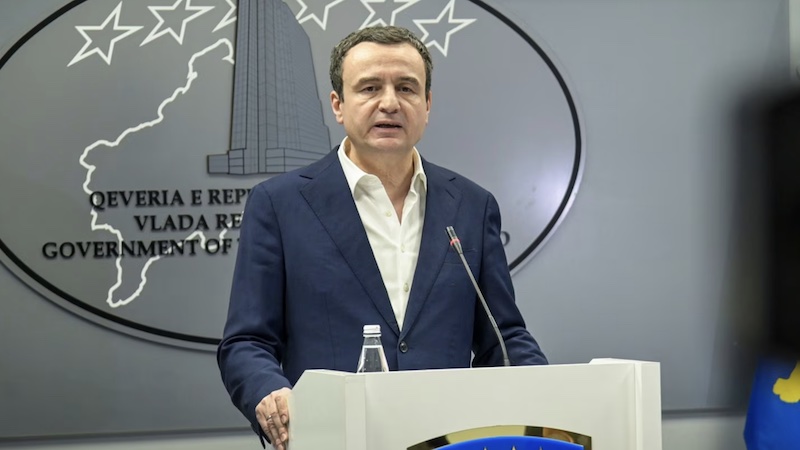
(EurActiv) — Snap elections are set to take place in Kosovo on Sunday, setting the stage for a new round of government formation after nationalist Prime Minister Albin Kurti failed to form a government.
The election results could test Kosovo’s commitment to EU demands, particularly vis-à-vis the Serbian minority. Brussels has consistently called on Kosovo, which applied for EU membership in 2022, to respect a 2013 agreement that would create self-governing autonomous areas in Serb-majority regions. EU officials see the implementation of the agreement and the formation of a so-called Association of Serb Municipalities (ASM) as vital for Kosovo’s eventual EU integration.
But Kosovo’s Albanian majority, which unilaterally declared independence from neighbouring Serbia in 2008, views the ASM as a way for Belgrade to undermine Kosovo’s sovereignty. That has been especially true under Kurti and his Self-Determination Party, Vetevendosje, which has used its time in power to cement Albanian control of Serb-majority areas and abandon commitments Kosovo made to Brussels. His recalcitrance has caused repeated tensions with the EU, pushing relations to an all-time low.
Now, due to political gridlock in Pristina, the international community is hoping that Kosovo will get a fresh leader who is more open to the EU’s policy preferences. But polling is scant, and it’s possible that the election will deliver little more than the same headache for Brussels.
The push for Serb governance
The elections follow an especially fraught period in Albanian-Serb relations that sparked growing frustration in Europe.
Violence broke out in northern Kosovo in 2022 amid a dispute over whether Serbs, who still refuse to recognise Kosovo’s independence from Belgrade, would be compelled to use Kosovo-issued license plates on their vehicles. What followed was an election boycott by Kosovo’s Serbs, who hoped to push officials in Pristina to negotiate. Around 600 ethnic Serb police officers and 144 judicial staff also resigned en masse that year.
Instead of negotiating, however, the ruling Vetevendosje party seized the opportunity to install ethnic Albanian mayors in majority-Serb municipalities. Pristina also began forcibly closing Serb institutions such as post offices and sports halls, both of which were supposed to be integrated into Kosovo institutions through the ASM.
Brussels responded in 2023 by cutting off financial support to Pristina.
This year, however, Serbian politicians once again stood for office in Kosovo. In local elections in October, the ethnic Serb political party Srpska Lista won in every municipality where Serbs are a majority.
Serbs’ return to municipal rule was one of the EU’s main conditions for lifting financial restrictions, and Brussels released some funding to Kosovo on 5 December.
However, that same week, the Kosovo election commission banned Srpska Lista from participating in the upcoming 28 December national parliamentary elections. The EU and other international actors strongly criticised the “politicisation” that “undermines the inclusive process” and demanded that Srpska Lista be allowed to run.
The party was reinstated on appeal, but the clash with Brussels continues.
Church and State
Another symbol of the brewing tensions is Kurti’s failure to recognise the Serbian Orthodox Church (SOC).
The SOC is one of the largest property owners in Kosovo with hundreds of monasteries and churches from the early Middle Ages. Many Kosovo Serbs see the church as their most trusted institution and a focal point of their identity, and around 80% of Kosovo’s Serbs want the church to represent their interests in normalisation negotiations between Serbia and Kosovo.
Recently, SOC properties have been occupied by individuals claiming that empty churches or ruins are, in fact, ethnic Albanian. The occupations appear to be taking place with the tacit permission of the Kosovo authorities.
Despite numerous international agreements obligating Kosovo’s government to recognise the SOC, officials in Pristina have refused to do so.
Veton Surroi, a former member of Kosovo’s parliament, noted that entering the buildings violates the legal framework of the Ahtisaari Plan, which served as the basis for Kosovo’s constitution. Rejecting the plan’s terms means ignoring the deal that allowed Kosovo to become an independent state, Surroi said.
In a July 2025 speech, Kurti argued that the government has “depoliticised the integration of Serbs in Kosovo – not through backroom deals with shady actors, but through law, order, professionalism, and meritocracy.”
But Milica Andrić Rakić, a representative of the local policy organisation New Social Initiative, said that Kurti has long rejected negotiated agreements facilitated by the EU. A large part of the party’s identity is the slogan Jo Negociata (No Negotiation).
“[They] have undoubtedly thrown out previous agreements through their actions,” she said.
Few options for the EU
The Kosovo government’s refusal to implement the terms of various international agreements has created a credibility problem for the EU, which has long been a backer of Kosovo’s statehood.
James Ker-Lindsay, professor and expert on national sovereignty, said that at this point, the EU has lost its leverage in Kosovo.
“There is nothing the EU can do,” Ker-Lindsay said. “If it derecognises Kosovo, it would then legally cede it back to Serbia. But a future deal between Kosovo and Serbia looks very difficult to imagine happening now.”
With the new elections and the return of Serbs to parliamentary power, 2026 could be tumultuous for Kosovo. And it’s unclear whether Brussels can do much to change the facts on the ground, or move Pristina forward on its European path.