
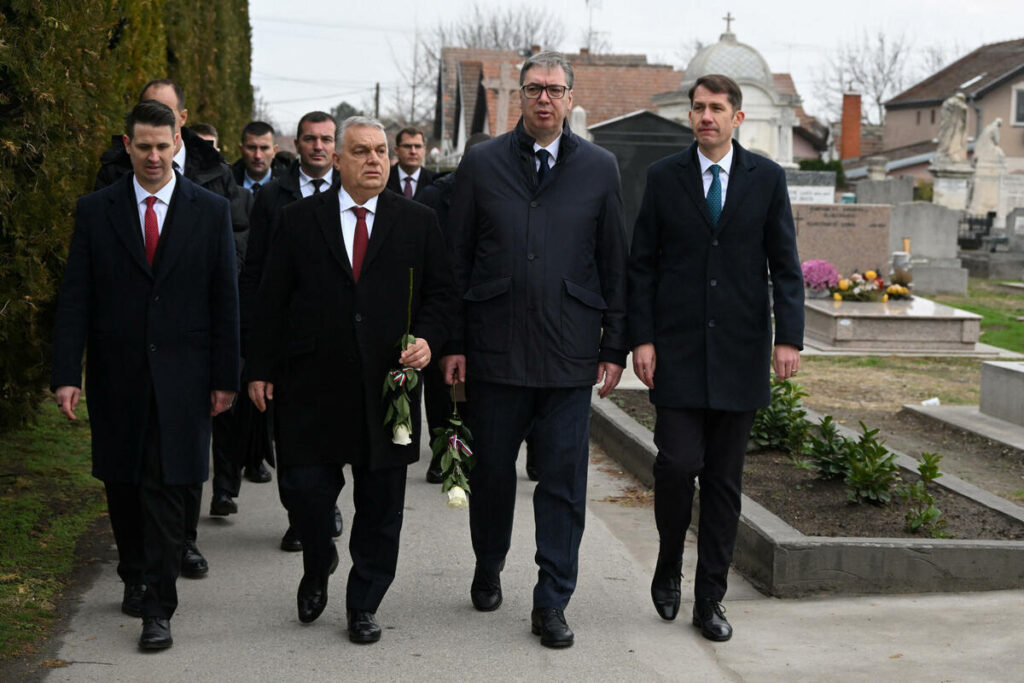
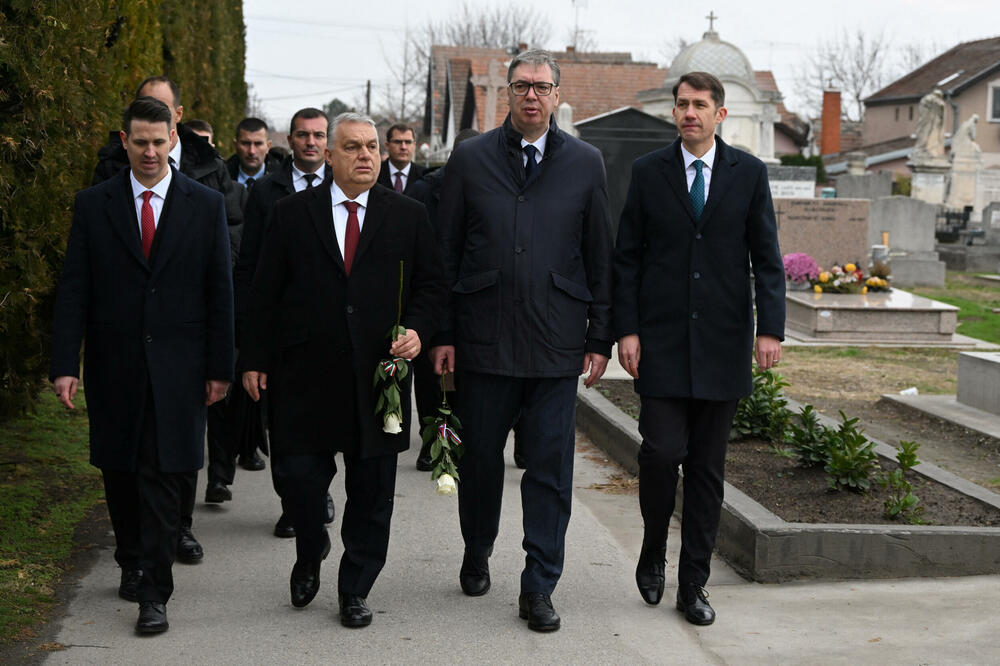
Vučić with Hungarian Prime Minister Viktor Orban in Subotica on November 27, Photo: Reuters
Russian energy giant Gazprom is negotiating the sale of its majority stake in the Oil Industry of Serbia (NIS) to the Hungarian company MOL, Serbian President Aleksandar Vučić announced yesterday.
The United States announced sweeping sanctions on Russia’s oil sector in January over Moscow’s war in Ukraine, but their application to NIS was repeatedly delayed before finally taking effect on October 8.
“We have information that Gazprom representatives are talking, among others, with the Hungarian company MOL, and we have nothing against that, the Hungarians are our friends,” Vučić told reporters at the Palace of Serbia yesterday.
“We need to finish this as soon as possible, by January 15th,” the president said, adding that US sanctions have been in effect for 75 days and that there have been no shortages so far.
Vučić, however, said that there is no way to import enough diesel on a daily basis and that the problem needs to be solved as soon as possible.
“That date is approaching and I hope a solution will be found before then. If not, what should I do,” he said.
Reuters writes that banks have suspended payment transactions with NIS due to sanctions and recalls that the Croatian oil pipeline JANAF has stopped delivering crude oil to the refinery in Pancevo.
The largest single owner of NIS is Gazprom Neft, the oil arm of Russian energy giant Gazprom, with a stake of about 45 percent. The Serbian government owns almost 30 percent, while about 11 percent is owned by the St. Petersburg-based company ‘Intelligence’, which is indirectly controlled by Gazprom. The rest belongs to minority shareholders.
Vučić also said yesterday that Serbia has an agreement with Russia to extend gas supplies for another three months, until March 31st.
“People can be safe and sleep peacefully, Serbia will have both electricity and enough gas for the upcoming winter season.”
The long-term contract for supplying Serbia with Russian gas expires at the end of this year.
Moscow is using NIS and gas to blackmail and warn the Serbian government not to side with the European Union (EU) and the US because it is absolutely dependent on Russia in the energy sphere, former diplomat Srećko Đukić said.
Commenting on the extension of the gas agreement with Russia for just three months, Djukic told the Beta agency that the situation with Russian energy sources in Serbia is becoming more complicated and that there is every chance that Serbia will be left without Russian gas.
“Considering how Russia is reducing the deadlines for gas deliveries and is moving away from concluding a long-term agreement, there is every chance that, in addition to being left without Russian oil, we will also be left without Russian gas. The Russian government has already announced that they do not want to abandon the NIS oil refinery in Pančevo at any cost, and by tightening the gas arrangement, Moscow has sent two messages to the authorities in Belgrade: to stop pressuring to resolve the problem with NIS in a way that does not suit Russia, and the second message is to show that Serbia is absolutely dependent on Russia in the energy sphere,” said Đukić.
The authorities in Moscow have told Serbia, he added, to choose Russia when choosing between the West and Russia.
“This is such an unenviable situation that even the biggest opponents of Russian energy in Serbia could not have foreseen this kind of entanglement and blackmail that Serbia is experiencing. It is up to the authorities in Belgrade to decide what to do. If they side with Russia, the West will not allow Russian energy in Serbia, and if they side with the West, Russia can respond by cutting off gas supplies,” said Djukic.
When asked whether Russia would find a solution for NIS within the 50-day deadline that Vučić gave to Russian President Vladimir Putin, which expires on January 15, Đukić said that Putin gave a cynical response to that ultimatum.
“Putin told Vučić that the Serbian leadership is friendly, and he outlined the price of over 3,5 billion euros that Serbia would have to pay for the Russian share in NIS, and he said that Serbia has no choice because it has been playing the Russian energy card all along. He also said that it is not Russia’s problem that Serbia could be left without energy, but Serbia’s relations with the West. Serbia is being blackmailed by both sides, and this is the result of our government’s long-standing short-sighted foreign policy in the field of energy, because it has not diversified its sources of oil and gas, nor its supply routes,” said Đukić.

News