
By Rade Veljanovski
Professor emeritus at the Faculty of Political Sciences
Rule by the people has never truly occurred anywhere in the full sense of the term, not even when, in ancient Greece, the inhabitants of a polis gathered at the agora to discuss and decide on important issues. At home, slaves awaited them, unfree and regarded as inferior beings. Yet the idea of democracy nevertheless made its way through history and over the centuries became not an ideal, but the best possible framework for governing a human community.
In a democracy, the possibility of choice, commitment and free expression of views constitutes the basic set of instruments for caring for the common good.
It happens, however, that life circumstances, poor judgement and mistakes create a situation in which democracy becomes an illusion, its mechanisms are abused and serve not the interests of all, but those of an individual and a group loyal to him. Serbia is clearly in such a state, and it is no consolation that this is not the first time.
Arbitrariness of the few
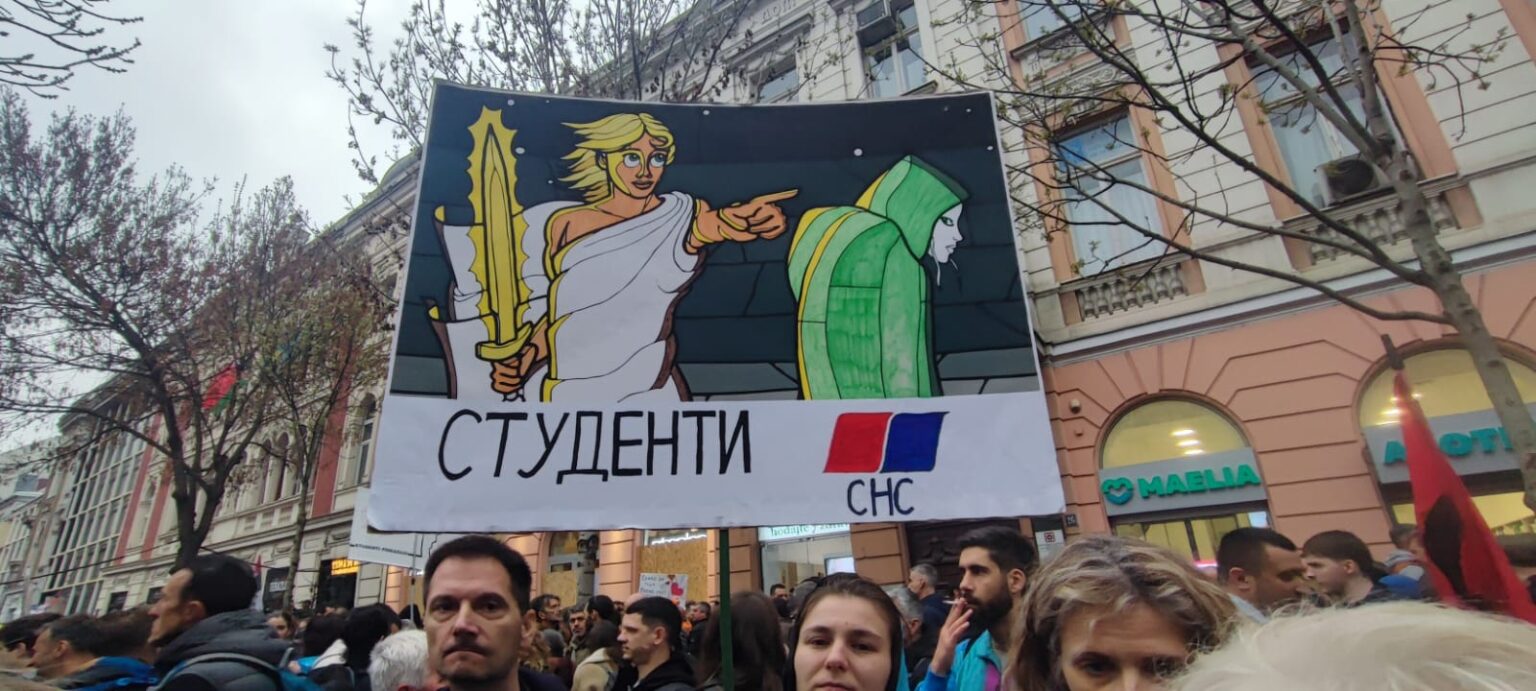
Protests have been going on for more than a year, with people in the streets, squares and on roads: students, school pupils, workers and citizens. They are dissatisfied, they want change, they do not want an authoritarian, corrupt and self-serving government. The more the regime is criticised and exposed, the more it renews itself through rigid and violent means, moving further away day by day from the principles of the Constitution and the law, from civilisational values, democracy, Europe, its own people and their future.
The ruler’s delusion that he knows best what is good for the state, the people and the destiny of the country inevitably leads to the view that all those who think differently, who have objections, different ideas or proposals, are opponents, enemies, foreign mercenaries or terrorists of a so-called coloured revolution. The regime wants to demolish and build, invest, sell, give away and transfer what belongs to everyone, to incur debt, without being accountable to anyone. That is why it panders to like-minded supporters who cheer the leader, but even that is not enough.
Aleksandar Vučić needs his own judiciary, prosecutors, lawyers, his own universities, schools, journalists, media, associations, his own police, army and paramilitary forces. And he has them. So that no sheep strays and leaves its fleece in the bush by the roadside.
The regime also wants to have its own oil industry, but it cannot, because it was handed over at a knock-down price by predecessors to “brotherly” Russia, which was supposed to preserve Kosovo for us. If they have it, then so do we is the reasoning embraced by the current government as well, so we are now being crushed energetically between two of Vučić’s great friends, Putin and Trump. That is the independent, sovereign policy by which we have been childishly pushed between hammer and anvil, while European institutions point out to us that we are not sufficiently on the path of reforms, that we lack the rule of law and that we have identified ourselves too closely with the interests of Russia and China.
On the other hand, perhaps out of an excessive desire for things to be different, there are unfounded remarks about a regime on the verge of collapse, about its instability and terminal condition. In the past year alone, during the period of the largest protests, Vučić appointed Đuro Macut as prime minister, Dejan Vuk Stanković as minister of education, Boris Bratina as minister of information and telecommunications, and Dragoslav Bokan as chairman of the board of the National Theatre. After the demolition in Hercegovačka Street, without any judicial epilogue, construction of Belgrade Waterfront continued, metastasising along the banks of the Sava and soon the Danube; the old bridge and Hotel Yugoslavia were demolished despite mass opposition by citizens. Expo is progressing, and soon there will be an American hotel on the site of the General Staff complex. Does this show the weakness of the authorities?
All of this are indicators of authoritarianism and disregard for the will of citizens, that is, a departure from democracy, sometimes perhaps a nervous display of the regime’s power, but it is hard to see it as proof of its imminent collapse. In the recent local elections, the regime nevertheless won.
From virtue to flaw
Changes are therefore necessary. Are we doing enough to achieve them, and are we doing it in the right way?
The demand for early elections has once again been seen as the right solution, but this time opponents of the regime pushed it into the hands of students without a clear idea of how it would ultimately be carried out, and even less of what their own role would be, apart from supporting and waiting. Students were initially the voice of rebellion and protest, demanding justice, and they did not want to be political actors in the true sense of the word, but in the meantime they have become precisely that.
The demand for elections is unequivocally a political act, and politics is a serious matter, one that entails responsibility, and responsibility cannot be anonymous. In theory, and for a long time in practice, politics implies governance, interest and publicity. Depersonalisation, which at the outset was a virtue of the student movement, is now becoming a flaw. Republican governance is, in fact, based above all on publicity.
Is it serious, responsible and realistic to pledge in advance that we will support a student list “whoever may be on it”? The view that announcing the student list now could trigger an avalanche of satanisation of those on it by the regime raises many questions. Is it really better for satanisation from all regime weapons to occur just before the elections, when there will be no time for reasoned responses either from those being demonised or from those who proposed them? By what logic do students know best which individuals are a salvation for Serbia? Why are only the regime’s reactions to a potential list being considered? Do citizens who want change not have the right to express their views on it through public debate, but are instead expected to give blank-cheque support? What does that have to do with democracy?
If we accept that a mysterious list will be filled with names of individuals so unquestionable that they are granted absolute trust because they are competent, independent and incorruptible, why are they given only a temporary status, merely to call proper, fair elections afterwards? After early elections, new elections cannot follow immediately. At least a year is needed, more likely two. If the names on the student list are so outstanding, it is possible that they later turn out to be weaker candidates, and it is also possible that temporary rulers fail to show political skill, disappoint the public, and thus create an opportunity for the current rulers to return through the front door. Is anyone thinking about this? All credit to the students, they have done a great deal, but if their plenums are the highest achievement in learning democracy, as is being said, why is this form of communication reserved only for them and not extended to society as a whole?
Just before the New Year, students will be collecting signatures for a petition calling for elections and organising a large rally. There was 15 March, then 28 June, now it will be 28 December. In the meantime, countless gatherings, protests, blockades, clashes, inappropriate reactions by the police, not to mention masked hooligans. What is the argument that Vučić, who makes all the decisions, will now give in? If not, then a general strike, everything comes to a halt. A general strike under conditions in which trade unions have been devastated and the regime’s electorate is privileged on a daily basis? In any case, nothing will stop for Vučić; he will have heating, transport, food and music from Ćaciland.
Abandoning illusions is necessary. There will not be a single list. Let students make their own, but as soon as possible and publicly. Opposition parties must go to the elections; that is their duty. If not with one list, then with two. It should not need to be said what happens if together they win more than half the votes. There is no guarantee of change, but it can be a beginning. That is a possible way out of the dead end and a return to the path of democracy, if naivety and a mere desire for change are not our only assets.
(Radar, 23.12.2025)
https://radar.nova.rs/politika/pobuna-u-srbiji-demokratija-u-slepoj-ulici/