
It is good to know which side of one’s bread is buttered. The older I get, the less cynical that phrase sounds and the more accurate it becomes. In a Europe currently gripped by moral theatrics, diplomatic hedging, and fashionable outrage over Israel, a few countries have quietly chosen something far less glamorous but far more consequential: strategic clarity.
Greece is one of them.
At a moment when much of Europe is engaging Israel with a long pole – issuing condemnations, suspending cooperation, or offering lectures from the comfort of distance – Athens has done something refreshingly un-European: it has acted in its own long-term national interest, and in doing so, deepened a friendship with Israel that is paying tangible dividends.
I find this deeply reassuring. Not because Israel needs validation from Europe – it has long learned to survive without applause – but because genuine partnerships, built on shared threats, shared values, and shared capabilities, still matter in a world addicted to symbolism over substance.
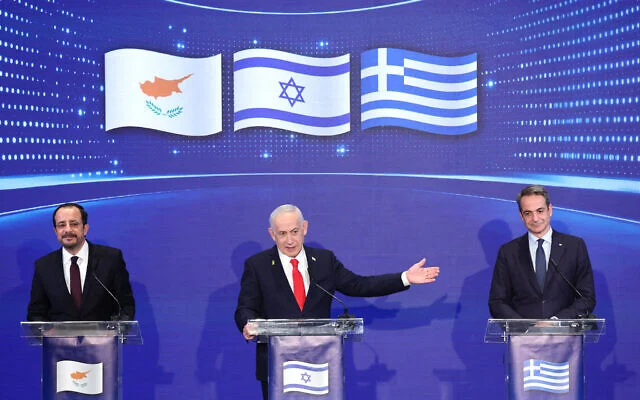
This week’s trilateral summit in Jerusalem between Israel, Greece, and Cyprus is not merely another diplomatic photo opportunity. It is the visible tip of a relationship that has been maturing for over a decade, quietly and deliberately. Prime Minister Benjamin Netanyahu’s meetings with Greek Prime Minister Kyriakos Mitsotakis and Cypriot President Nikos Christodoulides speak to something deeper than polite alignment. They reflect a convergence of strategic realities in a volatile Eastern Mediterranean.
For Greece, the calculus is straightforward. Turkey’s expanding military posture, its assertive maritime doctrine, and its increasingly erratic regional behavior are not abstract concerns debated in university seminars. They are lived realities across the Aegean and beyond. Deterrence is not optional; it is existential. I was in Turkey recently, and the murmurs were unmistakable.
Israel understands this instinctively. Its people, too, live in a neighborhood where wishful thinking is a luxury and preparedness a necessity. This is where the friendship becomes more than rhetorical. Israel does not simply offer solidarity – it offers capability.
Greek defense modernization today is unimaginable without Israeli technology. From advanced drone systems and precision artillery to air and missile defense architectures modeled on Israel’s layered systems, Athens has found in Israel a partner forged in operational reality, not theoretical doctrine. Israeli defense firms are not selling catalog products; they are embedding hard-earned battlefield knowledge into Greece’s security architecture.
This is what real partnership looks like.
It is also why the reported discussions around a joint Israel–Greece–Cyprus rapid-response framework – whether or not they materialize into a standing force – matter symbolically and strategically. Even the act of coordination sends a message: deterrence is collective, and aggression will not be cost-free.
Predictably, not everyone is pleased.
Turkey, watching this alignment solidify, has made its displeasure known. Turkish commentators decry an “axis,” accuse Israel of destabilization, and warn of encirclement. The irony is hard to miss. Ankara’s own actions – its militarization, its maritime brinkmanship, its inflammatory rhetoric – are precisely what drove Greece and Cyprus to seek deeper cooperation with Israel in the first place.
Cause, meet effect.
What strikes me most, however, is the contrast between Greece’s clarity and the hypocrisy of some of Israel’s louder European critics. The same governments that denounce Israel in international forums quietly rely on Israeli intelligence, Israeli cyber expertise, Israeli innovation, and Israeli deterrence models. They benefit from Israeli stability while scolding Israeli self-defense. Greece, to its credit, has chosen honesty over duplicity.
This is not blind allegiance. Athens does not agree with Israel on everything, nor should it. But friendship is not about uniformity of opinion; it is about reliability when it counts. In moments of pressure, Greece has refused to join the performative pile-on. Instead, it has doubled down on cooperation – in defense, energy, innovation, tourism, and emergency response.
Energy cooperation, in particular, tells an important story. While grand pipeline dreams like EastMed have faded, quieter and more achievable projects – electricity interconnectors, grid integration, and regional energy resilience – continue to bind Israel to Europe through Greece and Cyprus. These are not headline-grabbing initiatives, but they are the infrastructure of long-term stability.
And then there is Gaza.
Here, too, Greece has demonstrated a maturity absent in much of Europe. Rather than indulging in maximalist slogans, Athens has signaled a willingness to play a constructive role in the “day after” – potentially contributing engineering or logistical support within an international framework. That matters. Israel cares deeply not only about who helps rebuild Gaza, but how and under what mandate. Trust is not automatic; it is earned.
For Israel, Greece offers something invaluable: strategic depth without moral posturing. For Greece, Israel offers something equally vital: proven resilience, cutting-edge defense innovation, and a partner that understands what it means to live under constant threat.
This is where the broader theme emerges.
Israel’s story, especially since October 7, has been one of resilience and renewal. Israelis absorb blows, mourn their losses, and then rebuild – stronger, smarter, and more determined. They innovate not because it is fashionable, but because survival demands it. That same instinct now animates Israel’s regional partnerships. Israel is not retreating into isolation; it is refining its alliances
Greece has recognized this – and chosen wisely.
While others wag fingers, Greece studies systems. While others issue statements, Greece signs agreements. While others posture, Greece prepares. That is not cynicism; it is statecraft.
And here is the quiet truth Europe would rather not confront: the future belongs to countries that align values with capabilities. Israel is not merely a country defending itself; it is a country innovating the future of security, energy, and resilience under fire. Those who engage with that reality gain far more than those who boycott it.
In time, today’s moral grandstanders may rediscover pragmatism. They usually do. When they do, Israel will still be here – building, innovating, defending. Greece will be here too, better protected, better prepared, and better positioned because it chose partnership over pretense.
Friendship, after all, is not measured in press releases. It is measured in trust, technology, and the courage to stand together when it is easier not to.
Greece understood that. And Israel will not forget it.