
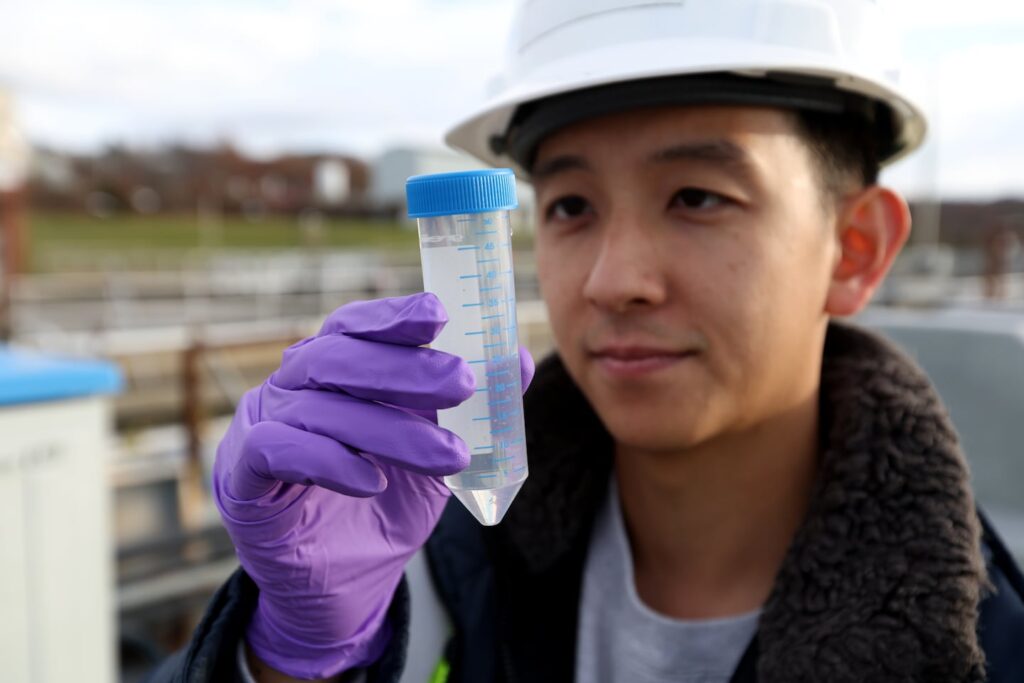
If the world can’t cut it’s fossil fuel addiction and other sources of emissions quickly enough to reign in climate change, removing greenhouse gasses from the atmosphere is plan b. And companies like CREW Carbon offer a more cost-effective model to do that: embedding carbon removal directly into existing infrastructure rather than building processes from scratch.
“We don’t need massive new infrastructure or subsidies,” said Joachim Katchinoff, the company’s cofounder and CEO. “And because our process delivers real operational and cost benefits, it creates a win-win for utilities and for the planet.”
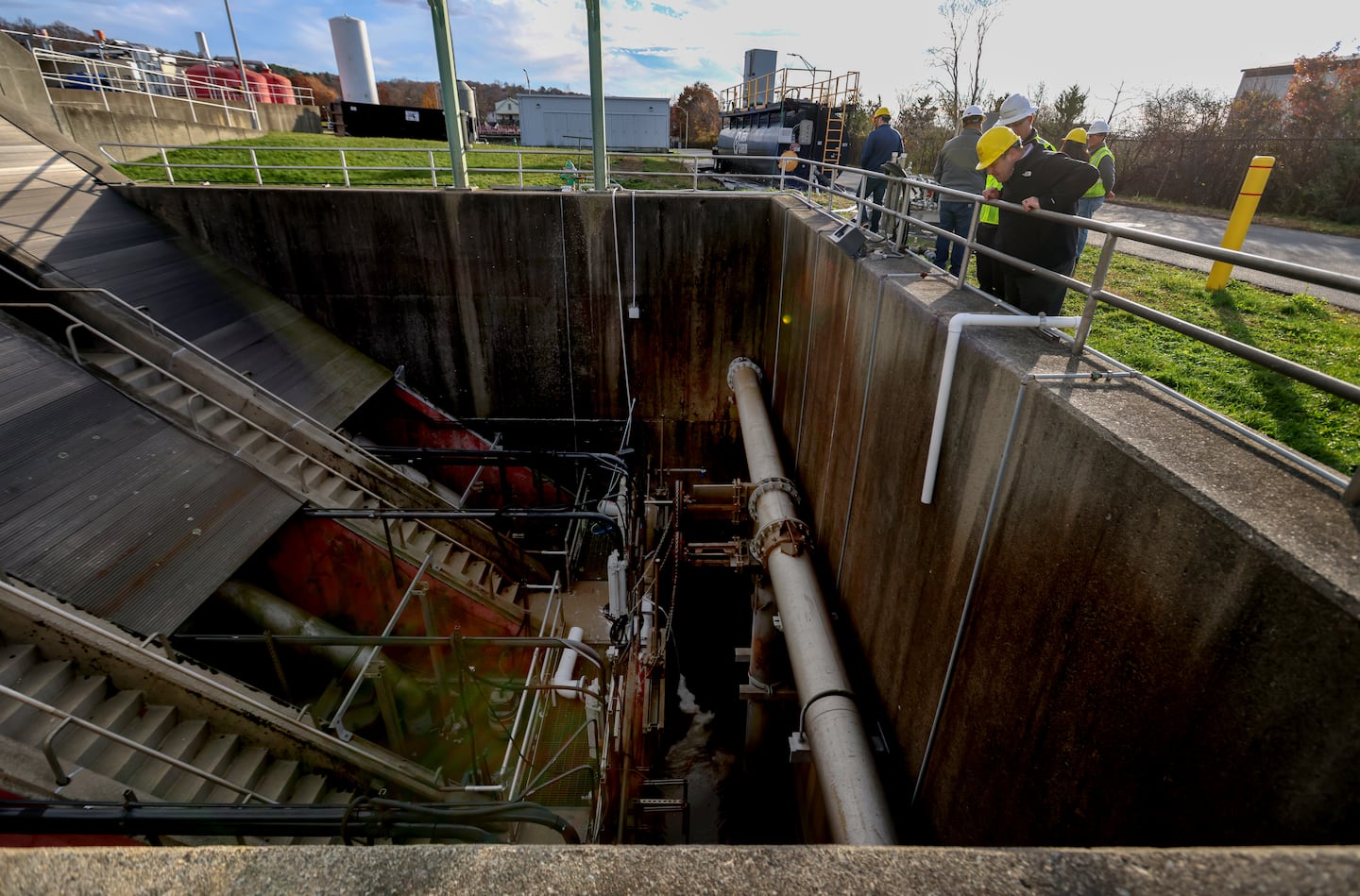 Limestone is mixed in with waste water at the bottom of this tank at the Fall River facility.Jonathan Wiggs/Globe Staff
The company grew out of research at Yale and was founded in 2022 by Katchinoff and Noah Planavsky, a geochemist and Yale professor.
Katchinoff completed a PhD in geological and Earth sciences at Yale, and while there, he worked with researchers to identify waste water treatment as an opportunity to remove carbon by adding minerals that improve the water’s ability to neutralize acid.
CREW Carbon partners with waste water facilities to treat the waste water with limestone. The calcium carbonate in the limestone rock reacts with carbon dioxide in the waste water, a byproduct from the breakdown of biological waste, to produce bicarbonate ions. When the water flows out of the plant, the company says, the dissolved ions eventually make their way to the ocean, where they can be stored for thousands of years.
Katchinoff estimated that a single treatment plant can remove thousands to tens of thousands of tons of carbon dioxide annually. The startup sells carbon removal credits, a way for companies to pay to offset their climate pollution. CREW Carbon is one of the first companies to deliver credits in New England.
The municipalities benefit as well. Some waste water treatment plants see cost savings and increased safety for workers by using limestone instead of chemicals for controlling pH. The limestone also can yield cleaner water flowing out of the plant. And in some cases, CREW Carbon is sharing revenue with the treatment facility from the carbon credits it sells.
Erik Adcock, the startup’s commercial lead, said CREW Carbon’s initial pitch to waste water treatment plants focused on the climate impact. But when the other benefits became clear, the company switched its approach: “We started focusing more on the treatment benefits to the plant,” he said. “The CO2 removal is the cherry on top.”
The company’s first partnership was with the local utility in New Haven. Since then, it has grown to have six full-scale projects, most located on the East Coast. It delivered its first carbon credits in the spring, making it the first company in the world to have done so using waste water alkalinity enhancement, as the method is known. Alkalinity is a measure of the water’s ability to neutralize acids.
In the coming years, the startup has committed to delivering about 70,000 tons of carbon dioxide removal, the equivalent of taking over 16,000 gas-powered cars off the road for a year, to a coalition of companies that includes Alphabet and McKinsey.
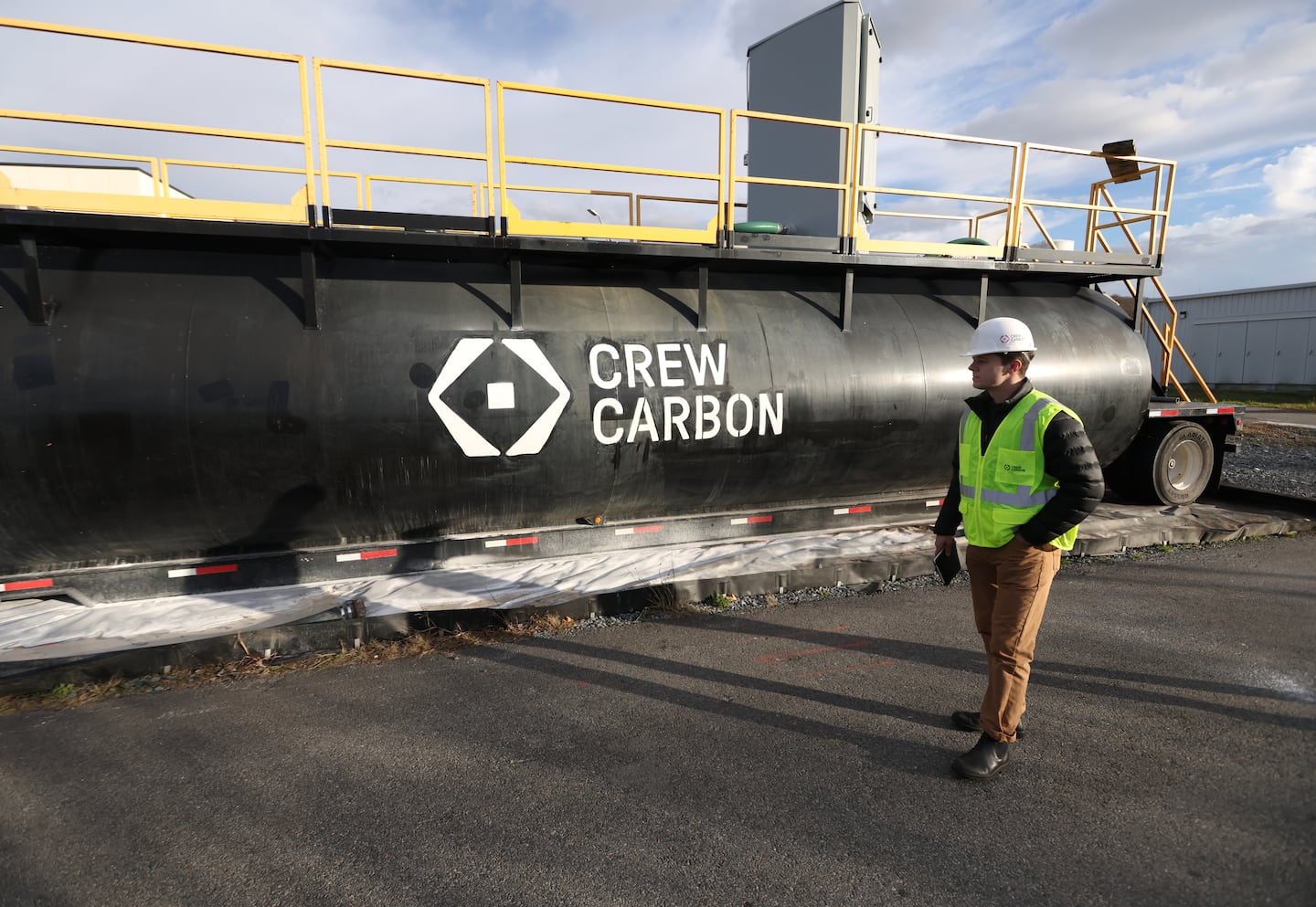 Joachim Katchinoff, the cofounder and CEO of CREW Carbon, stood in front of a tank where the limestone is stored before it is mixed in with waste water in Fall River.Jonathan Wiggs/Globe Staff
Fall River’s waste water treatment plant sits on the bank of Mount Hope Bay, an estuary whose waters eventually reach the ocean. Hundreds of yards out, the plant discharges treated water into the bay. The facility started adding limestone to its waste water over the summer.
On a recent day, Jonathan Mongie, a project manager for Inframark, which operates the Fall River plant, leaned over a tank where waste water treated with limestone was being disinfected.
“I can see deeper than we’ve ever seen before,” he said, observing the clarity of the water. The limestone increased the amount of solid particles in the waste water separated out using gravity.
The plant was already meeting stringent discharge standards, Mongie said, but the limestone has improved the cleanliness of the water flowing into the bay.
In the coming years, CREW Carbon hopes to continue scaling up, signing on more treatment plants to give limestone a shot. A recent paper from a research team in China estimated that this carbon removal approach could one day store about 20 million metric tons of carbon dioxide annually if deployed globally.
To put that in perspective, researchers have projected that the world may need to remove several gigatons — billions of metric tons — of carbon each year to keep global temperatures within climate targets.
Planavsky, the Yale professor, said CREW Carbon’s approach is not a silver bullet for the climate crisis. Instead, he said, it could be part of a future integrated approach where many industries each do their relatively small part. (Though Planavsky is a cofounder, he does not receive any money from the company.)
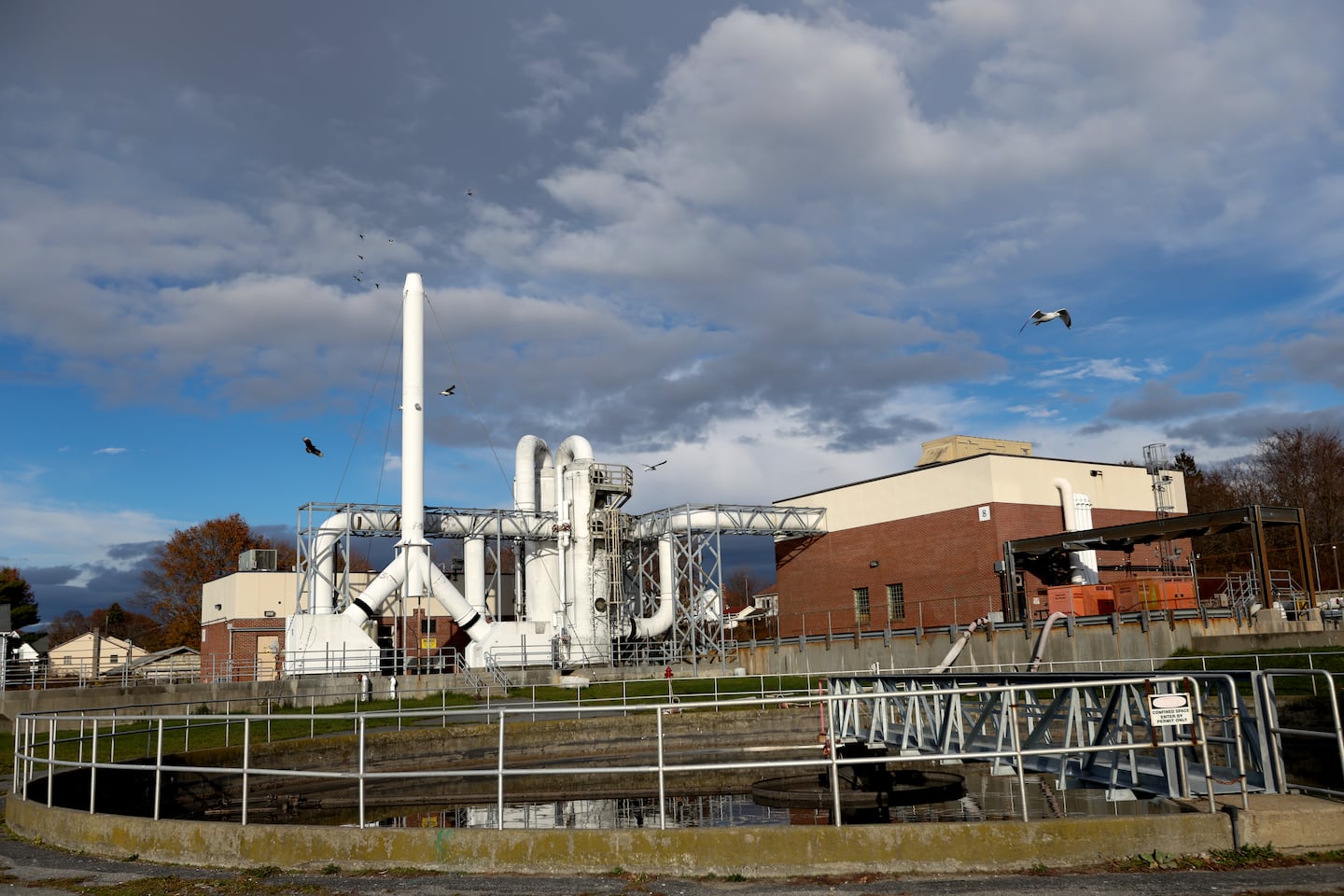 The Fall River regional waste water treatment facility.Jonathan Wiggs/Globe Staff
Some scientific questions remain about waste water alkalinity enhancement, especially what happens after the water leaves the treatment plant.
Tyler Kukla, a research scientist at CarbonPlan, a nonprofit that analyzes climate solutions, said the chemical reactions that occur within the waste water plant are well understood and take place within a closed system, making them easier to monitor. However, he said, it is less clear what happens to the carbon as it travels out to the ocean.
“This is a work in progress,” he said. “We can make measurements that we feel very confident about in many cases, but there is still a part of the system that is a little bit fuzzy to us.”
Adam Subhas, a researcher at the Woods Hole Oceanographic Institution, said he’s hopeful that early deployments such as CREW Carbon’s projects can provide the data to make these determinations. He said he’s also watching for research into the environmental impact of alkalinity added to waterways.
Subhas is leading a project studying the impacts of enhancing the ocean’s alkalinity to speed up its natural ability to capture carbon. The project team is not endorsing the method or selling carbon credits.
“There’s a lot of scientific basis for taking the approach that CREW is,” he said. “We’re all interested to see what happens.”
Planavsky said the company subtracts an estimate of the carbon lost along the way from its calculations. As the science advances, the models to calculate carbon removal will improve as well, he added.
The open questions haven’t kept Fall River from acting where the benefits are clearest. When Mayor Paul Coogan was approached by a city administrator about the idea, he asked, “Is there a downside?” Hearing none, he approved the project.
Coogan’s come to believe it’s a “brilliant idea,” generating revenue for plant upgrades down the road and helping the environment.
“It’s the kind of new innovation we’ve seen that are going to help us all,” he said. “I’m all in.”
Kate Selig can be reached at kate.selig@globe.com. Follow her on X @kate_selig.