
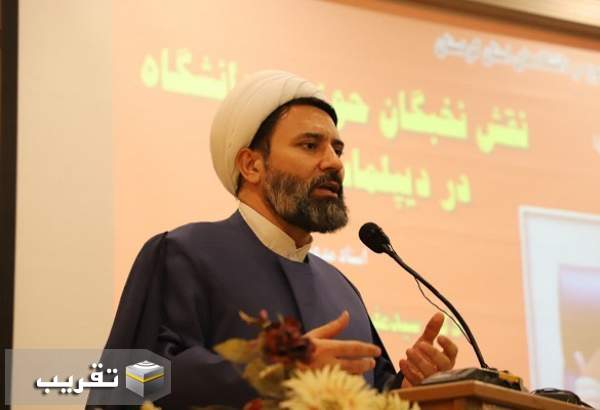
According to Taghrib News Agency(TNA), Ranjbar, the Director of the Kurdistan Seminary, spoke at the conference titled “The Role of Seminary and University Elites in Scientific Diplomacy.”
Referring to the Supreme Leader’s remarks on the “soft‑war scientific movement,” he said that any society lacking scientific and technological production will inevitably be forced to import knowledge—and with it, an invasive foreign culture.
He added that the Islamic society of Iran, founded upon divine values, naturally resists such cultural aggression, and therefore the country must remain vigilant about the type of science entering from the West.
The West’s Bitter Experience with Separating Science from Religion
Ranjbar cited historical examples from medieval Europe, explaining that the Church, through misguided actions, executed or imprisoned many scholars simply for thinking differently. This flawed approach popularized the idea of separating science from religion in the West and ultimately led to a deep spiritual crisis.
He stressed that Islam, through its teachings, encourages reason and reflection, and considers the rank of a scholar higher than that of a mere worshipper. Therefore, comparing Islam with distorted forms of Christianity is a grave mistake.
Western Thinkers’ Critique of Secular Culture
Referring to Western intellectuals, Ranjbar noted that Herbert Marcuse, in his book One‑Dimensional Man, criticized Western culture, and Michel Foucault described the Islamic Revolution as “a spirit in a spiritless world.”
He added that such perspectives show even Western thinkers acknowledge the spiritual crisis caused by the separation of science and religion, while the Islamic Revolution succeeded in presenting an alternative model.
Unity of Seminary and University: A Core Ideal of the Islamic Revolution
In conclusion, the Director of the Kurdistan Seminary highlighted the Islamic Revolution’s ideal of unifying seminary and university. He quoted the Supreme Leader, who has emphasized that a society without universities is deprived of knowledge, and a society without seminaries faces a crisis of spirituality.
Ranjbar added that academic and scholarly dialogues must pave the way for realizing this ideal so that the Islamic society can advance on the path of both scientific progress and spiritual elevation.
taghribnews.com/vdcdzs05zyt0zo6.em2y.html