

24.12.2025. 21:33h
The message “Partnership for the Future” on billboards with intertwined Serbian and Russian flags is a reminder of Russia’s presence in the Oil Industry of Serbia (NIS).
It seems that the Russians are not giving up on this partnership while the company has found itself under American sanctions precisely because of its majority Russian ownership.
Serbian President Aleksandar Vučić recently stated that they care not only about money but also about position.
Ivana Stradner from the Washington-based non-governmental Foundation for Defense of Democracies estimates for RFE/RL that NIS is “Russia’s center of gravity in the Balkans, which allows Moscow to control the region.”
Asked what Russia would lose by losing NIS, she says that NIS is much more than oil.
“It’s soft power that Russia uses to strengthen its geopolitical position,” she added.
While Russia found itself isolated by Western countries due to its invasion of Ukraine, Serbia is, along with Belarus, the only European country that has not imposed sanctions on Moscow.
The US imposed sanctions on NIS to prevent Russia from using energy revenues for the war in Ukraine.
Serbia still does not want to take decisions contrary to Russian interests, leaving Russia to find a buyer for NIS or sell its stake to the Serbian side.
Russian owners have 56,15 percent ownership in NIS, of which 44,85 belongs to state-owned Gazpromneft.
Gazpromneft is in charge of crude oil business and its subsidiary is Gazprom, which is a producer and exporter of natural gas.
NIS is the only company in Serbia engaged in oil exploration, production and refining, as well as natural gas production.
Visibility through sponsorships too
Marko Savković from the non-governmental Center for International and Security Affairs (ISAC) in Belgrade told RFE/RL that the purchase of NIS was Russia’s last major investment in Serbia.
“Due to the nature of resource management in Russia, it has inevitably been tied to the Russian Federation, Russian politics, and even its political leaders,” he says.
In 2008, the state sold a 51 percent stake in the company to the Russian state-owned company Gazpromneft for 400 million euros, through a direct deal, without a tender.
Savković also states that Gazpromneft has “managed NIS with great success in recent years and brought it to a level that certainly makes the company one of the regional leaders.”
The Russian presence in the national oil company, as he recalls, was also strong through sponsorships.
Thus, the logo of Gazpromneft, which has the largest share in NIS ownership, is on the jerseys of Red Star football players, and the NIS logo is worn by Partizan basketball players.
Part of the promotion were billboards that were placed with the logos of Gazpromneft and NIS and the aforementioned message of “partnership for the future”.
Gazpromneft has supported music and film festivals over the years, and also financed the creation of the interior mosaic of the Temple of Saint Sava in Belgrade.
As Patriarch Irinej once stated, the agreement on financing these works was agreed upon during Russian President Vladimir Putin’s visit to Serbia in January 2019, when he also visited the Temple of Saint Sava.
Then, the Russian president was welcomed by tens of thousands of people in front of the temple, organized by the government.
Ivana Stradner estimates that Moscow has been using Gazprom as an “ambassador” for many social, cultural and sporting activities for years.
“In order to position itself as a reliable partner for Serbia and carry out propaganda about ‘Serbian-Russian brotherhood,'” she added.
Russian state-owned company Gazprom Neft did not respond to RFE/RL’s inquiry about how much NIS’s profit represents in the company’s overall operations.
According to NIS’s financial report, the company had more than 18 billion dinars (153,8 million euros) in net profit in 2024, which is less than the previous year, when it recorded 41 billion dinars (350,4 million euros).
What do the officials say?
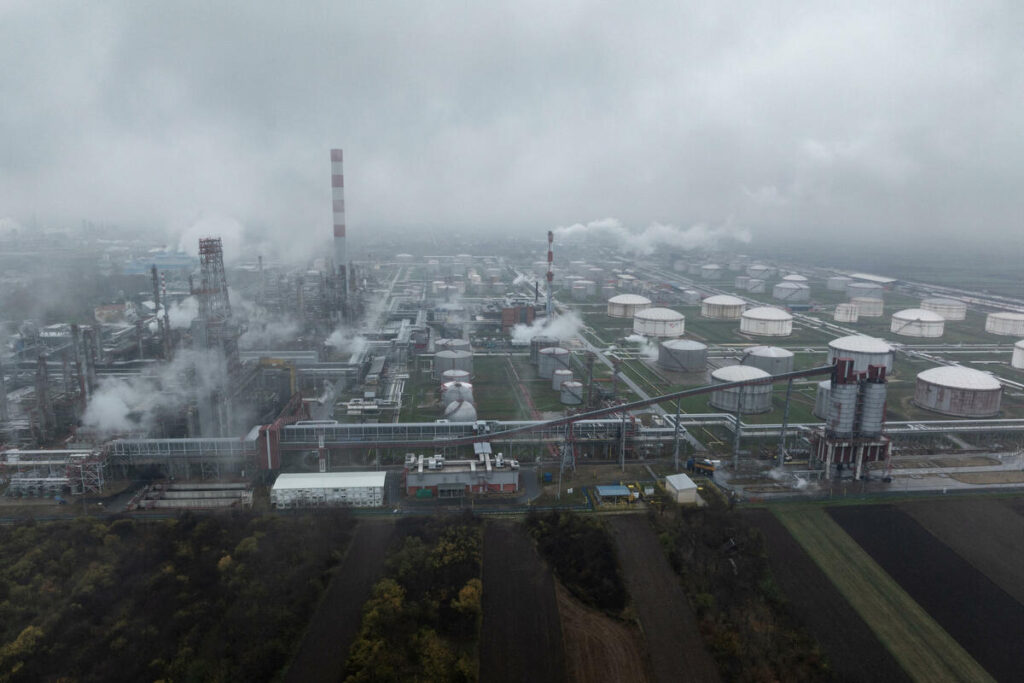
NIS’s oil refinery in Pančevo, near Belgrade, has already suspended operations due to a lack of crude oil for processing.
Authorities in Serbia say that if the Russians do not resolve the problem by January 15th, they will take matters into their own hands.
Meanwhile, Serbian President Aleksandar Vučić said that the Russians want to stay there and that it is a political matter.
“We need to understand the Russians, they want to remain the owners of NIS for political reasons,” he said on TV Prva on December 11th.
When asked by RFE/RL, the Russian Embassy in Belgrade did not comment on these allegations by the Serbian President, nor on analysts’ assessments that Moscow is exercising political influence in Serbia through NIS.
Recently, Russian President Vladimir Putin stated that Russia “has ideas” on how and in what direction the NIS issue could be resolved, but he did not provide further details about it.
On December 19th, at the annual conference, he said that a dialogue on this with Serbia was underway.
At the same time, he said that he assumed that “the friendly leadership of Serbia will fulfill its obligations.”
“Otherwise, the question arises: how can we invest money in the country’s economy and where are the security guarantees if even intergovernmental agreements do not work,” Putin said.
What does energy dependence lead to?
Ivana Stradner of the Washington-based Foundation for Defense of Democracies notes that Putin sent a clear message to NIS.
“And Moscow will not easily give up its main lever in the Balkans,” she believes.
Serbia has so far justified its decision not to impose sanctions on Russia mainly by its energy dependence on that country.
Marko Savković from the ISAC Fund assesses that it is important for Russia that Serbia remains in that position and that the relationship that was established a long time ago will not be disrupted or questioned.
“And all these years, NIS has been a guarantee that Serbia will not take any action against Russia,” he added.
Although a candidate for membership in the European Union, Serbia has continued to maintain close ties and cooperation with Russia, which was not interrupted even after the Russian invasion of Ukraine in February 2022.
Savković states that the position Russia has in the national oil company of Serbia means that “you can influence the economic situation, and indirectly the political situation in the country, with your actions.”
“The infrastructure that NIS has is part of Serbia’s critical infrastructure. Therefore, it is important for Serbia’s national security,” he added.
In addition, Serbia, despite taking steps to diversify its gas supply, still remains predominantly dependent on Russia for this energy source.
“You have a situation where one country has a decisive influence on your energy supply. That is a position that no country can be comfortable with, hence the huge effort being invested in diversification,” says Savković.
Serbia, as President Aleksandar Vučić said on December 23, has received an extension of the gas supply contract with Russia until March 31, 2026.
The long-term contract expired in May, and a new long-term one has not yet been concluded. The current short-term agreement expires at the end of the year.
Ivana Stradner notes that Putin has a long history of using gas as a “weapon” for manipulation and blackmail.
“Putin has sought to deepen Europe’s dependence on Russian gas, perpetuating the myth of cheap Russian gas,” she added.
What would leaving NIS mean for Russian influence?
Marko Savković estimates that even if Russian ownership disappeared from all possible companies in the Balkans, a number of people would still look at Russia with sympathy.
He states that the reasons for this are complex and numerous.
“There are cultural reasons, ideological closeness, political affinities, Putin’s personality which impresses many people, all the way to religious ties which are often emphasized, but I don’t think they are that important,” he added.
The United States has repeatedly delayed the implementation of sanctions in recent months, while NIS and the Serbian government have said they are seeking a solution.
According to RTS, on December 24, the US Office of Foreign Assets Control (OFAC) issued a license to NIS, extending the possibility of negotiating the sale of the Russian stake until March 24, 2026, but not for NIS’s operations.
A day earlier, Vučić said that there was information that representatives of Gazprom Neft were negotiating the sale of NIS to the Hungarian company MOL.
The question, however, is whether the US administration will approve the transfer of the money from the sale to Russia, just as the question is whether Moscow will agree to deposit the money.
“Whoever controls gas and oil controls the region,” observes Ivana Stradner. “America understands very well that without Gazprom, Russia’s power will decline drastically.”
Peace talks to end the war in Ukraine, involving the United States, Russia, the European Union, and Ukraine, have so far yielded no results.
The authorities in Serbia say that nationalizing NIS is not an option because, as officials stated, they do not want to seize other people’s property.
They have repeatedly stated that Serbia would pay for the Russian share of ownership if it had to, because NIS must continue to operate.
The NIS Group has more than 13.000 employees, and the company has over 320 gas stations in Serbia.

News