
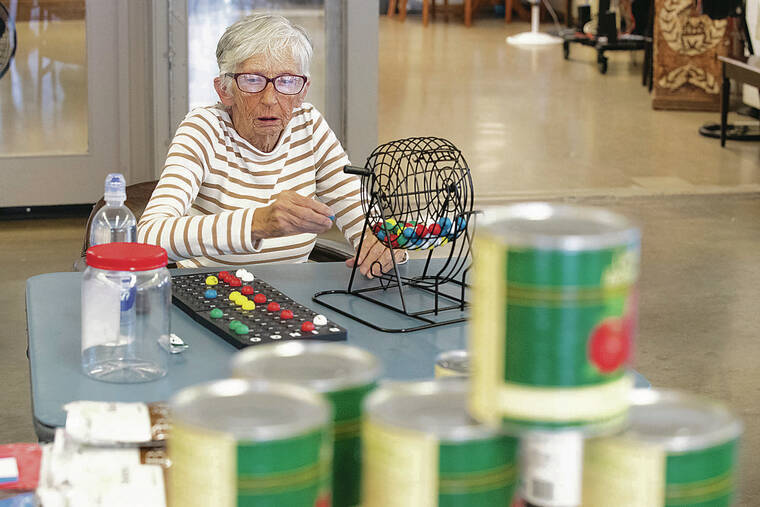
Baby boomers in Hawaii were born between 1946 and 1964 — the year after World War II ended, through the Korean War and as Democratic President Lyndon B. Johnson escalated U.S. military involvement in Vietnam.
Today’s Hawaii boomers — the youngest is 61 and the oldest 79 — primarily rely on fixed incomes such as Social Security. While some retirees have savings, pensions, real estate or stock portfolios to supplement their income, many others do not and worry about becoming homeless as they face deteriorating health, rising housing costs and higher prices for food, energy and insurance. They also worry about keeping their children and grandchildren home in the islands.
“Housing is a big one,” said Susie Chun Oakland, program director at Catholic Charities Hawai‘i’s Lanakila Multi-Purpose Senior Center in Kalihi on Oahu. “All the food prices have doubled and eating at restaurants or buying groceries has significantly impacted people.”
Chun Oakland, 64, retired after 26 years in the Legislature and now helps care for her seven grandchildren, ages 8 months to 21.
“Hawaii has ranked as the highest percentage of grandparents raising grandchildren in the nation,” Chun Oakland said as her youngest grandchild cooed in her arms. “Part of it is cultural … and part of it is the cost of living. Seniors want to pick up the financial slack.”
Bernadini White, 75, has six grandchildren on the mainland and wants to help them financially, “but I can’t,” she said.
White lives with her 51-year-old son in an apartment near Lanakila, where the rent recently increased to $2,400 a month.
She struggles to survive on Social Security disability payments, and is being treated for a cyst in her brain that likely will require surgery, among other health issues.
“It’s real difficult to pay horrendous rent, on top of food and electricity,” White said.
White’s son — a self-employed remodeler and licensed plumber — sometimes struggles to find work, but helps with the rent and utility bills.
White’s fears deepened during the 43-day federal government shutdown that threatened Supplemental Nutrition Assistance Program benefits for 161,132 Hawaii residents until Gov. Josh Green provided a month of state aid. Even after the shutdown ended, she worries she could end up like other homeless seniors she sees around Kalihi.
“I am afraid of being homeless,” she said.
Diane Terada, the division administrator for Catholic Charities Hawai‘i overseeing the organization’s senior program, called Hawaii’s lack of affordable housing a “tremendous” challenge for seniors on fixed incomes.
“We are seeing a lot of seniors who are losing rental housing,” she said. “Even affordable rentals are not affordable for a lot of clients we have.”
State Rep. Cory M. Chun (D, Pearl City-Waipahu-Waikele), who helps lead the joint Senate-House Kupuna Caucus, said the cost of living remains the top issue for seniors.
“A lot of them are on fixed incomes, so any additional costs hit harder,” Chun said.
Care costs
John McDermott, ombudsman for the state Health Department’s Long-Term Care Ombudsman Program, especially worries about long-term care residents who live in facilities that only accept private pay as health care costs rise.
Hawaii seniors historically rely on their children, grandchildren and other relatives to enable them to live out the rest of their lives in their own homes, McDermott said.
“We have the highest percentage of three generations living under one roof in the country,” McDermott said, but the traditional is eroding as younger relatives move away because they can’t afford to stay.
Without family support, seniors must hire private caregivers — an expense many cannot afford, even if they can find available workers.
Seniors who sell their homes to pay for long-term care also affect their children’s and grandchildren’s future finances because they won’t have a home in Hawaii to inherit, McDermott said.
For seniors who decide to move into long-term care facilities that do not accept government health coverage, he said, “they can make it as long as their increases aren’t too high. But for most residents of the assisted living facility model, it isn’t sustainable. The prices for long-term care keep rising, rising, rising while their income isn’t rising. “
“We all know we don’t have enough affordable long-term care for seniors,” McDermott said. “Historically our facilities all have waiting lists.”
McDermott said privately paid facilities often raise rates as high as the market will bear, leaving residents with little recourse. If someone has already sold their home expecting to stay in a facility long-term and is later told they must leave, he said, they have virtually no leverage.
“The residents generally have no power and the facility has all the power, so we’re there to assist the residents as an advocate, McDermott said.
Kupuna
protections
McDermott said “the silver tsunami” has already arrived and will require new approaches.
“We need the Legislature to protect our elders from becoming homeless,” he said.
The Kupuna Caucus — a coalition of community members and senior advocacy groups including AARP and the Alzheimer’s Association — voted this month to introduce its maximum of five bills. The measures, set for introduction during the legislative session, which begins Jan. 21, are aimed at helping Hawaii’s seniors.
The top proposal would provide an annual $5,000 tax credit to family caregivers.
“If everyone who is eligible gets it, it would probably add up to over $100 million a year,” Chun said.
“The focus is on the family unit and there’s concern about burnout,” he said. “It’s should be a full-time job at the same time that the family caregiver often has a full-time job.”
Other bills would fast-track home modification permits; fund a $2 million program for seniors who don’t qualify for Medicaid; require annual dementia training for first responders; and lock in current county property tax rates for homeowners 75 and older.
Once the home is sold, inherited or otherwise transferred, Chun said the tax rate would them jump to the existing property tax rate at the time.
“Taking care of seniors puts pressure on the family unit, puts pressure on their children,” Chun said. “We need to figure out a way to let them age in their home. We need to look at long-term care because it’s going to become a big expense for a lot of families.”
Chun knows first hand the family pressures. His parents, who are both in their 70s, live on Oahu and are doing fine. But Chun handles the finances for his 80-year-old uncle, who lives in a long-term care foster facility on Oahu.
“He has Social Security, is on Medicare, but is otherwise living off retirement savings,” Chun said. “He’s not very ambulatory and had to sell property to help cover his living expenses.”
At 48, Chun’s part of the so-called “sandwich generation” that looks out for aging family while also supporting their own children or grandchildren.
His 20-year-old daughter is in her third year at the University of California-Davis, where she’s studying to become a nutritionist in the food science program and wants to come back to Hawaii one day.
She has a campus job and lives off campus with Chun helping to pay her tuition and other costs.
“It’s expensive,” Chun said.
He also has an 18-year-old son who’s a senior at Hawaii Baptist Academy and is considering studying engineering at a mainland college or possibly the University of Hawaii.
Chun also is likely to help him out when he goes to college.
“Cost is a big factor for him and he’s trying to get the most financial aid,” he said.
Last session, lawmakers extended rental assistance for kupuna at risk of homelessness and required annual cognitive assessments for Medicare beneficiaries 65 and older.
Chun told the Honolulu Star-Advertiser that “our kupuna deserve our respect so they can have a decent quality of life.”
Top economic
challenges
• Income: The median income for Baby boomers in Hawaii of $96,126 is slighter higher than the overall Hawaii household median income of $94,814, according to a state-by-state financial analysis by yahoo/finance. Boomers, overall, spend more on health care than younger generations but face different financial challenges depending on age. Kupuna rely more heavily on public programs such as Social Security, Medicare and Medicaid, according to the University of Hawaii Economic Research Organization. Older kupuna aged 75 and above have less income than younger boomers, rely more on their adult children and face higher costs due to their health care needs, according to UHERO.
• Surviving retirement: The average monthly income for boomers in 2025 is about $6,038 a month — or $72,456 per year, but can vary widely depending on how well they prepared for retirement, whether they continue to work and whether they live in high-priced areas, such as Hawaii, according to ZipRecruiter.
• Long-term care: There are not enough beds in Hawaii’s long-term care facilities. Residents who live in facilities that do not accept government health care are forced to pay higher rates whenever facilities increase them, according to the ombudsman for the state Health Department’s Long-Term Care Ombudsman Program.