
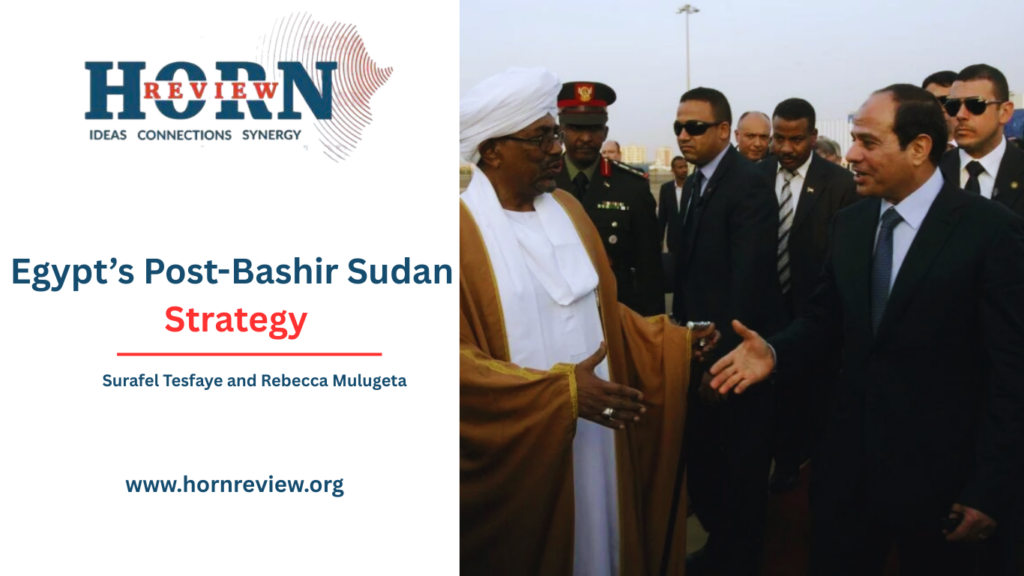
Egypt’s steadfast commitment to a militarized administration in Sudan is a calculated geopolitical mandate, etched into the foundational reality of Nile dependency and the necessity of a stable southern frontier. In the current regional climate, Sudan functions as a critical buffer, a strategic firewall designed to insulate Egypt from the systemic instability radiating from the Sahel and the fragmented landscapes of South Sudan and Libya. Following the 2019 dissolution of the Bashir era, Egypt pivoted toward a policy of ‘centralized cohesion, betting that a military-led and also centralised framework offers the only viable mechanism to consolidate Sudan’s fractured locus of power and secure the downstream flow of national interests.
Why is the propagation of the Egyptian model of military rule as the preference? The military represents a future of controlled certainty and a clear chain of command from which Egyptian politicians throughout history could hang their hats when negotiating overtures on the international stage. Further, the Egyptian government believes a militarized Sudan represents a governing apparatus able to resist the winds of interference in a manner that maintains the Blue Nile in proper flow. After all, the Blue Nile remains a prime target for Egypt and a persistent flashpoint in its disputes with Ethiopia over the “Black Nile.” Cairo has strategically sought to install a strong, militarized government in Sudan, one that prioritizes influence over its territory rather than risking disputes on its own soil. Egyptian politicians have thus aimed to manipulate every successive leader in Khartoum to advance these interests.A militarized Sudan represents a government able to keep this in motion. rather Militias represent a certain danger of additional fuel on the fire of smuggling operations, which would ultimately be detrimental to Egyptian concerns.
The Egyptian mandate for a militarized Sudan is not a reactionary shift but a long-standing geopolitical doctrine that views the Sudanese Armed Forces as Egypt’s de facto southern flank. For decades, Cairo’s regional architecture has prioritized institutional stability over ideological alignment, a stance that hardened into overt friction following the 2019 transition. The emergence of the Hamdok-led hybrid administration was perceived by Egyptian intelligence not as a democratic milestone, but as a high-risk experiment in state fragility. Drawing from the historical volatility of 1964 and 1985, Sisi’s administration views civilian-led governance in Sudan as a vacuum susceptible to external interference and internal fragmentation. From a pragmatic security standpoint, Cairo posits that Islamist elements are more effectively neutralized when subsumed within a rigid military chain of command rather than being allowed to gain parliamentary legitimacy. In the Egyptian calculation, a militant within the barracks is a managed asset; a militant within a legislature is a sovereign threat.
The Egyptian preference for a militarized Sudan is rooted in the belief that autocracy minimizes operational variables; it suppresses the ideological pluralism that Egypt views as a conduit for foreign-sponsored instability. Historically, this relationship has been defined by a profound irony. The Islamist architecture of the Bashir regime, an ideological byproduct of the Egyptian Muslim Brotherhood’s 1928 foundations, was frequently weaponized against Cairo. Under Bashir’s tenure, Sudan evolved from a neighbor into a launchpad for transnational militancy, hosting Al-Qaeda assets and providing a sanctuary for Egyptian dissidents targeting the Mubarak and Sisi administrations. Despite Bashir’s shift toward Pan-Islamist adventurism and the resulting regional blowback in Darfur and South Sudan, Egypt’s fundamental strategic calculus remained unchanged. Even when the Sudanese military apparatus facilitated the arming of Sinai-based insurgents, Cairo continued to view the Sudanese Armed Forces (SAF) as the only viable anchor for regional security. In the Egyptian view, a hostile military state is a manageable adversary with a clear chain of command; a fragmented civilian democracy is an uncontained risk.
Historically, Egypt viewed the SAF as a geopolitical perimeter, providing a ‘zoned shield’ against the spillover of Chadian nomad incursions, Libyan state collapse, and southern irredentist pressures. In the interest of maintaining this buffer, Egypt tolerated the ideological volatility of the Bashir era, prioritizing the army’s role as the permanent arbiter of Sudanese stability and a guardian of Egypt’s upstream Nile security. The post-2019 transition offered Egypt a perceived window to formalize this arrangement. The Egyptian strategic objective was to engineer an institutional merger between the SAF and the RSF, aiming to co-opt the latter into a subordinate role within a unified command structure. The goal was to manufacture a monolithic, ‘über-power’ hybrid, a Sudanese mirror of the Egyptian military-political apparatus. However, this attempt to force a synthetic cohesion between two inherently antagonistic entities proved to be a catastrophic strategic miscalculation. Instead of achieving consolidation, Egypt’s policy exacerbated the internal schisms that eventually catalyzed the total collapse of the Sudanese state architecture.
Why a united military Sudan? A united military Sudan would ensure Khartoum an iron spine with which it could buffer Egypt in the GERD question, as Ethiopia is filling the GERD Dam, which Egypt perceives as a threat. Egypt feels cornered; Egypt could counter this by having a strong military in Sudan to prevent harassment at the borders and a harbor in the Red Sea to territorial gains that could disturb Ethiopia itself. The involvement of the SAF allies well with national unity, the location of the Nile River banks, and historical coercion tactics. Even rumors of Brotherhood penetration within the SAF hierarchy, led by General Abdel-Fattah Al-Burhan, were not insurmountable; the Egyptian politician thinks Islamists are manageable as long as they are institution-bound; civilians, however, could prove unmanageably disastrous.
Egypt fully leaned into this doctrine, aggressively aligning with the SAF leadership post-2019 and viewing the 2021 coup not as a setback, but as a necessary operational correction to sideline Hamdok’s civilian aspirations. Egypt’s support was tangible, facilitating hardware transfers and spearheading diplomatic summits to refurbish General Burhan’s international standing. The prevailing logic was that a military-led transition would mitigate the ‘unpredictable’ volatility of street-level democratic movements and secure Egypt’s southern buffer.
However, this reliance on the ‘Sisi-esque’ template revealed a fundamental fault line in Egyptian intelligence. The RSF represents a radical departure from the traditional model of army supremacy; it is a regional juggernaut anchored in the Rizeigat and Misseriya tribal networks, with a trans-border reach extending into Chad and Libya’s Fezzan. While Cairo’s militarized mindset honed in a centralized, institutionalized environment valued the SAF for its predictability, it failed to account for the RSF’s decentralized, kinetic power base. By seeking to consolidate a ‘militarized’ Sudan, Cairo inadvertently catalyzed a conflict with a non-state actor that does not respect the institutional ‘umbrella’ of a traditional national army.
Hemeti operates as a sovereign extraction-to-militia complex, fueled by gold revenues that bypass the national treasury and render traditional foreign leverage obsolete. Unlike the institutional SAF, the RSF functions as a ‘kinetic feudalism’, a network bound by bullion rather than state allegiance. Cairo’s objective to harmonize the RSF into a unified, pro-Egypt command structure for the GERD negotiations has failed to account for this tribal autonomy. The resulting conflict threatens to transform the Nile corridor into a transnational smuggling artery for arms. The RSF’s ethnic friction specifically targeting the Masalit along critical riverine routes risks a ‘Libyanization’ of Sudan. As Rizeigat and Misseriya networks ignite cross-border instability from Chad to the Upper Nile, Egypt faces its ultimate strategic nightmare: a fragmented southern flank where the security of the Nile is no longer managed by a state, but contested by a volatile collection of autonomous warlords. Civilian governments might fragment similarly, but RSF embodies the peril acutely: self-preserving, foreign-funded, prizing tribal fealty over Nile stewardship. Why trust it when gold autonomy breeds defiance? SAF institutionalizes power under state banners; RSF ethnicizes it, loyal to Hemedti’s kin network. Egypt fears “ethnic militarization, guns wedded to kinship, not institutions, eroding the predictable buffer
The April 2023 collapse of the SAF-RSF pact forced Egypt into a geopolitical miscalculation of institutional identity. Hemeti’s gold-financed legions operating outside traditional state fiscality have captured Khartoum’s administrative core, validating Cairo’s existential dread of state balkanization. Yet, Cairo persists in its clinical distinction: an Islamist within the military hierarchy is a managed variable; an Islamist in a civilian parliament is a sovereign threat. Cairo’s commitment to the SAF’s ‘institutional spine’ is a desperate hedge for Nile supremacy. As the GERD reaches terminal operationality in 2025, Egypt continues to view a centralized military administration as its only viable buffer against the ‘tribal hydra’. Cairo is betting that a brittle military rampart is superior to the ‘gold-and-mercenary’ autonomy threatening to ignite a transboundary inferno.
The core question to ask last is, Will Egypt work with the RSF if they seize power? Strategically, Cairo has framed an RSF victory as a ‘red line’ that justifies military activation. However, the history of Egyptian foreign policy is one of ruthless survivalism. If the SAF evaporates, Cairo will likely undergo a ‘predatory realignment’ engaging the RSF not as a legitimate peer, but as a de facto warlord-entity that must be bribed or coerced into maintaining the Nile status quo. For Egypt, the only thing worse than a hostile army is an unmanageable desert.
By Surafel Tesfaye and Rebecca Mulugeta, Researchers, Horn Review