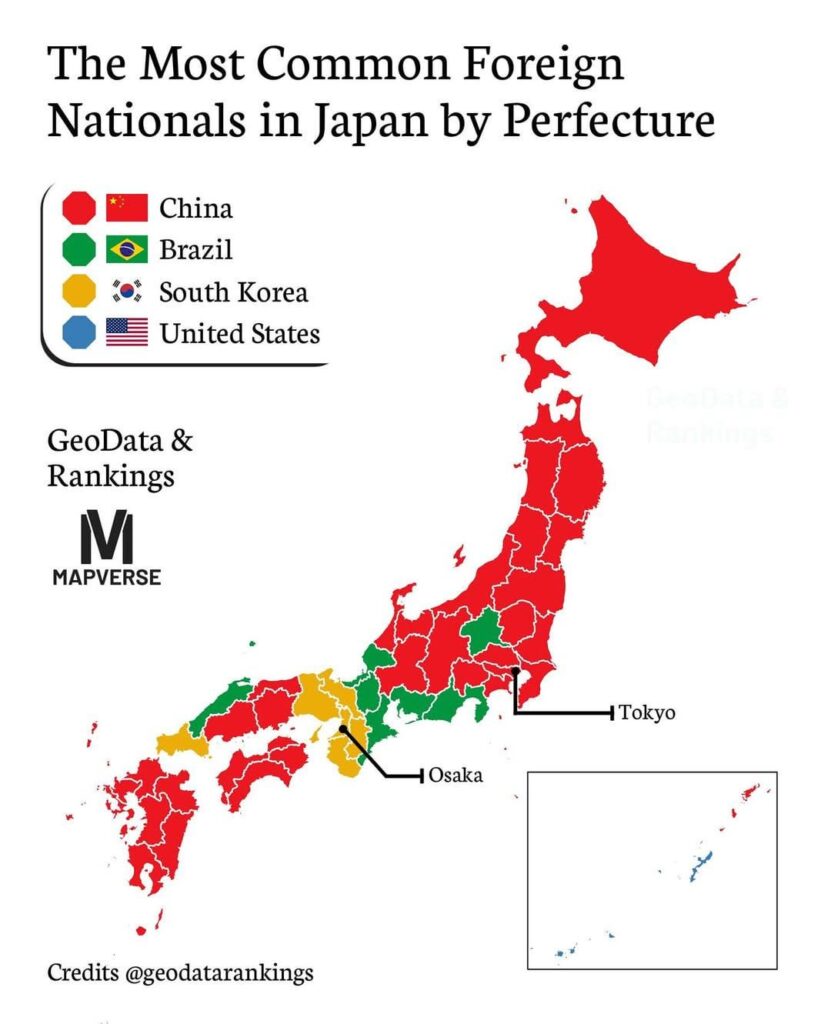
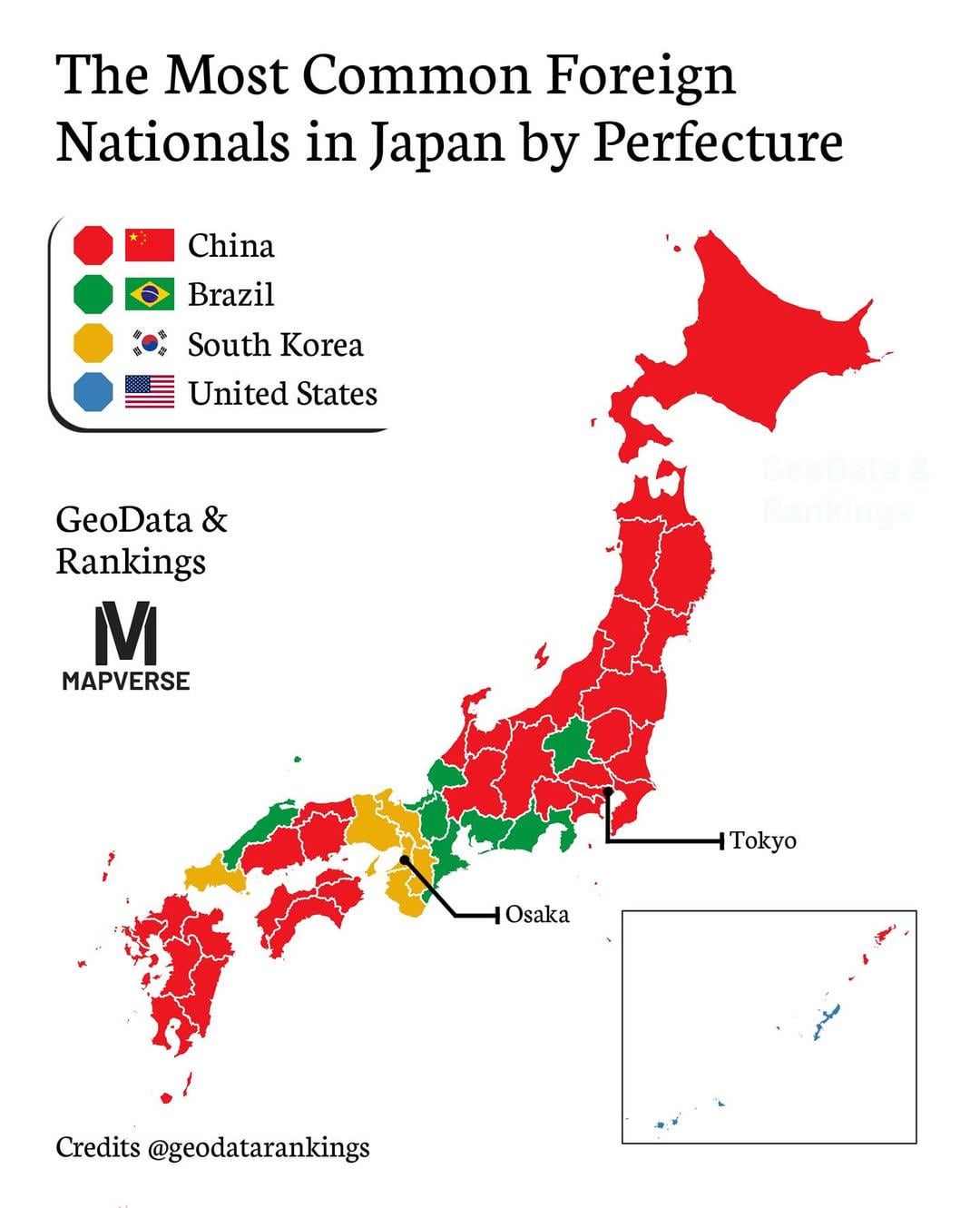
Chinese nationals form the largest foreign population in most areas, reflecting long-standing migration ties, geographic proximity, and strong economic connections between China and Japan. Brazilian communities are especially prominent in several central prefectures, largely due to labor migration linked to manufacturing industries and Japan’s policies toward descendants of Japanese emigrants. In a smaller number of prefectures, particularly around major urban and international hubs, Americans are the most common foreign nationality, influenced by business presence, education, and military-related factors.
yeontura on
I wanna know the top Southeast Asian nationalities by prefecture
lost-myspacer on
Hyogo not being Chinese is interesting considering they’ve got such a famous Chinatown
Silver-Advantage8502 on
Where are the Americans? Okinawa?
ReporterSouthern7712 on
And white supremacist are always crying about Indians when there are just 50k of Indians.
May be they confuse Nepalis, Sri Lankans, porkis and bangladeshis with Indians.
They are notorius for poor geography and cultural education.
Objective_Ad_5779 on
What’s the story behind all the Brazilians?
HeirophantGreen on
Kanagawa with Yokosuka and Zama apparently aren’t enough to offset Chinatown and the general Chinese population.
General_Resident_915 on
I think most of the Americans that live in Okinawa are either retired veterans or they have their own businesses there
ckoocos on
As someone who has recently renewed her visa, it is quite interesting to see that Koreans are the most common foreigners in Osaka.
I remember seeing / hearing so many Chinese at the immigration center.
Surprised Kyushu isn’t mostly Koreans. I went there this year (only Fukuoka and Beppu), but it felt like I heard more people speaking Korean than Japanese (not really, but a lot of Koreans).
Front_Fill1249 on
It’s always a funny experience as a Brit visiting Okinawa and everyone I meet assumes that I’m American
ligament11 on
All these comments and nobody sees the misspelling?
alexfreemanart on
How many Chinese immigrants currently reside in Japan?
karatechop97 on
I wonder if they’re excluding U.S. military personnel stationed in Japan.

15 Comments
Chinese nationals form the largest foreign population in most areas, reflecting long-standing migration ties, geographic proximity, and strong economic connections between China and Japan. Brazilian communities are especially prominent in several central prefectures, largely due to labor migration linked to manufacturing industries and Japan’s policies toward descendants of Japanese emigrants. In a smaller number of prefectures, particularly around major urban and international hubs, Americans are the most common foreign nationality, influenced by business presence, education, and military-related factors.
I wanna know the top Southeast Asian nationalities by prefecture
Hyogo not being Chinese is interesting considering they’ve got such a famous Chinatown
Where are the Americans? Okinawa?
And white supremacist are always crying about Indians when there are just 50k of Indians.
May be they confuse Nepalis, Sri Lankans, porkis and bangladeshis with Indians.
They are notorius for poor geography and cultural education.
What’s the story behind all the Brazilians?
Kanagawa with Yokosuka and Zama apparently aren’t enough to offset Chinatown and the general Chinese population.
I think most of the Americans that live in Okinawa are either retired veterans or they have their own businesses there
As someone who has recently renewed her visa, it is quite interesting to see that Koreans are the most common foreigners in Osaka.
I remember seeing / hearing so many Chinese at the immigration center.
This data seems a bit old. In Mie for example, Vietnamese have already overtaken Brazilians [[1]](https://www.pref.mie.lg.jp/TOPICS/m0011500502.htm). In Gifu Vietnamese and Filipinos both have (With the number of Filipinos being the highest)[[2]](https://www.pref.gifu.lg.jp/page/62167.html). In Ishikawa Vietnamese have overtaken Chinese [[3]](https://www.pref.ishikawa.lg.jp/kokusai/gaikokujin/chosa.html).
etc.
Surprised Kyushu isn’t mostly Koreans. I went there this year (only Fukuoka and Beppu), but it felt like I heard more people speaking Korean than Japanese (not really, but a lot of Koreans).
It’s always a funny experience as a Brit visiting Okinawa and everyone I meet assumes that I’m American
All these comments and nobody sees the misspelling?
How many Chinese immigrants currently reside in Japan?
I wonder if they’re excluding U.S. military personnel stationed in Japan.