
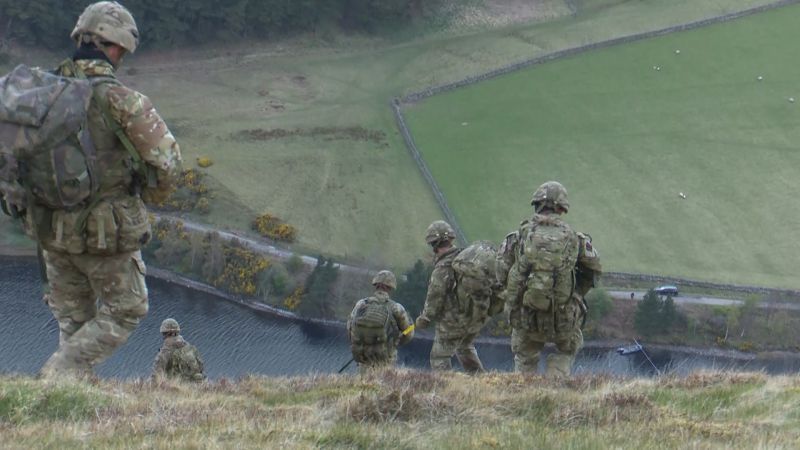
Being neutral doesn’t mean that you’re a pacifist, expert says
The Swiss government has launched a consultation on realigning its security policy “in light of the deteriorating security situation”.
Bern revealed that the consultation will look at defence through several strategic objectives, including strengthening resilience, improving protection and prevention, and enhancing defence capabilities.
It comes amid a growing threat from Russia conventionally in Ukraine and unconventionally via hybrid means, as there have been a number of alleged hybrid warfare incidents across Europe, using drones and petty criminals.
BFBS Forces News looked into the debate about neutrality and how it relates to the defence world now.
First, we need to define what neutrality actually is. Neutrality is a legal status, which means that a state does not take part in an armed conflict and needs to deal with all parties involved in the same way through the principle of impartiality.
There’s no way back
Speaking to BFBS Forces News, Grégoire Roos, Chatham House’s director, Europe and Russia and Eurasia programmes, said following the announcement that “there’s no way back” for Bern once it decides to develop its capabilities to defend against the threat posed by its adversaries.
“This calls for deep strategic shifts in terms of defence spending budgets,” Mr Roos explained.
“It’s not just about buying, reinvesting in real estate, and you can sell whatever you’ve just bought the day before.
“It’s 10, 20, 30-year investment plans.”
Mr Roos added that the subtle shift away from neutrality is part of a trend, as history has shown that countries do not just decide to join Nato and then leave.
In the future, the former head of political dialogue and policy innovation at the BMW Foundation Herbert Quandt, highlighted that there will be debates around interoperability between Nato and non-alliance members, such as Switzerland and the Republic of Ireland.
He suggested that this could involve joint exercises and spending on technological development.
Neutrality doesn’t mean pacifism
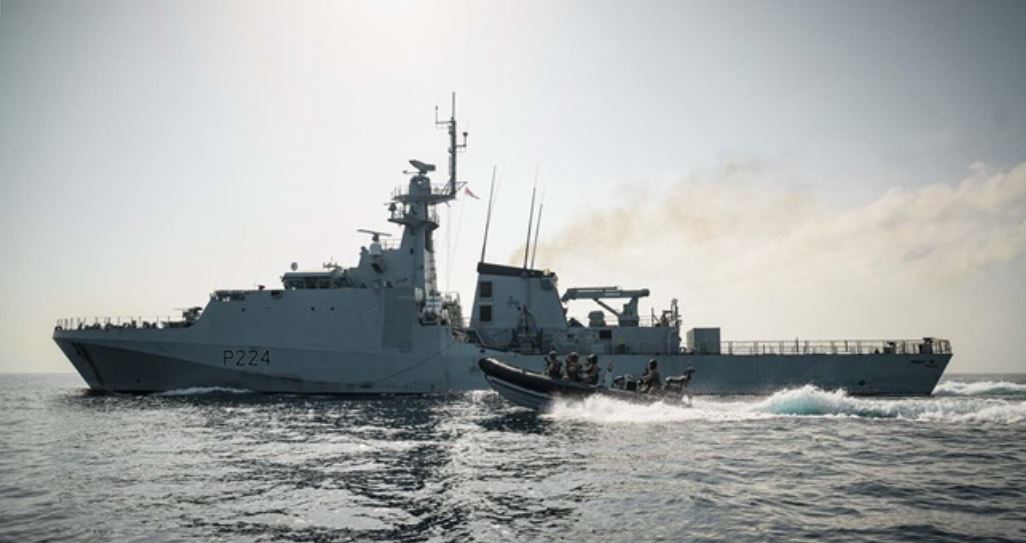 Dublin’s navy comprises four offshore patrol vessels, two large patrol vessels and two inshore patrol vessels (Picture: Royal Navy)
Neutral countries are not completely powerless and impotent; rather, they have different capabilities compared to their neighbours, who are part of alliances like Nato.
For example, Mr Roos pointed out that Switzerland has military service, meaning that every Swiss man must serve in the military from the ages of 18 to 30.
“Many Swiss young people do like it because they get to learn a lot and it sharpens their profile as they are about to enter the job market,” he told BFBS Forces News.
Mr Roos said that the first aspect of neutrality is that it doesn’t mean that you’re a pacifist or that you are not willing to prepare your population for any potential conflict.
The second aspect is that these countries don’t have sizable militaries, but do have drones, military technology and stockpiles.
The lack of a sizable military is certainly the case in Dublin, as the Irish Defence Force has 7,400 active personnel, of which 5,950 are in the army, 750 in the Irish navy, and 700 in the air corps, meaning that there is a lack of personnel, according to the Atlantic Council, an American think-tank.
Despite the distinct lack of material capabilities – particularly noted as Dublin’s navy comprises four offshore patrol vessels, two large patrol vessels and two inshore patrol vessels – these nations still have to live in a world where their neutrality will not necessarily be able to protect them from the consequences of conflict.
“A country’s neutrality does not mean that you’re blind to what is going on around you, and by essence it doesn’t prevent war from happening, as we saw with Russia and Ukraine,” Mr Roos stated.
“But, geography somehow dictates some dependencies.”
This geography means Switzerland is integrated into the European institutions through foreign direct investment, education, and the Swiss economy, and that it complies with the economic sanctions on Moscow.
How has Ukraine changed the debate around neutrality?
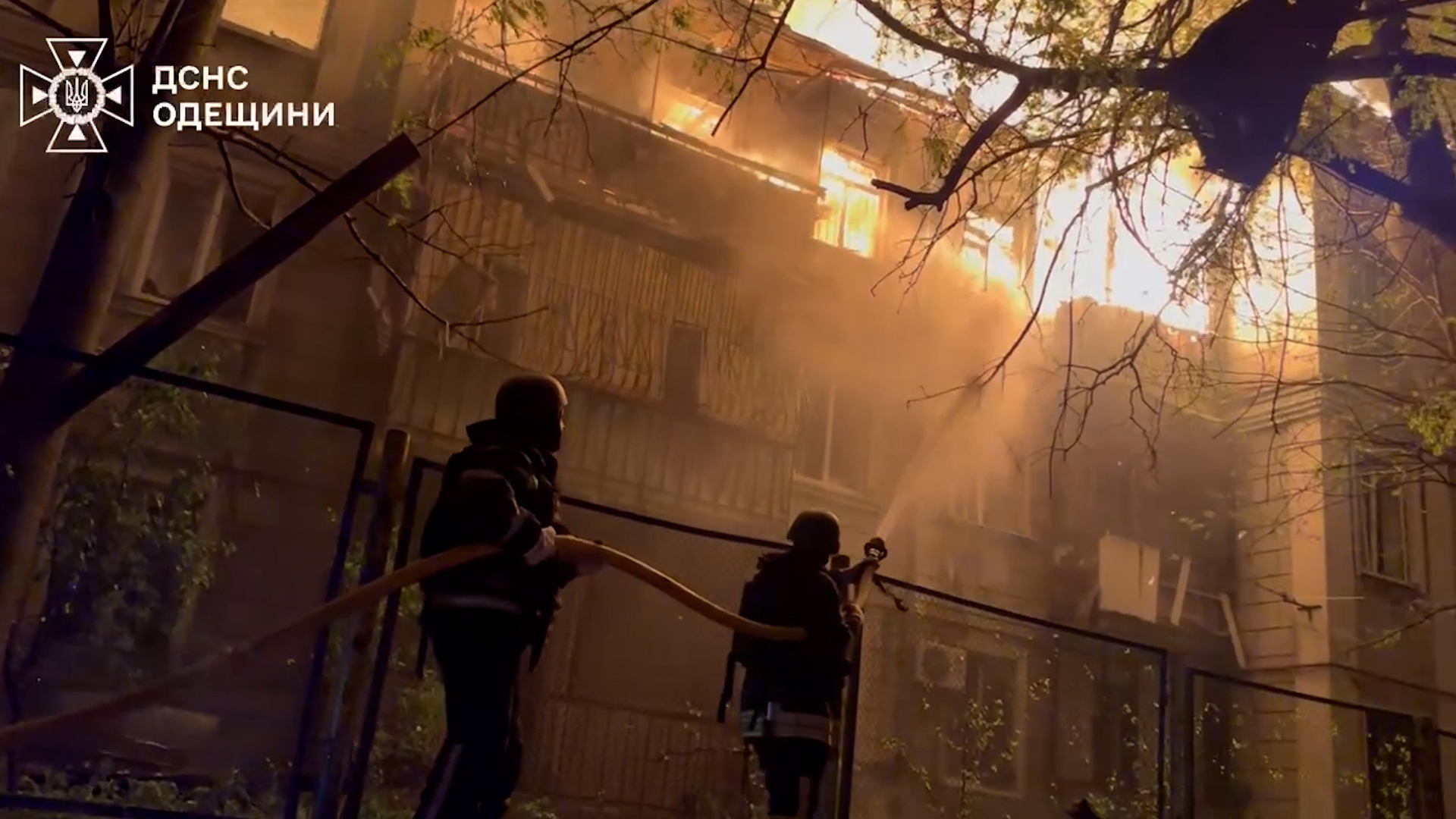 Many countries around Europe have been forced to reevaluate their defence spending since Russia invaded Ukraine (Picture: Emergency Service of Ukraine)
Since Russia’s full-scale invasion of Ukraine in 2022, many countries, including nations seen as neutral, around Europe have been forced to reevaluate their defence spending and entire defence strategy.
Mr Roos explained that the Ukraine war has “obviously” moved the debate around neutrality, as that is the reality of the situation, and that the war has had a “significant impact”.
He noted that Switzerland has joined the European Sky Shield Initiative, the air defence system used across Europe, and that there has been a debate over defence spending in the country.
However, Bern was not alone in changing its stance on defence after Moscow’s troops went into Ukraine, as Finland, one of Russia’s neighbours, ended its policy of non-alignment by joining Nato in 2023.
Meanwhile, Sweden joined Nato the following year, leaving only the Republic of Ireland, Austria and Malta as the only non-aligned nations in Europe.

