
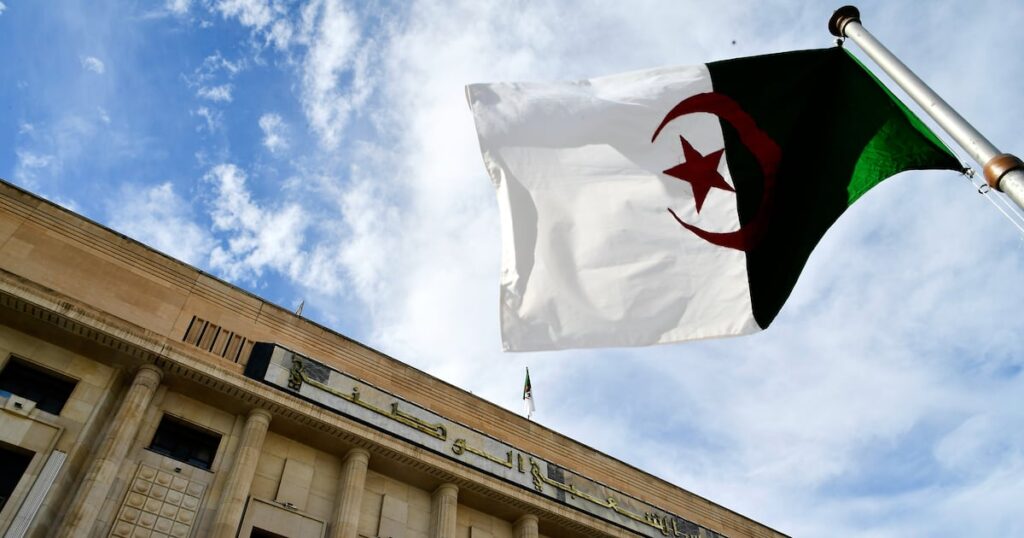
Algeria’s parliament has unanimously approved a law declaring France’s 132-year colonial occupation a crime, demanding an apology and reparations.
Lawmakers wearing scarves in the colours of the national flag rose to their feet and chanted “long live Algeria” as they applauded the progress of the bill, which states that France holds “legal responsibility for its colonial past in Algeria and the tragedies it caused”.
France’s rule over the North African country, which lasted from 1830 until 1962, still blights relations between the two countries.
The French Foreign Ministry said the move was “hostile” and counterproductive to “the desire to resume Franco-Algerian dialogue and to calm discussions on historical issues”.
The vote comes as the two countries are embroiled in a major diplomatic crisis, and while the move is largely symbolic, it is politically significant, one analyst said.
The legislation lists the “crimes of French colonisation”, including nuclear tests, extrajudicial killings, physical and psychological torture, and the systematic plundering of resources.
It states that “full and fair compensation for all material and moral damages caused by French colonisation is an inalienable right of the Algerian state and people”.
The new law also criminalises what it calls glorification of French colonialism in any form, including acts, writing and videos.
Those convicted may face a prison term of up to 10 years and a fine of as much as one million dinars ($7,720) though it does not precisely define what would count as glorifying.
The Parliament’s speaker Brahim Boughali said the vote would send “a clear message, both internally and externally, that Algeria’s national memory is neither erasable nor negotiable”.
The period of French rule was marked by mass killings and large-scale deportations, all the way up to the bloody war of independence from 1954-1962.
Algeria said the war killed 1.5 million people, while French historians put the death toll at 500,000 in total, 400,000 of them Algerian.
French President Emmanuel Macron has previously acknowledged the colonisation of Algeria as a “crime against humanity” but has stopped short of offering an apology.
Hosni Kitouni, a researcher in colonial history at the University of Exeter in the UK, said that “legally, this law has no international scope and therefore is not binding for France”.
But “its political and symbolic significance is important: it marks a rupture in the relationship with France in terms of memory”, he added.
The move comes at a time of diplomatic friction between Paris and Algiers that began last year, when France officially backed Moroccan sovereignty over the disputed Western Sahara region, where Algeria supports the pro-independence Polisario Front.
Several events have since inflamed tensions, such as the conviction and imprisonment of the French-Algerian writer Boualem Sansal, who was pardoned following German intervention.
Sansal, 81, who has cancer, had been living in France but was detained while visiting Algeria in November for statements to a French media outlet in which he endorsed Morocco’s position that part of its territory was seized during French colonial rule and annexed to Algeria.
He was charged under Algeria’s anti-terrorism laws and convicted of “undermining national unity”.